

Vanna AI
: How to use it, features, and the business problems it solves
Add bookmark
What is Vanna AI?
An open-source (MIT) Text-to-SQL framework that generates accurate SQL from natural-language questions. Train it on your database's DDL, docs, and example SQL, and it generates runnable SQL via agentic retrieval. Now "Vanna 2.0 (The SQL Agent)" with user-aware row-level control and a web chat UI; the OSS core is free while managed Vanna Cloud is paid. Works with major DBs (Postgres, Snowflake, BigQuery) and LLMs (OpenAI, Anthropic).
Business problems it solves


About "Vanna AI"
What is Vanna AI
Vanna AI is an open-source (MIT) Text-to-SQL framework that generates accurate SQL from natural-language questions. Once you "train" it on your database's DDL (schema), documentation, and example SQL, it generates SQL you can run on that database for questions in English or Japanese, using agentic retrieval (RAG). It is now evolving as "Vanna 2.0 (The SQL Agent)," with user-aware permissions and a web chat UI.
Vanna's core is "connecting question → SQL → answer, grounded in your own schema." The OSS core (pip install vanna) is free, embeds into Flask/FastAPI, and drops into internal apps via the <vanna-chat> web component. 2.0 adds enterprise features like per-user row-level security (e.g., only HR sees salary), audit logs, and rate limiting, plus a managed Vanna Cloud. Note: the OSS repository was archived (read-only) in early 2026, and the main development has shifted to Vanna Cloud.
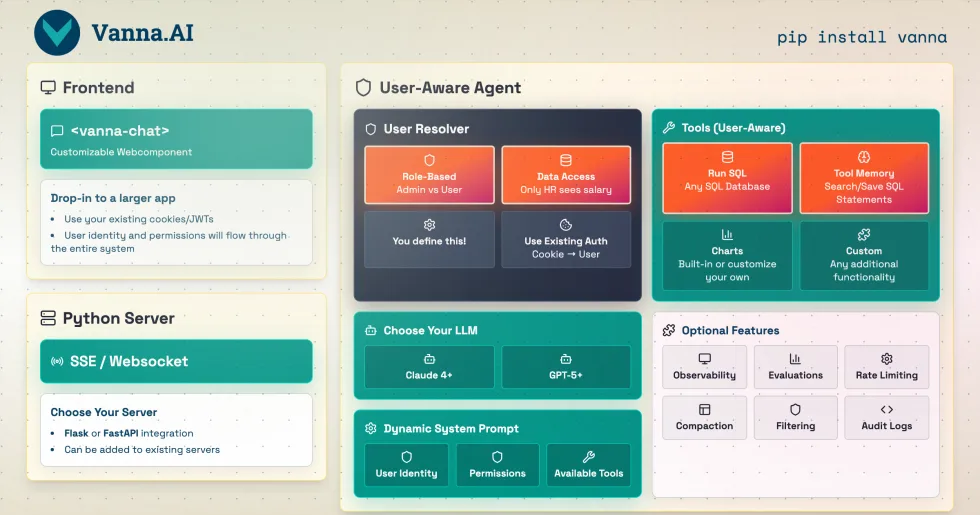
Drop the web component into an existing app and add the Python server to your existing stack. It runs Text-to-SQL with any LLM and database while carrying user permissions through the whole system.
How to use
Train it, ask, and embed.
Train
Register your DDL, documentation, and past example SQL with Vanna.
Ask
Ask in natural language, and it generates runnable SQL.
Run and visualize
Run the SQL and view results as tables or charts.
Embed
Embed into internal apps via the web component, carrying permissions.
The OSS core is free to self-host, and you choose your LLM and database. If you need more operational management or hosting, use Vanna Cloud. Note that the official OSS repo has been archived since early 2026, and further development is on the Cloud side.
Key features
01Natural-language → SQL (RAG)
"Train" it on DDL, documentation, and example SQL, and it generates SQL for your own database from a question. Agentic retrieval pulls in relevant context to improve accuracy, and results can be returned as tables and charts in real time.
02User permissions and embeddable UI
Resolves the user from existing cookies/JWTs and controls access by role and row level (e.g., only HR sees salary). It drops into internal apps via the <vanna-chat> web component and integrates with Flask/FastAPI.
03Broad DB/LLM support and OSS
Supports major databases like PostgreSQL, MySQL, Snowflake, BigQuery, Redshift, Oracle, and SQL Server, and LLMs like OpenAI, Anthropic, Gemini, Ollama, and Bedrock. The MIT-licensed core is free to self-host, with operational features like audit logs and rate limiting.
Pricing
The OSS core is free. The managed Vanna Cloud is monthly, as below (20% off billed yearly).
| Plan | Monthly | Highlights |
|---|---|---|
| Vanna Core (OSS) | $0 | MIT license, self-host, bring your own LLM/DB |
| Explorer | $50 | 20 questions/day, admin features, API, email support |
| Team | $500 | 300 questions/day, setup support, same-day support |
| Enterprise | Contact sales | Unlimited questions, on-prem support, SAML SSO, etc. |
The OSS core is free (MIT); LLM and DB usage costs are on you. Prices are in USD and subject to change; check the official pricing page for the latest (as of August 2026).
How it differs from other Text-to-SQL/BI
Vanna's strength is that it's an OSS framework you train on your own schema and example SQL, running Text-to-SQL with any LLM and database. Compared with dumping SQL requests into a general chatbot or writing SQL by hand, its edge is accuracy grounded in your data and ease of embedding into internal apps.
| Aspect | Vanna | Ask a general chatbot for SQL | Hand-written SQL |
|---|---|---|---|
| Accuracy | Improvable via your schema | Easy to miss without schema | Depends on the person |
| Embedding | Easy via web component | Copy-paste each time | — |
| Permissions | Row-level control | None | Depends on implementation |
Ad-hoc SQL requests to a general chatbot, and hand-written SQL, are the comparison points. For development teams that want to embed natural-language querying of their own database into internal apps, Vanna is a strong choice.
The information on this page is based on the official website as of August 2026. Please check the official site for the latest specs and pricing.


