

Amazon Bedrock
: How to use it, features, and the business problems it solves
What is Amazon Bedrock?
Amazon Bedrock is AWS's platform for building generative AI applications and AI agents. It lets you call models from 19 providers, including Anthropic's Claude, OpenAI, Meta's Llama, Mistral AI and Amazon Nova, through the same API, and adds RAG on your own data (Knowledge Bases), Guardrails, and AgentCore, a runtime for agents. Pricing is pay-as-you-go by model: Claude Opus 5.5 costs $4 per 1M input tokens and $20 per 1M output tokens (Global, as of November 2026). Your data is not used to train the models.
Business problems it solves


About "Amazon Bedrock"
What is Amazon Bedrock?
Amazon Bedrock is AWS's platform for building generative AI applications and AI agents at production scale. AWS says it powers generative AI for more than 100,000 organizations worldwide.
Unlike ChatGPT or Claude, it is not a service you open and use as is. It is a foundation for building AI into your own applications and business systems. You can call foundation models from multiple companies through the same API, so switching models takes few code changes. RAG on your own data, guardrails for controlling output, and a runtime for agents are all available inside AWS.
How to use it
- Prepare an AWS account and permissions Create an AWS account and set up an IAM role for Amazon Bedrock.
- Try models in the console Sign in to the Amazon Bedrock console, choose a model from the model catalog, and test responses in the text playground. Many models are available by default with the appropriate AWS Marketplace permissions. Anthropic models require first-time users to submit use case details (once per account, or once in the organization's management account).
- Issue an API key and call the API The official guide walks you through generating a 30-day API key and making your first call. Examples are also provided for the AWS CLI, the AWS SDK for Python (Boto3), and SageMaker AI notebooks.
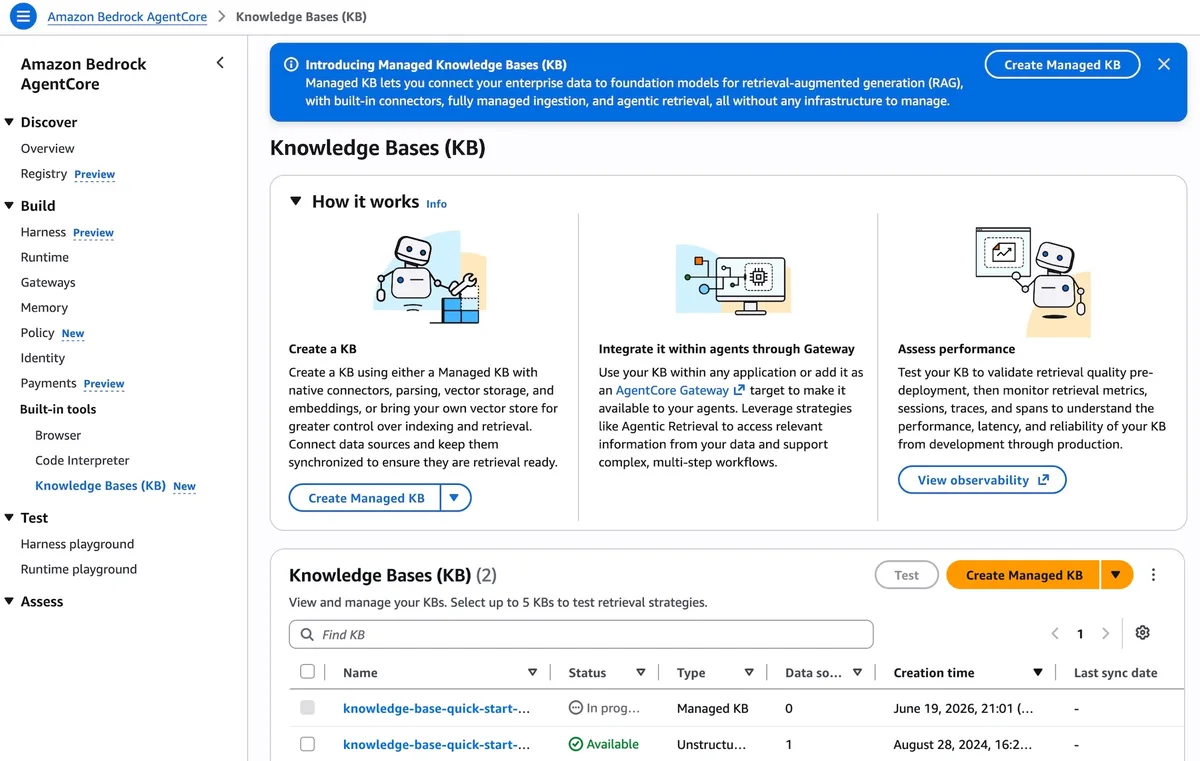
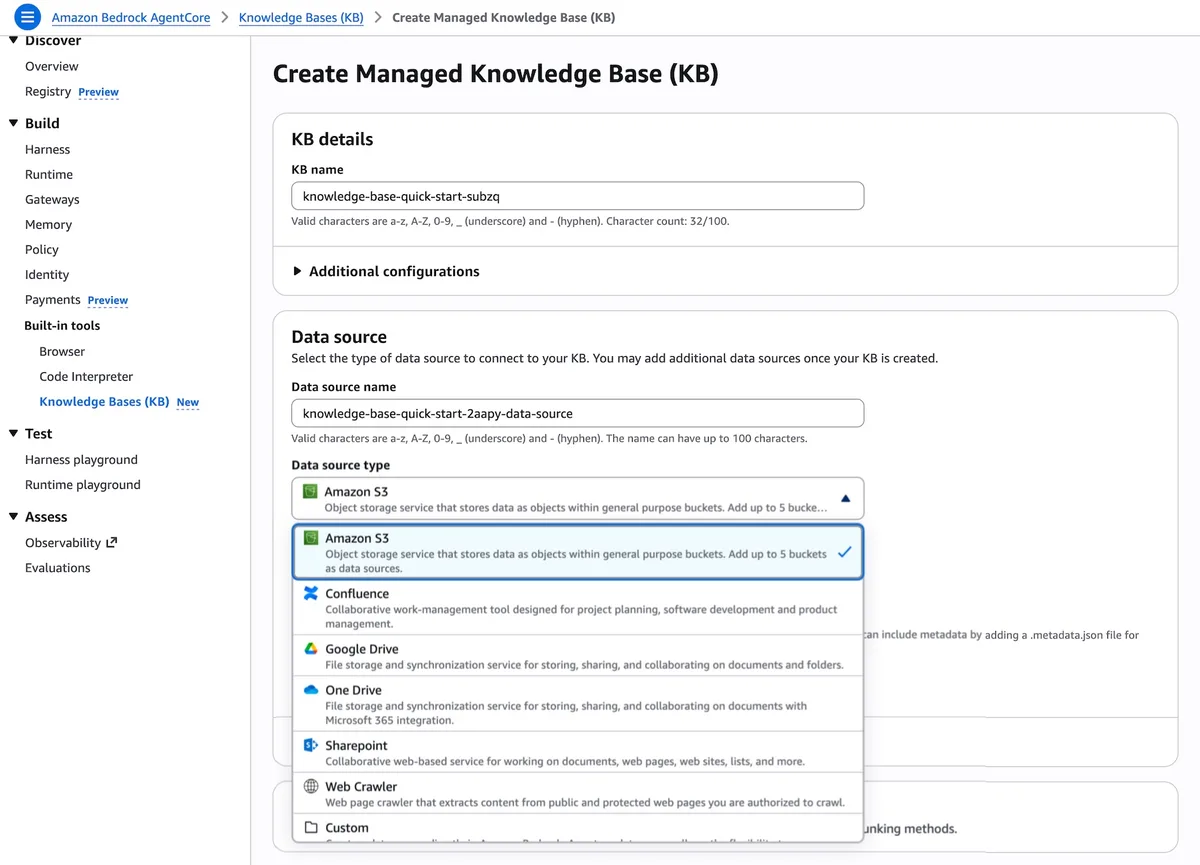
- Connect your data and guardrails Use Knowledge Bases to make internal documents searchable, and Guardrails to control harmful content and sensitive information.
- Run agents in production Let Amazon Bedrock AgentCore handle agent deployment, tool connections, memory and monitoring.
Teams that want to work from data preparation through app building in one workspace can also use Bedrock from Amazon SageMaker Unified Studio.
Features
01Choose and switch models
The pricing page lists 19 providers: AI21 Labs, Amazon, Anthropic, Cohere, DeepSeek, Google, Luma AI, Meta, MiniMax AI, Mistral AI, Moonshot AI, NVIDIA, OpenAI, Qwen, Stability AI, TwelveLabs, Writer, xAI and Z AI.
- Single API — Run inference through the same API whichever model you choose, and move to newer models with minimal code changes
- Model evaluation — Automatic evaluation of accuracy, robustness and toxicity, plus human evaluation workflows
- Marketplace — Pick additional models from the catalog and deploy them to SageMaker endpoints
02Make it smarter with your data
- Knowledge Bases — Managed RAG that connects internal data to models
- Data Automation — Turns unstructured content such as documents and video into structured data
- Fine-tuning — Customize models without writing code, using training data stored in S3
03Build and run agents
- Amazon Bedrock AgentCore — A platform that runs agents built with any framework or model in production. Runtime, Gateway, Memory, Identity, Browser, Code Interpreter, Observability, Evaluations and Policy can be used together or on their own
- Amazon Bedrock Agents — Guided agent building that breaks tasks down and plans the steps for you
04Manage safety and cost
- Guardrails — According to AWS, blocks up to 88% of harmful content and, with Automated Reasoning checks, identifies correct responses with up to 99% accuracy. The ApplyGuardrail API also works with models outside Bedrock
- Cost optimization — Model distillation, prompt caching, and Intelligent Prompt Routing (up to 30% cost reduction, according to AWS)
Pricing
Amazon Bedrock is basically on-demand, pay-as-you-go: you are charged for the model tokens and features you use. New AWS customers receive up to USD 200 in AWS credits.
On-demand prices for representative models (USD per 1M tokens, US East (N. Virginia), as of November 2026):
| Model | Input (Global) | Output (Global) | Input (Geo / In-region) | Output (Geo / In-region) |
|---|---|---|---|---|
| Claude Fable 5.2 | $8 | $40 | $8.80 | $44 |
| Claude Opus 5.5 | $4 | $20 | $4.40 | $22 |
| Claude Sonnet 5.5 | $2 | $10 | $2.20 | $11 |
| Claude Haiku 5.5 | $0.10 | $0.50 | $0.11 | $0.55 |
| Amazon Nova 2 Lite | $0.30 | $2.50 | $0.33 | $2.75 |
| Amazon Nova Pro | Not listed | Not listed | $0.80 | $3.20 |
| Amazon Nova Micro | Not listed | Not listed | $0.035 | $0.14 |
"Global" is the Global Cross-region Inference price and "Geo / In-region" is the Geo and In-region Cross-region Inference price. The inference option and the price depend on whether you need to keep data processing within a specific geography.
As a guide for use from Japan, the Geo / In-region prices shown for Asia Pacific (Tokyo) were $4.40 input and $22 output for Claude Opus 5.5, $0.11 and $0.55 for Claude Haiku 5.5, $0.072 and $0.288 for Amazon Nova Lite, and $0.96 and $3.84 for Amazon Nova Pro. Available models and prices vary by region.
Other pricing examples:
Prices are in US dollars, and the pricing page does not state how tax is handled. See the official pricing page for every model.
Customers and reputation
AWS has published these case studies from Japanese companies.
01Internal documents and advice
- 450 hours a month — Takihyo Co., Ltd., a textile trading company. About 160 employees use Amazon Bedrock and GenU, cutting 450 hours of work a month across four departments and saving two hours per piece in the design department
- 30% reduction — Yasashii-te Co., Ltd., a care service provider. Cut the time to write care records by 30% and automated the assessment information needed for care plans
02Customer interactions
- 15% more calls handled — JAPANNEXT. Rebuilt sales and support phone work with Amazon Connect and Amazon Bedrock, reducing call handover time to zero and overtime by 15%
Overseas, AWS features Robinhood, which grew daily volume from 500 million to 5 billion tokens in six months while cutting AI costs by 80%. All of these figures come from case studies published by AWS, not from independent reviews.
Security and data handling
- According to AWS, Amazon Bedrock does not store or use your data to train models, and does not share it with model providers
- Data is encrypted in transit and at rest, and you can use your own keys
- With AWS PrivateLink you can connect your VPC to Bedrock without exposing traffic to the internet
- AWS states that Bedrock is in scope for standards such as ISO, SOC, CSA STAR Level 2, GDPR and FedRAMP High, and is HIPAA eligible
How it differs from other generative AI platforms
| Amazon Bedrock | Gemini Enterprise | Microsoft Copilot Studio | Dify | |
|---|---|---|---|---|
| Positioning | Developer platform for building apps and agents through APIs | Enterprise AI agent platform for employees | No-code / low-code agent builder | Open-source LLM app development platform |
| Connections | Knowledge Bases, AgentCore Gateway and more | Searches across 100+ data sources | 1,400+ connectors and MCP | RAG and switching between vendors' models |
| Pricing | Pay-as-you-go by model | Editions | Copilot credits (a pack of 25,000 credits costs ¥29,985 per month) | Free cloud tier and up; self-hosting available |
The columns for other products reflect each product page as of its check date. You can also use Claude or Mistral models directly through each company's API. Bedrock suits teams that want everything inside AWS and its permission model.
FAQ
How much does Amazon Bedrock cost? It is basically on-demand, pay-as-you-go by model. For example, Claude Opus 5.5 costs $4 per 1M input tokens and $20 per 1M output tokens (Global, as of November 2026).
Can I try it for free? New AWS customers receive up to USD 200 in AWS credits. The price list itself is written as pay-as-you-go.
Is my data used to train models? According to AWS, your data is not stored or used to train models and is not shared with model providers.
Is it different from SageMaker? They are separate services that work together. Bedrock is available from the AWS Management Console and API, and also from Amazon SageMaker Unified Studio. Bedrock Marketplace models are deployed to SageMaker endpoints.
Does it support Japanese? AWS publishes Japanese pages for the product (the pricing page is shown in English) and case studies from Japanese companies. The quality of Japanese output depends on the model you choose.
This page is based on information published on the official AWS site as of November 11, 2026: the Amazon Bedrock product page, pricing page and its price data, AgentCore pricing page, FAQ and case studies. Prices and features may change, so please check the official site for the latest information.