
Microsoft Foundry
: How to use it, features, and the business problems it solves
What is Microsoft Foundry?
Microsoft Foundry (formerly Azure AI Foundry) is Microsoft's platform on Azure for developing AI apps and AI agents. Azure OpenAI (the GPT series) is now part of Foundry Models, and Foundry brings together 11,000+ models, Foundry Agent Service for building agents, RAG over company data (Foundry IQ), and evaluation, monitoring, and governance under a single Azure resource. Pricing is pay-as-you-go per service and model; GPT-6.1 Sol costs $2 per 1M input tokens and $10 per 1M output tokens (Global, as of November 2026). Input data is not used to train foundation models without permission.
Business problems it solves


About "Microsoft Foundry"
What is Microsoft Foundry?
Microsoft Foundry is Microsoft's development platform on Azure for building AI apps and AI agents, then evaluating, monitoring, and governing them. It brings models, agents, and tools together under a single Azure resource, so access control, networking, and policies can be managed in one place.
The product was renamed from Azure AI Studio to Azure AI Foundry and then to Microsoft Foundry. Azure OpenAI (Azure OpenAI Service) is now offered as part of Foundry Models. Existing Azure OpenAI resources can be upgraded to Foundry resources while keeping their endpoints, API keys, and existing state. If you want to use Azure OpenAI, Foundry is now the entry point.
How to use it
- Get an Azure subscription You can start exploring the Foundry portal (ai.azure.com) without an Azure account, but you need an Azure subscription before you start building agents. New Azure accounts are offered USD 200 in credit to use over 30 days.
- Make your first model call Set up your environment and send a prompt by following the quickstart in the official documentation.
- Choose a model Compare models in the Foundry Models catalog and deploy one. Available models differ by region and deployment type, and only some models are available in Japan East.
- Build an agent Start with a "prompt agent" defined with instructions and tools in the portal or SDK, then move to a "hosted agent" that runs your own code in a container when you need more control.
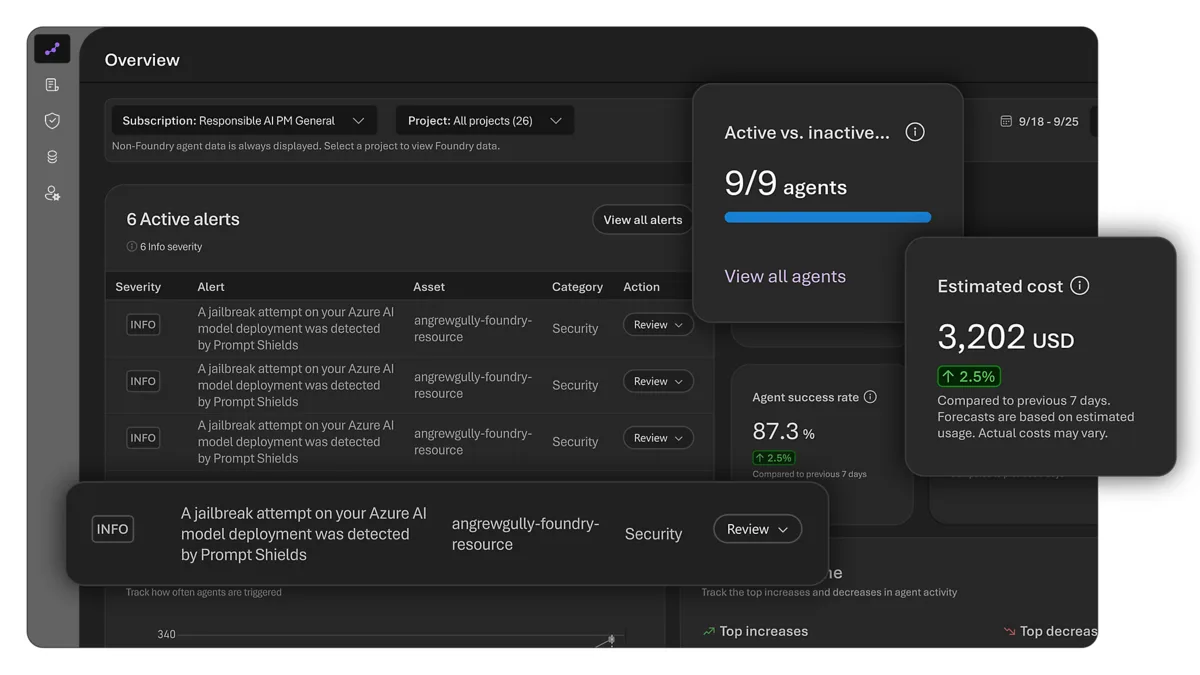
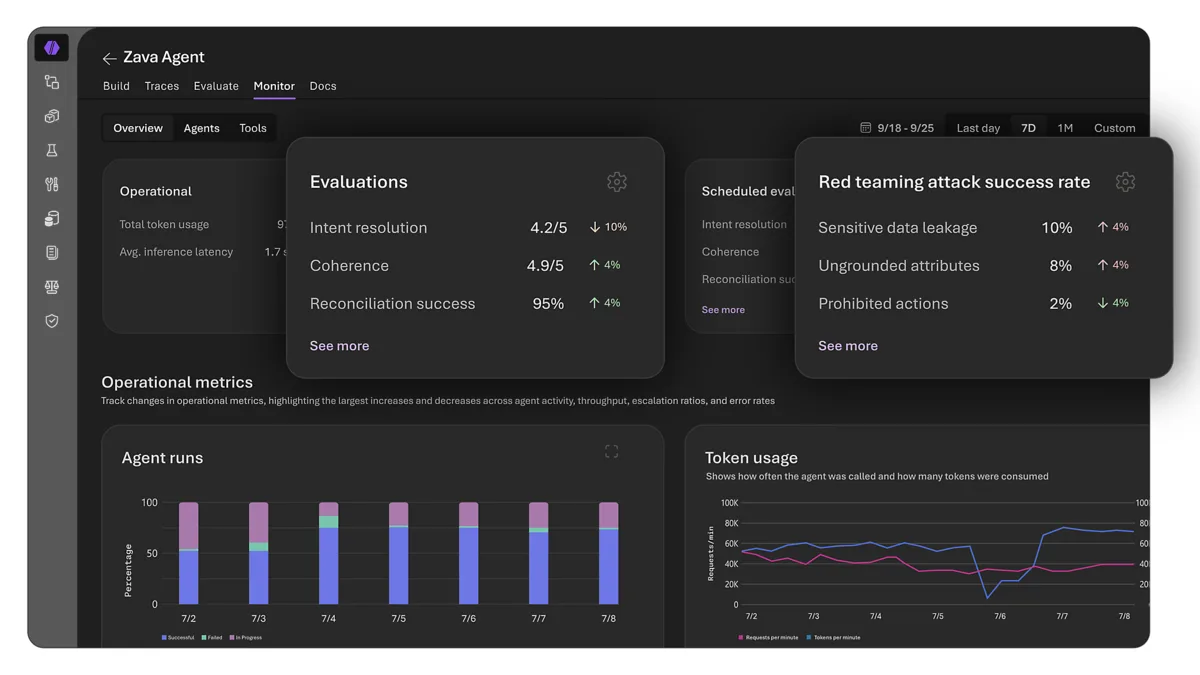
- Add tools and knowledge, then evaluate and monitor Use the toolbox to add search, memory, and connections to external systems, and check behavior with tracing and evaluation dashboards.
You can work through the portal, SDKs (Python, C#, JavaScript, Java), the Azure Developer CLI, the Visual Studio Code extension, or Foundry skills and MCP servers used from coding agents such as GitHub Copilot and Claude Code.
Features
01Choose and use models
- Foundry Models — Access to more than 11,000 foundation, open, reasoning, multimodal, and industry-specific models, with benchmarking and comparison for your use case
- Azure OpenAI — OpenAI models on Azure, including the GPT-6.1, GPT-6, and GPT-5.x series, sora-2 for video generation, and the open-weight gpt-oss
- Model routing — Automatically routes requests to the best model to balance quality and cost
- Customization — Adapt models to your use case through fine-tuning and other methods
02Build and run agents
- Foundry Agent Service — Build and run declarative prompt agents, voice-based agents, and hosted agents that run your own code
- Open frameworks — Host agents built with Microsoft Agent Framework, LangChain, LangGraph, CrewAI, LlamaIndex, and more
- Business system connections — More than 1,400 connections to enterprise systems such as SAP, Salesforce, and Dynamics 365, plus your own APIs via MCP
03Ground answers in company data
- Foundry IQ — Agentic RAG powered by Azure AI Search. Connects multiple data sources through one entry point and researches them based on each user's permissions
- Built-in tools — File search, code interpreter, web search, and prebuilt tools for OCR, translation, speech, and more
04Evaluate, monitor, and govern
- Observability — Tracing, evaluation, and dashboard monitoring for agents and models (some features in preview)
- Foundry Control Plane — Integration with Microsoft Entra ID, role-based access control, network isolation, Azure Policy, and Microsoft Defender
- Content safety — Guardrails that detect and mitigate prompt attacks, hallucinations, and harmful content at runtime
Pricing
There is no fee for Foundry itself; you pay as you go for the services and models you use. Prices for representative Azure OpenAI models are as follows (per 1 million tokens, USD, as shown on the pricing page in November 2026).
| Model | Deployment type | Input | Cached input | Output |
|---|---|---|---|---|
| GPT-6 Astra (short context) | Global | $10 | $1 | $50 |
| GPT-6.1 Sol (short context) | Global | $2 | $0.10 | $10 |
| GPT-6.1 Sol (short context) | Data Zone | $2.20 | $0.11 | $11 |
| GPT-6.1 Terra (short context) | Global | $1 | $0.05 | $5 |
| GPT-5.5 | Global | $5 | $0.50 | $30 |
| GPT-5.4 (under 272K) | Global | $2.50 | $0.25 | $15 |
With the Batch API, GPT-5.4 costs $1.25 for input and $7.50 for output. Long context and Priority Processing have separate rates, and from November 1, 2026, explicitly requested 12-hour prompt cache writes are billed at the 12-hour cache-write rate.
For agents, there is no additional charge for creating or running Foundry-native agents built with prompts and workflows (model tokens are billed separately). Hosted agents, which run agents built with your own frameworks, cost $0.0994 per vCPU hour and $0.0118 per GiB-hour of memory. Built-in tools include file search vector storage at $0.11 per GB per day (1 GB free), code interpreter at $0.033 per session, and web search at $14 per 1,000 transactions.
Prices on the pricing page are estimates; actual prices may vary depending on your agreement with Microsoft, the purchase date, and exchange rates. Tax treatment is not stated. Models from other providers such as Anthropic and Meta are priced separately by model.
Customers
According to the official site, Foundry is used by more than 80,000 enterprises and developers, including 80% of the Fortune 500. Logos of Commerzbank, Accenture, Astra Tech, and SK Telecom are shown as customers. All of this is information published by Microsoft.
Security and data handling
- According to the official documentation, prompts (inputs), completions (outputs), embeddings, and training data are not used to train generative AI foundation models without the customer's permission or instruction, and are not used by the providers of models sold by Azure to improve their models or services
- Models are stateless; prompts and completions are not stored in the model
- With "Global" deployments, prompts and responses may be processed in any region where the model is deployed. "Data Zone" deployments are processed within the US or the EU. If you have requirements about where data is processed, choose the deployment type and region accordingly
- Stored data is encrypted at rest with Microsoft's AES-256 encryption by default, and customer-managed keys are available
- For abuse monitoring, prompts and responses that have been flagged can be reviewed by humans
How it differs from other AI development platforms
| Microsoft Foundry | Amazon Bedrock | Google AI Studio | Microsoft Copilot Studio | |
|---|---|---|---|---|
| Provider / platform | Microsoft (Azure) | AWS | Microsoft | |
| Highlights | Azure OpenAI (GPT) and 11,000+ models, plus agent building, evaluation, and governance | Claude, Llama, Mistral, Amazon Nova and more through one API | Try Gemini in the browser and get an API key | Build agents with low code and publish to Teams and more |
| Best for | Teams developing AI apps and agents on Azure | Teams developing on AWS | Developers who want to try the Gemini API quickly | People building internal agents with low code |
| Pricing model | Pay-as-you-go per service and model | Pay-as-you-go per model | AI Studio free, API pay-as-you-go | Copilot credits |
The competitor columns reflect the content of each product page as of when it was checked. Within Microsoft, Copilot Studio is the low-code tool for building internal agents and Foundry is the platform for developers, and Copilot Studio can also use Foundry Models and Foundry IQ. If you want outside help developing with Azure OpenAI or Foundry, implementation partners such as ヘッドウォータース 生成AIソリューション are also available.
FAQ
How are Azure OpenAI and Microsoft Foundry related? Azure OpenAI is now offered as part of Foundry Models (Azure OpenAI in Foundry Models). Existing Azure OpenAI resources can be upgraded to Foundry resources while keeping their endpoints and API keys.
Is it different from Azure AI Foundry? That is a former name of the same product. It went from Azure AI Studio to Azure AI Foundry and is now called Microsoft Foundry. Earlier hub-based projects are available from the "Foundry (classic)" portal.
How much does it cost? It is pay-as-you-go per model and service. For example, GPT-6.1 Sol (short context, Global) costs $2 for input and $10 for output per 1 million tokens (as of November 2026). There is no additional charge for creating or running prompt-based agents themselves.
Can I try it for free? New Azure accounts are offered USD 200 in credit to use over 30 days. An Azure subscription is required to build agents.
Is my input data used for training? According to the official documentation, prompts and outputs are not used to train foundation models without the customer's permission or instruction.
Can I use it in Japanese regions? The pricing page lists the Japan East and Japan West regions, but the available models and deployment types are limited. The Data Zone scope described on the pricing page is the EU or the US. Check the region table in the official documentation for the model you want to use.
The information on this page is as of November 13, 2026, and is based on Microsoft Azure's Microsoft Foundry product page, the Azure OpenAI product page, the pricing pages for Azure OpenAI Service, Microsoft Foundry, and Foundry Agent Service, and Microsoft Learn documentation (What is Microsoft Foundry, Foundry Models sold directly by Azure, and Data, privacy, and security). Pricing and features may change, so please check the official website for the latest information.