

レガシー刷新AI(GembaShift)
: How to use it, features, and the business problems it solves
What is レガシー刷新AI(GembaShift)?
レガシー刷新AI (Legacy Modernization AI; formerly SpecLift) is a legacy system analysis and specification recovery support service from GembaShift Inc. (株式会社GembaShift) of Takasaki, Gunma. It reads source code, design documents and job definitions in COBOL, JCL, RPG, Java, VB6, PL/SQL, JP1 and more with structural analysis and AI, and delivers current specifications with evidence locations, asset inventories, dependency diagrams, impact maps, Excel-format test specifications and comparisons of old and new COBOL batch outputs. Fujitsu, Hitachi and NEC mainframe assets are also covered. It does not take on the rewriting itself. The first business process is a free trial; beyond that, pricing is quoted individually (as of November 2026).
Business problems it solves


About "レガシー刷新AI(GembaShift)"
What is レガシー刷新AI (GembaShift)?
レガシー刷新AI (Legacy Modernization AI) is a legacy system analysis and specification recovery support service provided by GembaShift Inc. (株式会社GembaShift) of Takasaki, Gunma Prefecture. It reads source code, design documents and job definitions in COBOL, JCL, RPG, Java, VB6, PL/SQL, JP1 and more using structural analysis and AI, and assembles the decision materials needed before modernization (rebuilding), such as current specifications, dependency diagrams, impact maps and test specifications.
It covers the upstream phases of modernization: current-state investigation, specification recovery and impact analysis, plus test specification creation and comparison of old and new outputs of COBOL batches. The company states that "it is not a service that takes on the rewriting itself"; design and implementation of the new system, data migration and production cutover are separate phases quoted separately. It launched in July 2026 under the name "SpecLift" and later changed its public name to "レガシー刷新AI" (according to the timeline on the representative's profile page and the product page FAQ). The first business process can be tried free; beyond that, pricing is quoted individually (as of November 2026).
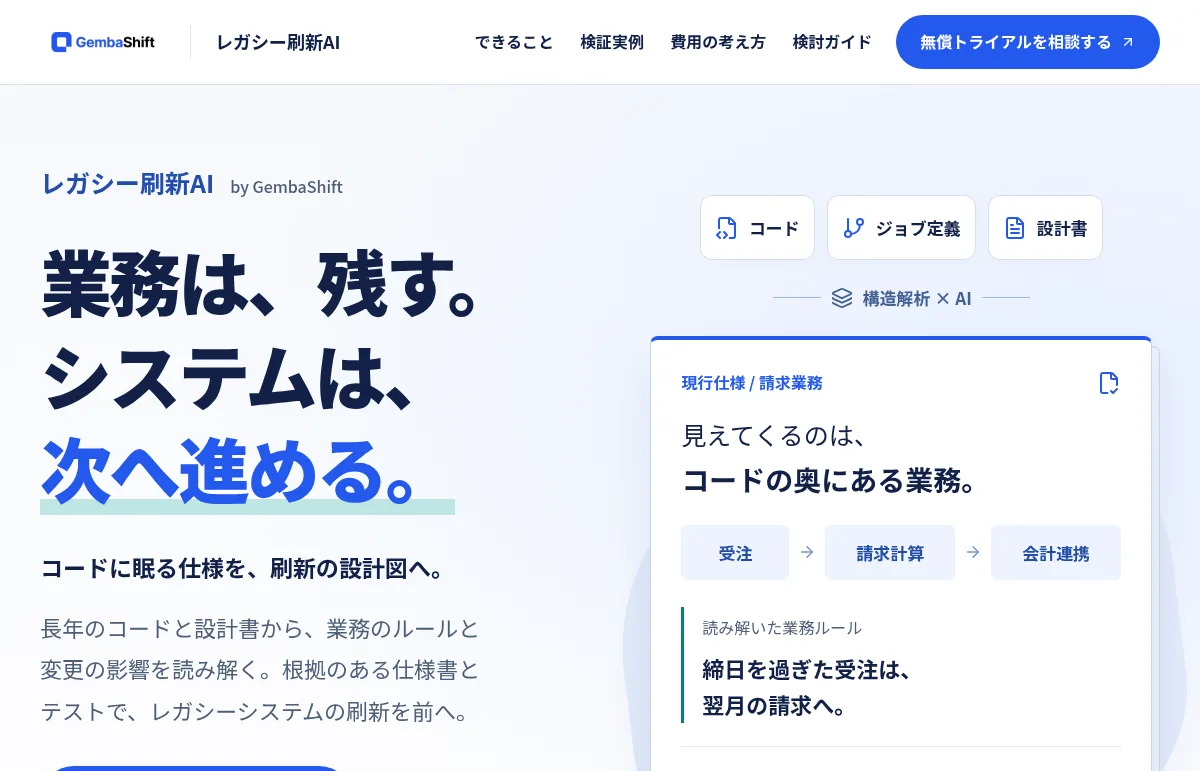
Source: レガシー刷新AI | GembaShift (also for the images below)
Turning business rules that exist only in code into specifications with evidence
The company divides what it provides into three parts.
01Read the business
It reads conditions built up over years of changes, such as amount calculations, closing-date logic and exception branches, and puts the business as it currently runs into words. It also checks discrepancies between design documents and implementation, and you can trace from each explanation back to the relevant code. Deliverables: current specification, business rules and design differences.
02Grasp the whole and the impact
It maps the connections across screens, programs, data and nightly batches that span files, and traces the impact of changes. It takes stock of assets to understand the whole system and also organizes missing materials and unverified paths. Deliverables: asset inventory, dependency diagram and impact map.
03Connect to the next development
It creates Excel-format test specifications from the recovered specifications and compares old and new outputs of COBOL batches field by field. It organizes what has been confirmed and what remains, and hands over a structured set of materials that developers and AI can refer to.
The company says every explanation comes with evidence that can be checked, citing three points: you can go back to which part of which file it was read from; confirmed facts, assumptions and missing materials are written separately; and review and approval records are kept in the deliverables. The screens and industry examples on the product page are noted as fictional examples for explaining the mechanism.
Assets it can analyze
| Category | Targets |
|---|---|
| Mainframe | COBOL / JCL / CICS / IMS / VSAM. In addition to IBM, assets on Fujitsu MSP and XSP, Hitachi VOS3 and NEC ACOS-4 |
| IBM i | RPG / CL / DDS |
| Business applications | Java / C#・VB.NET / Python / PHP, including Spring, Struts, Seasar2 and intra-mart |
| Long-used development environments | VB6 / Delphi / Oracle Forms and Reports, plus Notes/Domino, Access and logic inside Excel |
| Data and external integration | SQL / PL/SQL / T-SQL / HULFT |
| Operations and design materials | JP1 / BAT and PowerShell / design documents in Excel, Word and PDF |
The company says that even for the same language, the analyzable scope varies with dialect, version, framework and the state of materials, so it checks the actual assets and explains the supported scope and any additional information needed.
Free trial (the first business process)
After signing an NDA, you hand over source code, design documents and job definitions as they are, without selecting them. The handover method follows the client's rules.
Sign an NDA and hand over as is
No need to select or organize materials
Inventory everything and pick a process
Summarize asset types, volume and analyzable scope, then pick one process to read in depth
Read and check answers
About 20 business rules are checked by someone who knows the business, in about an hour
Decide with a measurement report
You may stop here if it does not fit
The measurement report delivered after a few weeks covers the analyzable scope and excluded parts of all assets, the business rules read and the evidence locations, the accuracy rate from the answer check, what could not be captured or understood and missing materials, and the scope and quoting materials for expanding the target, the company says. It notes that trial results are measured values for the assets provided and the process chosen, and do not guarantee accuracy for other processes or systems.
SIers and development companies can also consult on current-state analysis for their clients' modernization projects. In that case, the company asks them to apply with the consent of the client who owns the assets.
Published verification records
On its "Verification examples" page (content checked on October 7, 2026), the company publishes the results of its own development verification together with the targets, conditions and limits. The results compare the analysis output with answer data created from the source, and the page states that they do not represent certification by an external body or deployments in customers' production environments.
| Verification | Result | The company's note |
|---|---|---|
| Reading structure (design documents and code of a fictitious company) | 100% coverage and accuracy on all 25 aspects | Results for the structure within this material only; not a recovery rate for all business rules or accuracy on other assets |
| Detecting gaps between design documents and implementation (same material) | 32 of 38 items (84.21% coverage, 100% accuracy) | Run without AI-based semantic comparison of processing logic; 6 items such as tax calculation, fees and closing dates were missed |
| Ongoing verification of mainframe support | No decline or loss from the previous run across 269 main metrics and 1,713 auxiliary keys | Does not mean every metric is highly accurate; 31 main metrics and 12 reference metrics remain below 95% |
| Analysis of the open-source "Apache Fineract" (a past verification under the former SpecLift) | 63.6% accuracy (7/11) and 70% coverage (7/10) on business rules for 3 representative functions | A past, limited verification, not the accuracy of the current product as a whole; not a case of analyzing a financial institution's production system |
Coverage is the share of the answer data that was captured; accuracy is the share of output results that were correct. How well your own system can be read is checked in the free trial of the first business process, reported as the accuracy rate of the answer check.
Pricing
Pricing is not published. The company says "We do not list amounts on this page; we give an individual quote after confirming the targets and deliverables. The first business process is free" (as of November 2026).
| Item | Details |
|---|---|
| Free trial | Free. Inventory of all assets provided; current specification, business rules and impact map for one process; about 20 answer checks; measurement report and debrief. Takes a few weeks |
| Main contract | Individual quote. Current specifications for the second and later processes or the whole system, test specification creation, comparison of old and new COBOL batch outputs, materials for migration planning decisions |
| New system design and implementation, data migration, production cutover | Separate phases, quoted separately |
The company lists four factors that determine cost: asset volume and technology (volume of programs and jobs, languages, dialects and versions, related systems), the state of materials (whether there are design documents, data definitions, test data, etc.), the deliverables needed (inventory only, or also specification recovery, impact analysis and test specifications), and the review setup. Compared with conventional current-state investigations, it says what is reduced is the work of selecting and organizing materials, reading code and writing out business rules, matching design documents with implementation, and tracing change impacts, while promising no uniform reduction rate or timeline.
Information handling
The company says it confirms, before starting the analysis and based on the client's security requirements, the materials provided, storage location, access rights, the AI used and the scope of external transmission. If source code cannot leave the company, the handover method and working environment are discussed individually. It states that there is no need to enter source code or confidential information in the inquiry form.
Who it suits and who it does not
How it differs from AI development tools
AI development tools such as Kiro and Factory are tools developers use themselves to have AI read repositories and build specifications or implementations. レガシー刷新AI is a support service in which GembaShift analyzes the assets entrusted to it and delivers results as current specifications, impact maps, test specifications and other deliverables; it does not take on the rewriting itself.
| Service | Form | Main targets | Deliverables | Pricing (published) |
|---|---|---|---|---|
| レガシー刷新AI (GembaShift) | Analysis and specification recovery support service | Existing assets and design documents in COBOL, JCL, RPG, VB6, PL/SQL, JP1, etc. | Current specifications, asset inventory, dependency diagrams, impact maps, test specifications, old/new output comparisons | Not published (first process free) |
| Kiro | AI development tool used by developers | New and existing repositories | Requirements, design and implementation task documents, plus implementation | Free plan with 50 credits/month; Pro from $20/month |
| Factory | AI agent used by developers | Repositories | File changes, tests and pull requests | Free $0, Pro $20/month, etc. |
| 社内ナレッジAI (GembaShift) | Internal document AI (implementation-type) | Specifications, regulations, drawings, design documents, etc. | Answers with page-level evidence; lists of change impacts | Not published (free trial available) |
Details for other companies are as of the check dates on each product page.
The operator's AI implementation support is covered on the GembaShift page.
FAQ
Q. How much does レガシー刷新AI cost? Pricing is not published. The first business process can be tried in a free trial; beyond that, the company quotes individually based on asset volume and technology, the state of materials, the deliverables needed and the review setup.
Q. Will it automatically rebuild the system? No. It supports analysis of the current system, specification recovery, impact analysis and test and migration preparation. Design and implementation of the new system and production cutover proceed as separate phases after agreeing on targets and roles, the company says.
Q. Can we consult without design documents? Yes. It organizes current specifications from source code and definition files, and uses design documents, if any, to check against the implementation. Business intent and operating conditions not left in the code are organized as items to confirm, the company says.
Q. How is analysis accuracy checked? The company says it compares analysis results with ground-truth data built from the originals and evaluates the share captured and the share correct separately. In the free trial, some of the business rules read are checked by someone who knows the business and reported as an accuracy rate.
Q. Is it a different product from SpecLift? It is the same service. The company says it changed SpecLift's public name to "レガシー刷新AI".
The information on this page is based on what was published on the official website as of November 2026. Please check the official website for the latest prices and details.