

Kakusill
: How to use it, features, and the business problems it solves
What is Kakusill?
Kakusill is an "AI workspace for upstream development" provided by Atsumell Inc. of Chuo-ku, Tokyo. Its "requirements organization" feature takes in existing materials such as meeting minutes, interview audio, PDFs and Excel files, has AI draft business flow diagrams and issue lists, and asks follow-up questions about missing points. Its "specification management" feature keeps everything from requirement specifications to design documents in one place with versions, diffs and change history, and hands finalized specs to developers or AI agents (via MCP/API). Launched in April 2026. Pricing is proposed individually based on the target work, number of users and scope of hands-on support (as of November 2026). The interface is in Japanese.
Business problems it solves
About "Kakusill"
What is Kakusill?
Kakusill is an AI workspace for upstream development (requirements and specifications) provided by Atsumell Inc. of Chuo-ku, Tokyo. Feed it meeting minutes, interview audio, or existing materials such as PDFs and Excel files, and its AI drafts business flow diagrams and issue lists and turns undecided points into follow-up questions. The requirements you settle on, all the way through to design documents, are then managed in one place with versions, diffs and change history. Atsumell describes these as two features: "requirements organization" (Yokyu Seiri), which visualizes business processes, and "specification management" (Shiyo Kanri), which centralizes specifications.
The product targets situations where projects stall before requirements definition — "there are no specification documents" or "we can't see how the work is actually done." The product page recommends requirements organization for DX promotion, business improvement, business planning and line-of-business departments, and specification management for IT departments, PMs/PMOs, development leads and QA.
Kakusill officially launched on April 16, 2026 as a "next-generation AI specification editor" (Atsumell press release). A press release on November 17, 2026 introduced it as an "AI business organization FaaS (FDE as a Service)" and said it is being adopted by dozens of companies, centered on large manufacturers and financial firms. The same announcement disclosed a pre-Series A round totaling 183 million yen.
Requirements organization and specification management
April 16 press release
Announced November 17, 2026
Tenant isolation, AI retraining opt-out
Draft business flow diagrams and issue lists from meeting records and existing documents
Requirements organization starts from whatever you already have: business manuals, Excel, PowerPoint, meeting minutes, interview audio and so on. According to the official FAQ, Kakusill takes in minutes, PDFs, Excel, PowerPoint, business manuals and existing specifications, and its AI organizes them into drafts of business flows and requirements. Without rewriting anything by hand, steps, owners, branches and exceptions become a business flow diagram that stakeholders can review.
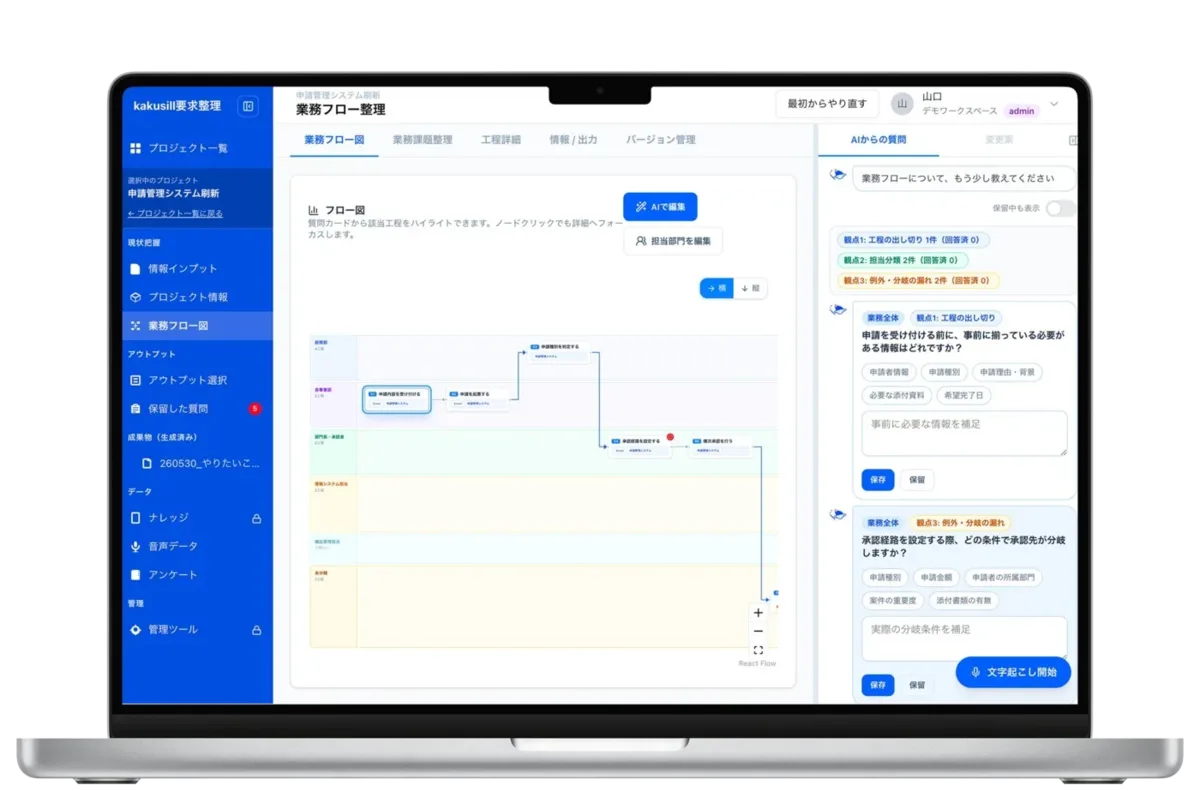
Source: Kakusill official website
Based on the business flow and the fragments of information collected, issues are arranged in a prioritized list. Because each issue can be reviewed alongside its business impact and related steps, scattered requests and pain points from different departments become something you can discuss and decide where to start. The November 17, 2026 press release adds that, besides existing documents and interview content, Kakusill also drafts business flows from PC operation logs.
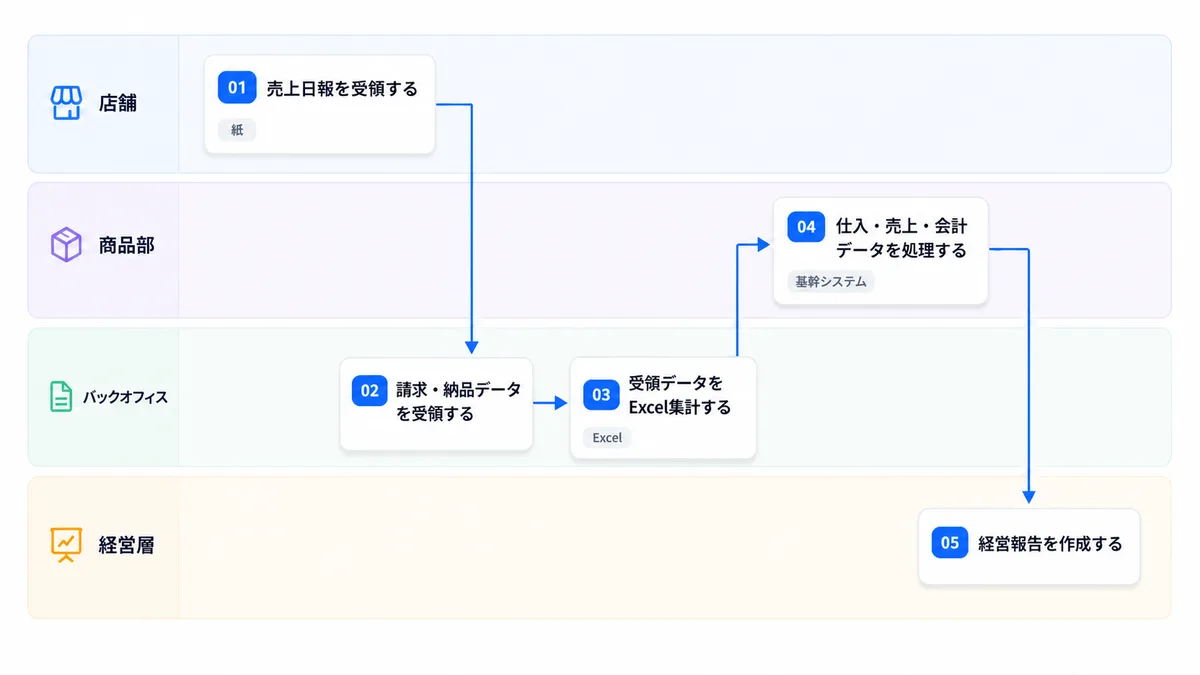
Source: Kakusill official website
AI turns missing points into questions
General-purpose generative AI answers only from what you write in your prompt. Kakusill's requirements organization has the AI extract clearly missing or ambiguous points and present them as follow-up questions for the people in charge. The official requirements organization page contrasts the two: with general-purpose AI "users have to notice missing information themselves," while Kakusill "presents gaps and ambiguities as questions."
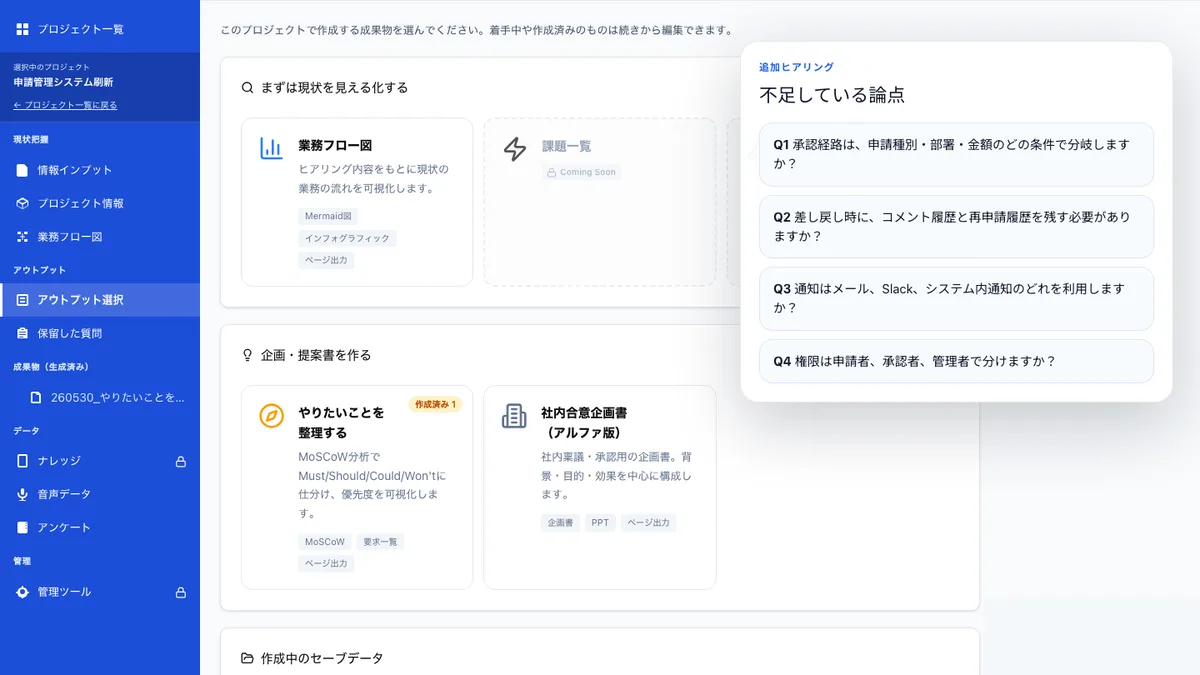
Source: Kakusill official website
As answers accumulate, differences in how individual staff do the work and the causes of stalled processes come to light, so stakeholders can align before writing requirement specifications. Atsumell says that because organizing happens through a dialogue with AI, people in DX promotion or business departments who are not IT experts can use it too.
Keep specifications — and the reasons behind them — from requirements to design
Specification management keeps everything from requirement specifications to design documents in one place. Versions, diffs and change history are recorded, so you can trace who changed what and when, and confirm why a specification ended up the way it did even after the person in charge changes. The product page lists the problems it addresses: specifications scattered so nobody knows the latest version, being unable to trace the impact of a change or "why this spec was decided," and reliance on specific people or vendors to understand and review specifications.
Finalized specifications can be documented and handed over to developers as well as AI agents. In the workflow on the product page, a draft specification is created from the requirements, linked to requirements definition and estimates, and passed to AI agents via MCP/API. In the team workspace, the AI remembers and shares past instructions, so output follows the same assumptions no matter who uses it.
Customer examples
- Daiichi Sankyo Healthcare Co., Ltd. — Case 01 on the official requirements organization page: "standardized around 100 AI investment projects" and "cut more than 300 hours a year." Requirements, assumptions and evaluation criteria that differed for each project were organized into a common format, aligning RFP/PoC scope and acceptance criteria so vendor proposals were easier to compare. The November 17, 2026 press release includes a comment from Mr. Eguchi, Associate Director of the company's Corporate Planning Department, to the effect that interviews can now be held at a consistent level of detail based on a preliminary survey, which has helped with setting company-wide priorities, organizing business flows and writing RFPs
- A major railway company (name not disclosed) — Case 02 on the same page: building the current-state (As-Is) business flow for audit work and using it for an RFP and requirements definition. Procedures, owners and gaps in judgment that were spread across documents, Excel files and staff knowledge were visualized, and points needing further confirmation were identified
- 株式会社金沢総合研究所 (Kanazawa Sogo Kenkyusho) — The case on the product page: organizing specifications and documents accumulated in existing systems into a form AI can handle, supporting impact analysis, redefining requirements, improvement planning and UI mockups. Beyond internal specification management, it was used for client proposals and DX support for universities, growing from a trial to full adoption and a partnership
The product page also shows the logos of Xincere and FUJI NEXTERA LABO. On June 10, 2026, Atsumell announced in a press release that Kakusill had been adopted by the professional staffing service "プロウィズ" (Prowiz).
How to use
Following the "four steps to organize your business" on the official requirements organization page, the flow is:
- Contact Atsumell or request materials Kakusill is for businesses. You start by consulting through the inquiry form or the materials download form on the official site (both require a corporate email address). Before adoption, Atsumell offers an "adoption sprint" that sets verification conditions to support a contract decision.
- Add documents and audio Import what you have on hand: business manuals, Excel, PowerPoint, meeting minutes, interview audio and so on.
- Visualize the work with AI The AI organizes steps, owners, branches and exceptions into a business flow diagram and presents missing information as follow-up questions.
- Confirm with the frontline and organize issues Align your understanding while looking at the flow, and update issues, impacts and priorities in one place.
- Connect to requirements and planning Use the settled business processes and issues as the basis for RFPs, requirements definition, PoCs and AI agent design. Specifications are versioned in specification management.
Combined with Atsumell's hands-on support, interview design and on-site confirmation can be done together.
Features
01Requirements organization
Visualize business processes and list issues.
- Importing documents and audio — minutes, PDFs, images, Excel, PowerPoint, business manuals, existing specifications, interview audio
- Business flow diagrams — steps, owners, branches and exceptions as a current-state (As-Is) flow, shared as a diagram stakeholders can edit
- Questions from AI — extracts missing or ambiguous points as follow-up questions
- Issue lists — lists issues by priority alongside business impact and related steps
02Specification management
Centralize everything from requirement specifications to design documents.
- Versions, diffs and change history — trace who changed what and when
- Recording the reasoning — keeps referenced documents and the background of decisions with each spec version
- Handing off to AI agents — passes finalized specs to developers and AI agents; integration via MCP/API
03Using AI as a team
Make AI a member of the team.
- Passing on on-site rules — gathers business flows, internal rules and the background of decisions so output reflects company assumptions
- Sharing instructions — the AI remembers and shares past instructions in the team workspace
- Working with the AI you already use — the product page says it also works with the AI tools you use day to day
04Features announced at launch
Features introduced in the April 16, 2026 press release (some are not listed on the current product page).
- Auto-generated multiple-choice questions — the AI runs interviews and structures requirements that had not been put into words
- Real-time meeting transcription — uses an audio LLM to turn what was said in meetings into specifications
- Glossary and relationship graph — automatically builds a glossary from all specifications and visualizes relationships between them as a graph
- Importing existing specs and code — imports Excel and Word specifications and reverse-generates specifications from existing code
Pricing
There is no price list on the official site (checked November 25, 2026; no pricing page appears among the URLs in the atsumell.com sitemap). Asked about pricing, the FAQ on the official requirements organization page answers that Atsumell will "make a proposal based on the target work, number of users and scope of hands-on support at adoption."
| Item | Details |
|---|---|
| Pricing | Individual proposal (based on target work, number of users and scope of hands-on support at adoption) |
| Pre-adoption verification | An "adoption sprint" that sets verification conditions for a contract decision, tailored to scale and use case |
| Materials | "Kakusill introduction deck" (product overview, ROI, examples of reduced workload, etc.), free download via form |
| Quotes | Request through the inquiry form |
| Deployment | Cloud (SaaS). On-premises deployment can be discussed separately |
The implementation period also depends on the scope of work, the state of existing documents and the departments involved; Atsumell says it confirms the target and goals at the first consultation and then explains the approach and timeline.
Data handling and security
The company and its hands-on support
Atsumell Inc. was founded in September 2022 and is located at 1-8-1 Nihonbashi Kayabacho, Chuo-ku, Tokyo; its representative director is Yamaguchi (山口公徳). Besides Kakusill, the company offers "consulting and hands-on support," covering everything from building a framework for requirements organization to preparing prompts and designing operating rules, and "AI agent development" based on organized business data (including building local LLM environments where data cannot leave the company). It says it supports companies from adoption through to in-house operation, even if they have no dedicated DX team.
How Kakusill differs from other AI tools for requirements and specifications
| Aspect | Kakusill | Kiro | レガシー刷新AI(GembaShift) | YOMEL |
|---|---|---|---|---|
| Main use | From visualizing business processes and organizing issues to versioning requirements and specs (upstream work) | A development tool that splits a prompt into requirements, design and implementation tasks before coding | Recovering current specifications from legacy-system code and design documents | Meeting transcription and summaries (AI meeting minutes) |
| Main inputs | Existing materials such as minutes, interview audio, PDFs and Excel | Prompts (development instructions) | Source code such as COBOL, JCL and Java, design documents and job definitions | Zoom, Teams and Google Meet meetings, recordings of in-person meetings |
| Pricing | Individual proposal | Free plan available; paid plans from Pro at $20/month | First business process as a free trial, then individual quotes | Starter from ¥28,000/month (excl. tax) |
Details for the other products are as of the check dates stated on each product page. If you want to involve business departments in deciding "what to build" and carry that through to managing specifications in one place, Kakusill fits; if you are an engineer who wants to write specs and go straight to implementation, Kiro fits. If you mainly want meeting minutes themselves, an AI minutes tool such as YOMEL is better suited.
FAQ
The information on this page is based on what was published on the official website and in press releases as of November 2026. Please check the official website for the latest specifications and pricing.