

社内ナレッジAI(GembaShift)
: How to use it, features, and the business problems it solves
What is 社内ナレッジAI(GembaShift)?
社内ナレッジAI (In-house Knowledge AI) is an internal AI from GembaShift Inc. (株式会社GembaShift) of Takasaki, Gunma that reads company documents such as specifications, regulations, drawings, policy terms, grid-style Excel sheets and meeting recordings, and answers with evidence showing which document and which page. Answers are mechanically checked against the originals before output; non-matching parts are removed, and without evidence it replies "I don't know". It automatically builds per-document reading programs and a synonym dictionary of internal terms, and is also used to list change impacts and conflicts between documents. After a free trial of a few weeks under NDA to measure the effect, it is built in the client's cloud environment. Pricing is quoted individually (as of November 2026).
Business problems it solves

About "社内ナレッジAI(GembaShift)"
What is 社内ナレッジAI (GembaShift)?
社内ナレッジAI (In-house Knowledge AI) is an internal AI that reads company documents such as specifications, regulations, drawings, policy terms, grid-style Excel sheets and meeting recordings, and answers with evidence showing "which document, which page". It is provided by GembaShift Inc. (株式会社GembaShift) of Takasaki, Gunma Prefecture. The company says answers are mechanically checked against the original documents before they are shown, parts that do not match are removed, and when there is no evidence it replies "I don't know". It launched in August 2026 (according to the timeline on the representative's profile page).
The company lists three conditions under which this approach works: "the source of truth is inside grid-style Excel, PDF and Word files", "the same thing is called by different names in different documents", and "omissions lead directly to accidents, audit findings or administrative sanctions". It also writes that for uses where a "roughly correct" answer is enough (such as searching an internal FAQ), ordinary RAG search is sufficient and its strengths do not show. The flow is to sign an NDA, take a free trial and confirm the effect in numbers before deciding to adopt; pricing is quoted individually (as of November 2026).
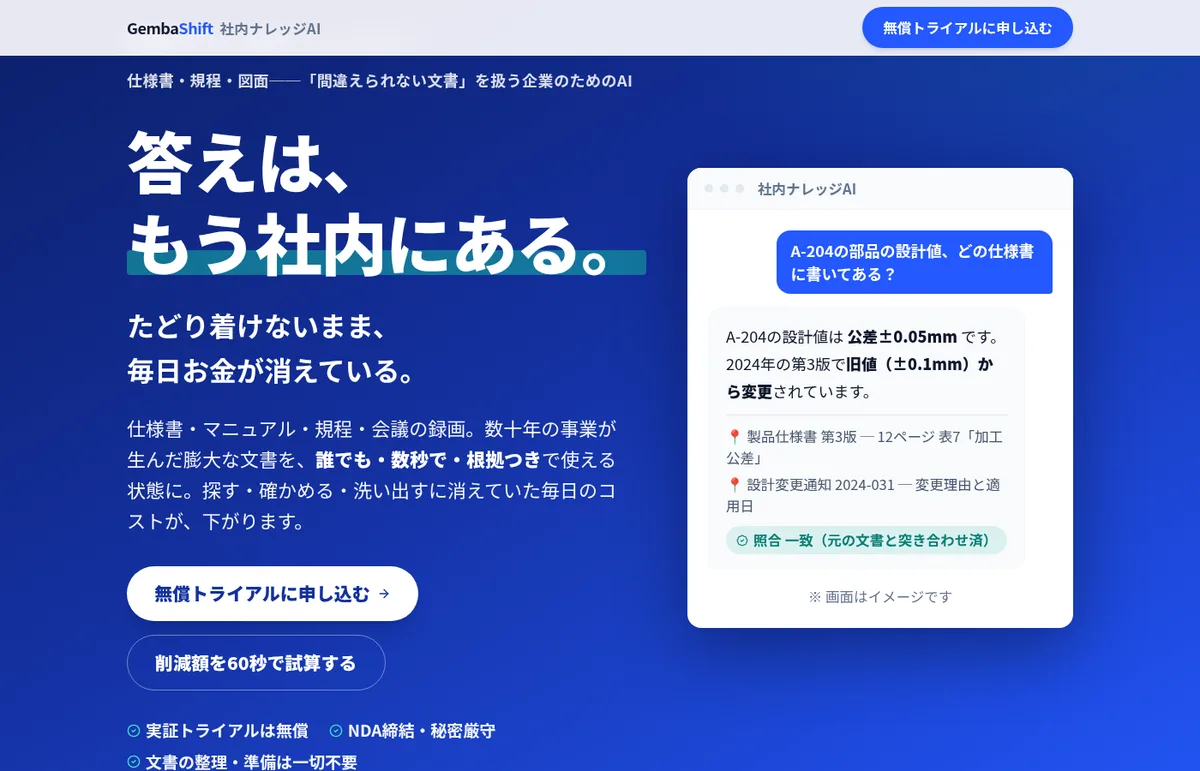
Source: 社内ナレッジAI | GembaShift (also for the images below)
Every answer comes with "where it is written"
Answers include evidence such as the document name, page and table number, so you can open the original and check it on the spot. In the company's mock-up, the question "What is the upper limit of this product's operating temperature?" is answered with "The upper limit is 85°C. However, a separate restriction of 75°C or below applies during continuous operation", listing the relevant page of the product specification and the relevant section of the design standard, with the label "Verified (checked against the original documents)".
On accuracy, the company says "making things up" cannot happen by design because answers that do not match the originals are removed before output, while "failing to find" can happen; that is why it shows numbers measured on the client's actual documents and questions in the trial before the client decides.
The "four walls" that block use of internal documents, and how they are addressed
The company organizes the causes of failed attempts to feed internal documents to AI into four walls and says it addresses each in a different way.
01Volume: too many to read
Before any question arrives, all documents are organized and every line is stored with an "address" of which document and which page. Only the relevant passages are used when answering.
02Format: workplace documents are not machine-readable
Grid-style Excel, drawings and recordings are included, and AI writes a reading program tailored to each document. Because most ingestion is done by these programs, there is no pay-per-use charge even for tens of thousands of pages, and AI is used only for parts such as reading images, the company says.
03Language: the same thing has different names in different documents
It automatically builds a "synonym dictionary" from the company's own documents that links official names, abbreviations and shop-floor terms.
04Trust: AI produces plausible fabrications
Every answer is checked by machine before delivery, and only answers that match the original documents are output.
In operation, records of "this answer was correct" accumulate as ground-truth data, the dictionary and index update whenever documents are added, and "things often asked but not documented" become visible, the company says. There is no need to change where documents are currently stored (file servers, etc.).
Uses by industry
The company says the same kind of question applies in every industry, "Can you list everything affected, without omission?", and gives these examples.
| Industry | Documents | Uses |
|---|---|---|
| IT / SIers | Design documents, source code, screen fields and database fields | Listing screens, forms and batches affected by changing a field's length; recovering specifications for systems whose design documents are lost |
| Construction / plants | Design documents, construction procedures, equipment lists | Tracking inconsistencies between documents and documents affected by design changes, keyed on equipment tag numbers |
| Pharmaceuticals / medical devices | SOPs, validation documents, regulatory filings | Checking consistency between documents; listing documents affected in change control |
| Insurance / banking | Policy terms, riders, operating rules, system specifications | Listing rules, policy terms and forms affected by regulatory changes; detecting conflicts between rules |
It adds that electricity and gas (version control of settings and inspection procedures), aviation and rail (matching maintenance manuals with parts lists), and government (identifying affected provisions when laws change) have problems with the same structure.
Free trial and adoption process
NDA and handing over materials
Sign an NDA using GembaShift's template or the client's own, and hand over existing materials as they are
Working system and measurement report in a few weeks
A screen working on real documents and questions, with numbers including what it could not find or cannot do
Decide based on the numbers
You may stop here if it does not fit (no cost)
Build and support
Built within the client's cloud environment, with support through operation
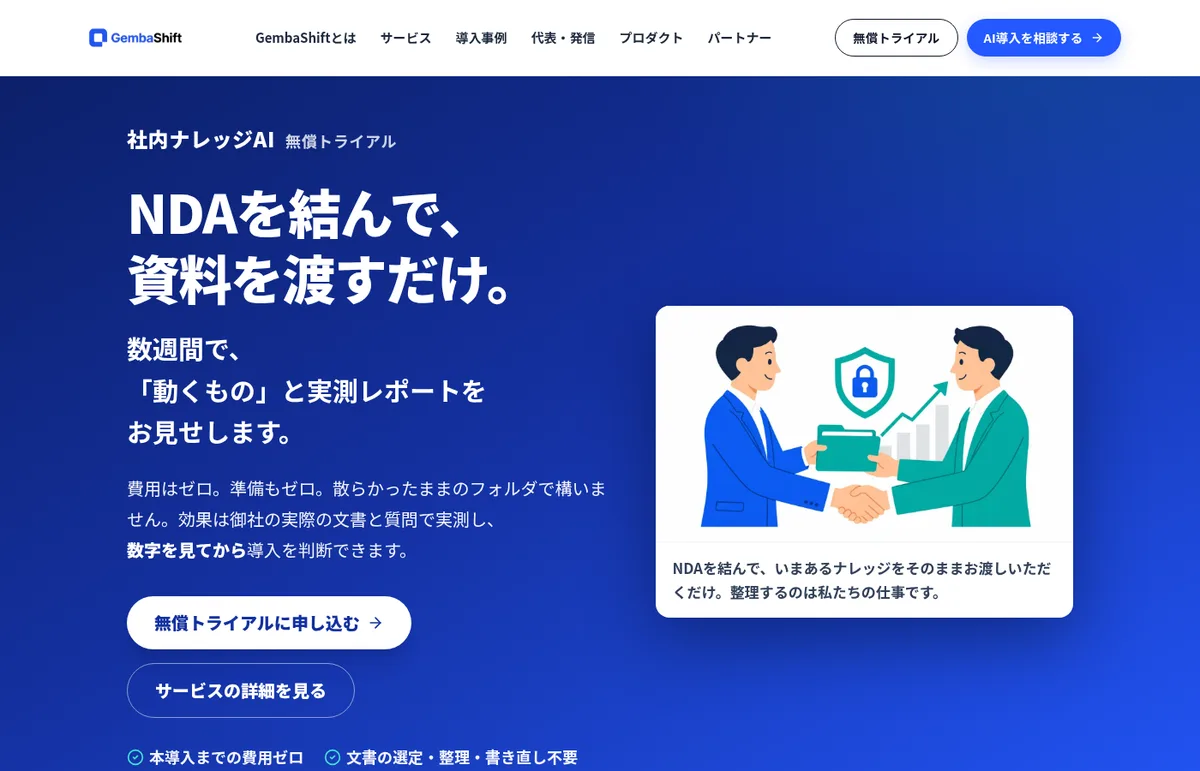
There is no need to select or tidy up documents for the trial; the client's work is reviewing the NDA, handing over materials, asking questions in everyday language and checking a few times whether answers are right, the company says. How materials are handed over (encrypted transfer, work inside an environment the client provides, etc.) is agreed individually according to the client's security rules. Production systems are designed to run entirely within the client's cloud environment, and documents are not sent to external services.
Pricing
Pricing is not published. The official FAQ says "We have no fixed price list. We present an individual quote based on the 'reduction for your company' measured in the free trial, with a payback period of about 3-4 months as a guide" (as of November 2026).
| Item | Price |
|---|---|
| Free trial (a few weeks) | Free (no cost until moving to production adoption) |
| Production adoption | Individual quote (payback in about 3-4 months as a guide) |
The product page has a calculator that estimates the savings from headcount, daily search time, hourly cost and reduction rate; with the default values (100 people, 40 minutes a day, 5,000 yen per hour, 240 business days) it shows an example in which 80 million yen a year is spent on "searching, asking and checking". The company notes that this is "a calculation example based on your inputs (not a guarantee of results)".
Track record and reputation
The official FAQ says "We have a track record at a major automaker. The company name and project details are not disclosed due to confidentiality". The chapter list of the roughly 10-minute product video includes "Track record (major vehicle manufacturer)", introducing a trial in the design department of a major vehicle manufacturer. No case studies naming clients are published.
Who it suits and who it does not
How it differs from other internal document search and RAG tools
社内ナレッジAI is not a tool you subscribe to and operate yourself; it is an implementation-type service in which GembaShift designs how the documents are organized and builds the system in the client's environment. The company recommends using it alongside existing RAG or enterprise search rather than replacing them, dividing roles so that vague searches go there and document sets where completeness and evidence are requirements come here.
| Service | Main use | How evidence is shown | Pricing (published) |
|---|---|---|---|
| 社内ナレッジAI (GembaShift) | Searching documents that must not be wrong, such as specifications, regulations and drawings; listing change impacts and conflicts between documents | Down to document name, page and table; outputs only answers verified against the originals | Not published (individual quote after a free trial) |
| AskDona | Assessments and reviews against regulations, standards and internal criteria; answers with evidence | Draft judgment, reason and cited evidence | Not published |
| Kasanare | RAG that understands internal terms and procedures, and AI agents that operate existing systems | Answers based on internal knowledge | Not published (individual quote) |
| Helpfeel | FAQ search robust to spelling variations; cross-search of internal PDFs and Word files | FAQ articles and documents | Individual quote |
| ChatDOC | Upload PDFs and Word files and read them through chat | Original passage, page and table | Free $0, Pro $8.99 per 30 days |
Details for other companies are as of the check dates on each product page.
If you also want to preserve experts' judgment that is not written down, the company says it can be combined with GembaShift's ベテランナレッジAI. The operator's AI implementation support is covered on the GembaShift page.
FAQ
Q. How much does 社内ナレッジAI cost? Pricing is not published. There is no fixed price list; the company gives an individual quote based on the savings measured in the free trial, with a payback period of about 3-4 months as a guide.
Q. What happens in the free trial? After signing an NDA and handing over existing materials as they are, you are shown, within a few weeks, a screen working on your actual documents and questions plus a measurement report. There is no cost until you move to production adoption, and you can stop there.
Q. Can it read grid-style Excel and drawings? The company says it can. AI writes a reading program tailored to each document for ingestion, and PDF, Word, near-handwritten notes and recordings or audio of meetings and handovers can also be included.
Q. Can it be used with documents that cannot leave the company? The company says production systems are designed to run entirely within the client's cloud environment, and documents are not sent to external services. It can also provide explanatory materials and architecture diagrams for IT departments.
Q. Won't AI usage fees balloon? The company says most ingestion is done by dedicated programs with no pay-per-use charges, AI is used only for parts such as reading images, and as operation progresses usage fees tend to fall the more it is used.
The information on this page is based on what was published on the official website as of November 2026. Please check the official website for the latest prices and details.