

ベテランナレッジAI(GembaShift)
: How to use it, features, and the business problems it solves
What is ベテランナレッジAI(GembaShift)?
ベテランナレッジAI (Veteran Knowledge AI) is a skills transfer AI from GembaShift Inc. (株式会社GembaShift) of Takasaki, Gunma. From interviews with experienced workers and meeting recordings, it creates cards for each decision situation covering the order of checks, decision points, things that must be confirmed with someone and the veteran's own words (an assessment notebook), including only content the veteran has approved. Younger workers open it on their smartphones when stuck and compare the veteran's approach with their own situation. The AI is a facilitator that does not give conclusions. After publication the veteran spends about 15 minutes a week. Free trial for one veteran; pricing by quote (as of November 2026).
Business problems it solves

About "ベテランナレッジAI(GembaShift)"
What is ベテランナレッジAI (GembaShift)?
ベテランナレッジAI (Veteran Knowledge AI) is a skills transfer AI that turns where experienced workers (veterans) look, the order in which they look and where their judgment branches into cards for each decision situation, built from interviews and meeting recordings, so that younger workers can open them on the spot when they are stuck. It is provided by GembaShift Inc. (株式会社GembaShift) of Takasaki, Gunma Prefecture. The collection of cards is called a "見立て帳" (assessment notebook), and only content the veteran has checked and approved is included. It launched in October 2026 (according to the timeline on the representative's profile page).
There is no need to write new manuals; interview recordings, meeting recordings or transcripts and reports can be used as material. In front of younger workers, the AI acts as a facilitator that picks the situation matching their problem, applies the veteran's order of checks to their circumstances and compares it with their own thinking; it does not give conclusions, the company says. After publication, the veteran's workload is about 15 minutes a week. There is a free trial for one veteran, and pricing is quoted based on scale and configuration (as of November 2026).
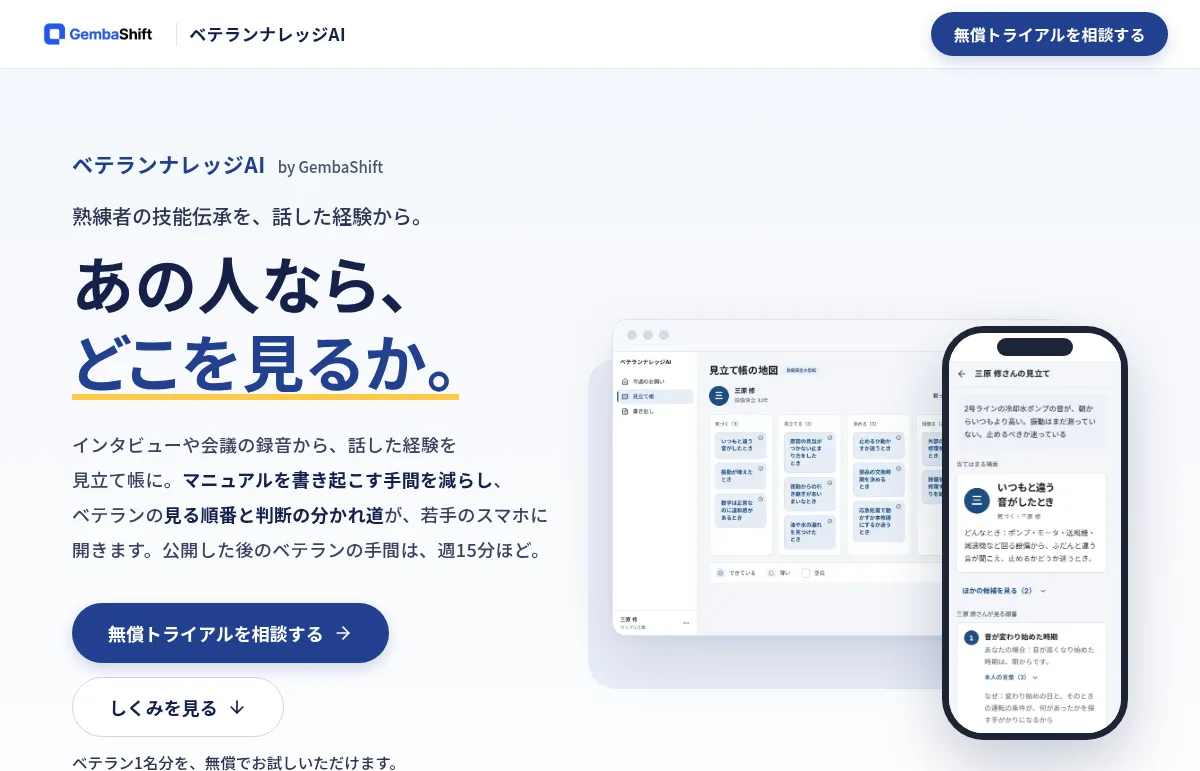
Source: ベテランナレッジAI | GembaShift (also for the images below)
Recording the order of checks and decision points as "cards" for each situation
Each card in the notebook covers one decision situation (such as "when you hear an unusual sound") and has four parts.
AWhere to look (order of checks)
The points the veteran checks, in order, each with "why to look".
BDecision points
The conditions where judgment branches and what to do next. Not a conclusion, but the veteran's own line.
C"Check with someone" rules
Things that must always be confirmed with a person, such as safety, legal and money matters. Always shown in the situations they apply to.
DThe veteran's own words and stories
Quotes of what the veteran actually said, with sources, including failures and near misses. Only words matched character by character with the original are quoted, the company says.
The company cites a survey showing that among establishments working on skills transfer, 22.0% document, database or manualize the know-how of employees due to retire (Ministry of Health, Labour and Welfare, "FY2025 Basic Survey on Human Resources Development", figure 64, multiple answers). It says procedures and videos suit recording fixed steps, while the notebook differs by recording the order of checks and decision points for each situation that requires judgment. Existing manuals and videos can be used as material for the notebook.
Younger workers "open it when stuck, write and compare, and practice at lunch"
01Open it when stuck
When a younger worker writes (or speaks) their problem, the card for the matching situation opens, and the veteran's order of checks is laid out applied to "your case". It shows only the order of checks and decision points; whether to stop is up to the younger worker.
02Write and compare
When they write their own thinking, they can see which of the veteran's points they touched and which they have not yet. No scores are given.
03Practice at lunch
They answer a single question built from only the "situation" of a veteran's story, after which what the veteran looked at first and the rest of the story are revealed.
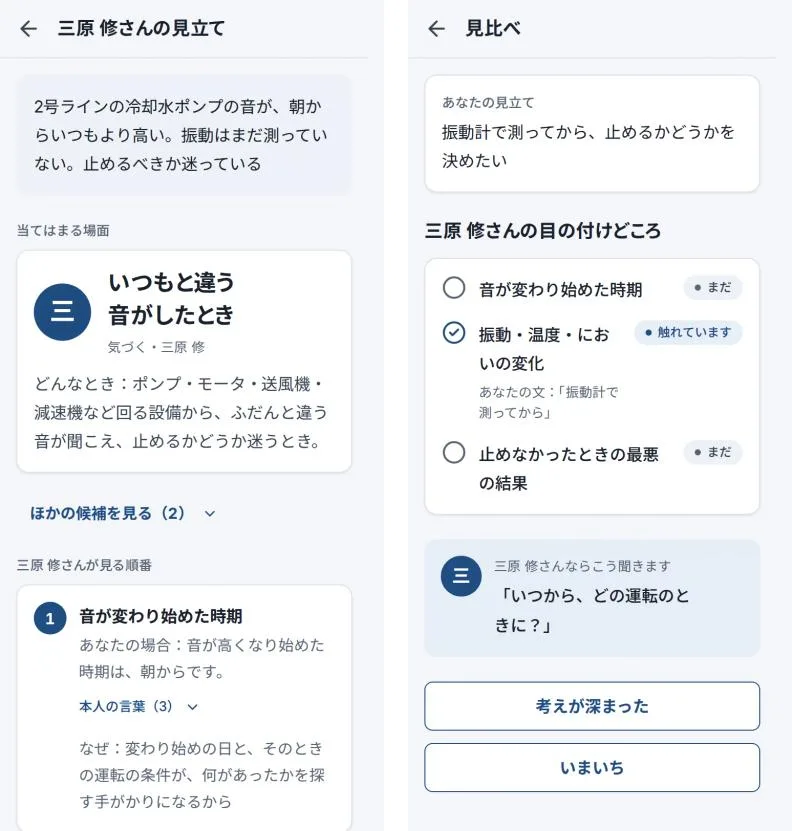
The names of those who ask are not shown to the veteran or to administrators. Administrators can see only aggregates that do not identify individuals (whether it is used, what younger workers tend to miss, "blank situations" without cards and how many people were stuck on them, etc.), and aggregates with small numbers are not shown either, the company says. The notebook can also be exported as a document for printing or PDF.
What is left to AI and what is not
The company says AI's work stops at transcribing recordings, drafting cards for each situation, finding situations that match a younger worker's problem, applying the veteran's order of checks to their circumstances and comparing it with their assessment. Text written by AI is checked by machine for conclusions, first-person statements or items not on the card, and if it fails only the card is shown. AI drafts are not visible to younger workers until the veteran approves them.
The company also writes that "the choice of matching situation and the one 'your case' line are made by AI, so they may be off". When no situation matches, it does not force one but says it is "a situation not yet covered" and turns it into a request for an interview with the veteran. Hand feel and force themselves cannot be recorded; what can be recorded is what to look at in a decision situation and where judgment branches, the company says.
Adoption process (target: first notebook published within six weeks)
Agreement
Decide with the veteran how names are shown, how recordings are handled and how long they are kept; choose the job template
Collect problems
Hand younger workers a "Things I want to ask (name)" form
Interviews
Record 2-3 sessions of 30-60 minutes; meeting minutes and reports too (optional)
Drafts and the veteran's review
For each card, the veteran chooses approve, fix or exclude
Trial run and publication
Test with selected younger workers and decide who can use it based on the results
After publication, a "This week's request" email arrives once a week, and the veteran only answers it, for example with red-pen corrections to younger workers' assessments or cards, or a short interview of about five minutes on situations without cards; in weeks with nothing to do, no email is sent, the company says.
Templates listing situations that come up often are available for equipment maintenance, product design, construction management, B2B sales and nursing care. For equipment maintenance, for example, situations include "when you hear an unusual sound" and "when you're unsure whether to stop or keep running", with "Leave the decision to stop equipment to the team leader" as an example of a check-with-someone rule. Jobs without a template can start with the general template "notice / assess / decide / arrange / reflect". The company says "Start with the engineering departments of manufacturers".
Data handling
The company says inputs to the AI (Azure OpenAI) are used in a configuration where they are not used for model training, and customer data is not used for other customers. By default, original recordings are deleted after transcription, and how recordings are handled, their scope of use and retention period are agreed with the veteran in advance. Data is managed separately for each company, sign-in uses Microsoft Entra ID, and operation logs (audit logs) are kept. A configuration placing it in the customer's Azure environment can also be chosen. How the notebook is handled after the veteran retires is decided in the consent form signed at the start, and the veteran can request suspension of use and deletion at any time.
Pricing
Pricing is not published. The official FAQ says "We will quote after hearing the scale and configuration of use" (as of November 2026).
| Item | Details |
|---|---|
| Free trial | Free. One veteran; drafts from materials and recordings provided; the veteran's review of the drafts (about 30 minutes); delivery in a state that can be tested on younger workers' problems. Takes a few weeks |
| Production adoption | Quote. Second and later veterans, interview sessions by GembaShift (30-60 minutes × 2-3), publication to and operation for younger workers, weekly "This week's request" |
The trial works by sending meeting transcripts, recordings and existing materials unorganized after signing an NDA; if there are no materials, you can start by recording an in-house interview of about 30 minutes and sending it, the company says.
Who it suits and who it does not
How it differs from other transcription and knowledge AI tools
It differs from recording transcription and internal document search in what it preserves and how it is used. What ベテランナレッジAI preserves is "what to look at in a decision situation", which is not written down.
| Service | What it preserves | How it is used | Pricing (published) |
|---|---|---|---|
| ベテランナレッジAI (GembaShift) | The veteran's order of checks, decision points, check-with-someone rules and own words (approved by the veteran) | Younger workers open the card when stuck and compare it with their own situation | Not published (free trial for one veteran) |
| 社内ナレッジAI (GembaShift) | Answers already written in specifications, regulations, drawings, etc. | Search and cross-check with page-level evidence | Not published (free trial available) |
| Sumarii | Transcripts and summaries of meetings and recordings | Create minutes | Free allowance of up to 3 hours a month |
| Helpfeel | FAQ articles and internal PDFs and Word files | Find answers with search robust to spelling variations | Individual quote |
Details for other companies are as of the check dates on each product page.
The operator's AI implementation support is covered on the GembaShift page.
FAQ
Q. How much does ベテランナレッジAI cost? Pricing is not published. The company quotes after hearing the scale and configuration of use. There is a free trial for one veteran.
Q. Can we start without manuals or materials? Yes. Two or three 30-60 minute interviews are recorded and organized into draft cards, and meeting recordings, minutes and reports can also be used. The company says there is no need to write new manuals.
Q. How much work is it for the veteran? At launch, the company asks for two or three 30-60 minute interviews and a review of the draft cards. After publication, the veteran only answers a weekly "This week's request" email, about 15 minutes a week.
Q. Does the AI answer in place of the veteran? No. The company says the AI only picks the matching situation card, applies the veteran's order of checks to the younger worker's circumstances and compares it with their assessment; it does not give conclusions. Cards contain only content the veteran has checked.
Q. Are recordings and internal materials used to train AI? The company says they are not. Inputs to the AI (Azure OpenAI) are used in a configuration where they are not used for model training, and by default original recordings are deleted after transcription.
The information on this page is based on what was published on the official website as of November 2026. Please check the official website for the latest prices and details.