
genrank
: How to use it, features, and the business problems it solves
What is genrank?
genrank is a GEO/LLMO service from PLATEER Japan Inc., the Japanese subsidiary of KOSDAQ-listed PLATEER, that improves corporate websites so generative AI is more likely to cite them. It supports the whole process—selecting target pages and diagnosing site structure, designing the questions people are likely to ask generative AI, measuring mentions and citations of your company and competitors, generating and publishing AI-oriented content such as summaries, FAQs and structured data (JSON-LD), and re-measuring and improving. It also covers non-e-commerce sites such as manufacturers, medical institutions and service companies, and officially launched in September 2026. Pricing is not published; a free site diagnosis and a one-month PoC are available.
Business problems it solves


About "genrank"
What is genrank?
genrank is a GEO/LLMO service that improves corporate websites so that generative AI such as ChatGPT and Gemini is more likely to cite them. It is provided by PLATEER Japan Inc. (株式会社プレティアジャパン), a company that builds AI for e-commerce sites.
It supports the whole process, from site diagnosis, question design and citation measurement to generating and publishing AI-oriented content and re-measuring and improving after each measure. It is not limited to e-commerce businesses and also covers websites of manufacturers, medical institutions, service companies and others.
The entry point for discovering products and brands is expanding from search engines to generative AI. On top of SEO, which aims for top search rankings, whether AI uses your information as the basis for its answers now affects customer acquisition. genrank aims to run a repeating cycle—from measuring the current state, to creating content AI is more likely to cite, to checking what changed after each measure.
For companies considering adoption, there is a free site diagnosis that reports how AI currently cites your site, and a one-month PoC that lets you try actual measurement and improvement measures before full adoption.
Features
According to the official site, official blog and the provider, the main features are as follows:
- Selecting target pages and diagnosing site structure Chooses the pages to optimize for AI citations and diagnoses the site's structure.
- Question design Designs the questions users are likely to actually ask AI, as the foundation for measurement. According to the product brochure, the provider designs the questions based on real consultation data from genser and search-term data from Google Ads.
- Measuring mentions and citations Measures, as a pre-measure baseline, which questions mention or recommend your company and competitors and which URLs are cited. The provider says it also visualizes how third-party media mention your company. The product brochure says you can see citations separately for ChatGPT, Gemini, Perplexity, Copilot, and Google's AI Overviews and AI Mode.
- Generating and publishing content AI is likely to cite Based on the measurement results and making use of your existing site content, generates and publishes information that helps generative AI understand and cite your pages—page overviews and summaries, key points, FAQs, and reviews and ratings. It also generates and publishes site information as structured data such as JSON-LD. Because it adds information to the existing site, the provider says it can be introduced without a major overhaul of the whole site. Content can be published in one of two ways to fit the site's structure: added to existing pages, or shown in detail in a pop-up.
- Re-measurement after each measure After publishing, measures citations again with the same questions, then repeats improving, republishing and re-measuring content based on the results. Changes in mentions, recommendations and citations from the baseline can be reviewed in reports, along with weekly trends.
The official blog presents this flow as a cycle of "measure → design questions → generate content → measure → improve," and describes being able to see three things—"how you look now," "what is missing," and "what changed"—as the first step in GEO/LLMO.
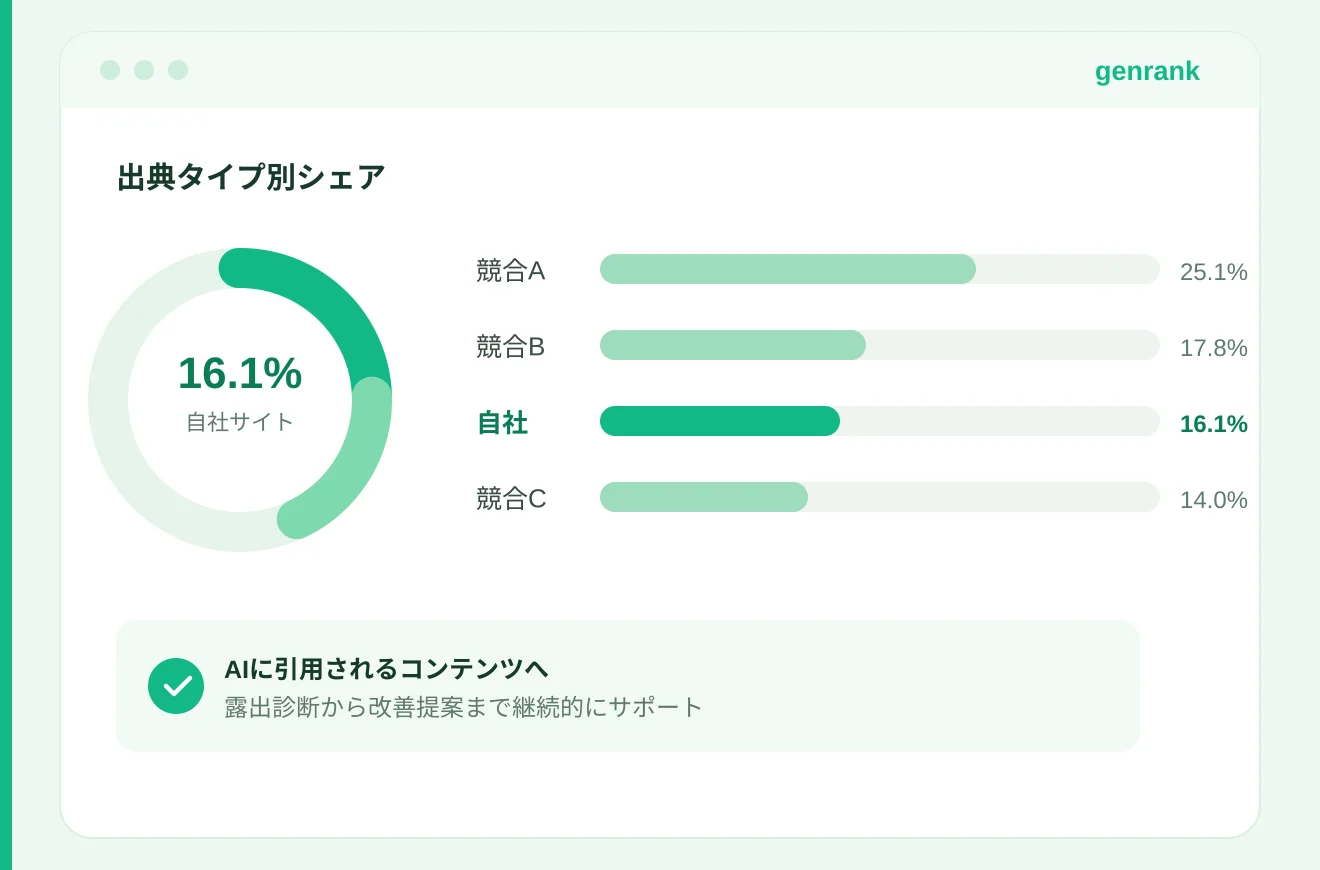
Source: PLATEER Japan official website. This is an illustrative image from the product introduction; the figures are not real data
How to use
- Consult or get a free site diagnosis Consult via the inquiry form on the official site, or download the genrank brochure. The free site diagnosis reports how AI currently cites your site.
- Choose target pages and questions, and measure a baseline Select the pages to optimize, diagnose the site structure, design the questions customers are likely to ask generative AI, and measure current mentions, recommendations and citations of your company and competitors.
- Publish AI-oriented content Generate page overviews and summaries, key points, FAQs, structured data (JSON-LD) and more, and publish them on your existing site.
- Re-measure and keep improving Re-measure citation results after publishing, then keep improving, republishing and re-measuring content based on the results. You can also try it with a one-month PoC before full adoption.
As a guideline in the product brochure, week 1 sets the target pages and conditions, week 2 covers question design and baseline measurement, week 3 generates and publishes content, and from week 4 re-measurement and improvement continue.
Pricing
As of October 2026, pricing is not published.
| Item | Details |
|---|---|
| Price | Not published (contact sales) |
| Offering | GEO/LLMO service |
| Free trial | Free site diagnosis / one-month PoC |
| Contact | Form on the official site, or info@plateer.co.jp |
Pros and cons
Pros
- Covers not only measurement but also generating and publishing AI-friendly content and re-measuring, as one continuous process
- Adds summaries, FAQs, review information and structured data (JSON-LD) to your existing site, so you can start without a major overhaul of the whole site
- Works not only for e-commerce sites but also for websites of manufacturers, medical institutions, service companies and others
- A free site diagnosis and a one-month PoC let you check the effect before full adoption
- Planned to be combined with the purchase-intent data accumulated in the same company's e-commerce AI assistant, "genser"
- The parent company has more than 20 years of experience building e-commerce systems
Cons
- Pricing is not published
- No customer cases in Japan have been published yet
Reviews and reputation
As of October 2026, no user reviews or customer cases in Japan have been published.
The published results come from a Korean case in the provider's product brochure. At Korea's largest food manufacturing brand, in the fifth week after introducing genrank, the own-site citation rate rose 1.6x, the product citation rate 2.1x, and the match accuracy between questions and cited URLs about 9x, while the brand's share within AI answers went from 28% to 40%.
Externally, genrank is listed under the "get found by AI" category in the agentic commerce service list of "AI Agent Navi," a media outlet specializing in AI agents. The provider also exhibited genrank together with genser at "AI Commerce EXPO 2026" in September 2026 and gave a seminar talk on GEO.
On its official blog, the provider explains why e-commerce businesses should work on GEO/LLMO and where they tend to stumble, citing Shopify's GEO playbook and a GEO research paper (KDD 2024).
How genrank differs from other LLMO/GEO tools
| Product | Characteristics | Best for |
|---|---|---|
| genrank | Also covers non-e-commerce sites. From site diagnosis and measurement to generating and publishing AI-oriented content and re-measurement | Adding AI-friendly information without a major overhaul of your site |
| LLMOinsight | A platform that measures exposure, recommendation rank and cited sources across major generative AI | Quickly understanding how you look with a tool |
| ミエルカGEO | A GEO diagnosis and optimization tool from Faber Company, maker of the SEO tool "Mieruca" | Tracking GEO alongside SEO |
| GMO AIOブースト | GMO Group's AIO tool, measuring mention rates and cited sources across five generative AI services | Seeing the gap between you and competitors across multiple AI services |
| AIsearchmap | CINC's GEO/LLMO monitoring tool that regularly collects AI answers | Continuously tracking exposure trends for you and competitors |
If you want to operate a measurement tool yourself and get started quickly, LLMOinsight or ミエルカGEO (Mieruca GEO) are easy options. If you want to hand off not only measurement but also creating and publishing AI-oriented content, genrank is a candidate. For a comparison of tools, see "LLMO/GEO tools comparison."
FAQ
Q. Is genrank available now? Yes. According to the provider, it officially launched in September 2026 (as of October 23, 2026, the product list on the official site still shows "SaaS / in development"). Before adoption, you can use the free site diagnosis and a one-month PoC.
Q. Can it be used for sites other than e-commerce? Yes. It is not limited to e-commerce businesses and also covers websites of manufacturers, medical institutions, service companies and others.
Q. How much does it cost? Pricing is not published. Please check via the inquiry form on the official site.
Q. How is it different from SEO? SEO aims for top positions in search results. The GEO/LLMO measures genrank handles aim to get your information mentioned and cited when generative AI builds its answers. The official blog explains that preparing product information, FAQs and structured data (JSON-LD) is the foundation for both.
Q. How is it different from genser? genser is an AI assistant that supports product discovery inside your own store, while genrank handles acquisition from outside the site—that is, from external generative AI. The provider proposes a cycle in which purchase-intent data gathered through genser is used to create information that AI is more likely to cite.
Provider
genrank is provided by PLATEER Japan Inc. (株式会社プレティアジャパン; Tenshō Tamachi Bldg. 903, 3-17-11 Shibaura, Minato-ku, Tokyo; CEO Bongkyo Lee; founded January 29, 2025; capital ¥80 million). Its parent company is PLATEER Inc., founded in 2005 and listed on Korea's KOSDAQ in 2021, which has built e-commerce systems for major Korean companies.
Besides genrank, PLATEER Japan offers the e-commerce agentic commerce AI "genser" and the AI shopping app "gelatto."
The information on this page is based on what was published on the official site, official blog and in the product brochures distributed on the official site as of October 2026, and on information provided by the company. Availability, features and pricing may change, so please check the official site for the latest information.