
Genview
: How to use it, features, and the business problems it solves
Add bookmark
What is Genview?
Genview is a GEO (generative AI search optimization) platform built to help your brand be understood correctly and chosen by generative AI such as ChatGPT and Gemini. Whether your name comes up in answers to questions like "What's a good ~ ?" affects every stage of the buying journey, from awareness and consideration to purchase and word of mouth. Genview makes visible the gap between the ideal brand image you want to convey and what generative AI actually says, working end-to-end from measurement and diagnosis through to improvement proposals across three perspectives: brand perception, mentions and citations for important queries, and your whole website (structured data, llms.txt, and more). It goes beyond mere measurement to present concrete actions for improvement. Genview is operated by FID, Inc. (Shinjuku, Tokyo), which has provided CRM and marketing support for more than 15 years, and was officially released on August 1, 2026, with 30 companies participating as early adopters in its beta.
Business problems it solves



About "Genview"
What is Genview
Genview is a GEO (generative AI search optimization) platform built to help your brand be understood correctly and chosen by generative AI such as ChatGPT and Gemini. Whether your name comes up in AI's answers to questions like "What's a good ~ ?" influences every stage of the buying journey, from awareness and consideration to purchase and word of mouth.
In most cases, however, there is a gap between the ideal brand image a company wants to convey and what generative AI actually says about it. Genview first makes this gap visible, measuring how a brand is perceived by AI, and then presents improvement measures to bring that perception closer to the ideal.
Beyond that, for important queries such as "What's a good ~ ?", Genview continuously measures AI's answers and how your brand and competitors are mentioned and cited, then recommends which queries to improve and how. It also takes a full view of your website, diagnosing the information and structure missing for AI to understand and reference you correctly, and turns that into site improvements including structured data and llms.txt.
In this way, Genview works end-to-end from measurement and diagnosis through to improvement proposals across three perspectives — brand perception, queries, and the whole website — going beyond mere measurement to present concrete actions for improvement. That is what sets Genview apart.
It is operated by FID, Inc. (Shinjuku, Tokyo), which has provided CRM and marketing support for more than 15 years. Genview was officially released on August 1, 2026, with 30 companies participating as early adopters in its beta.
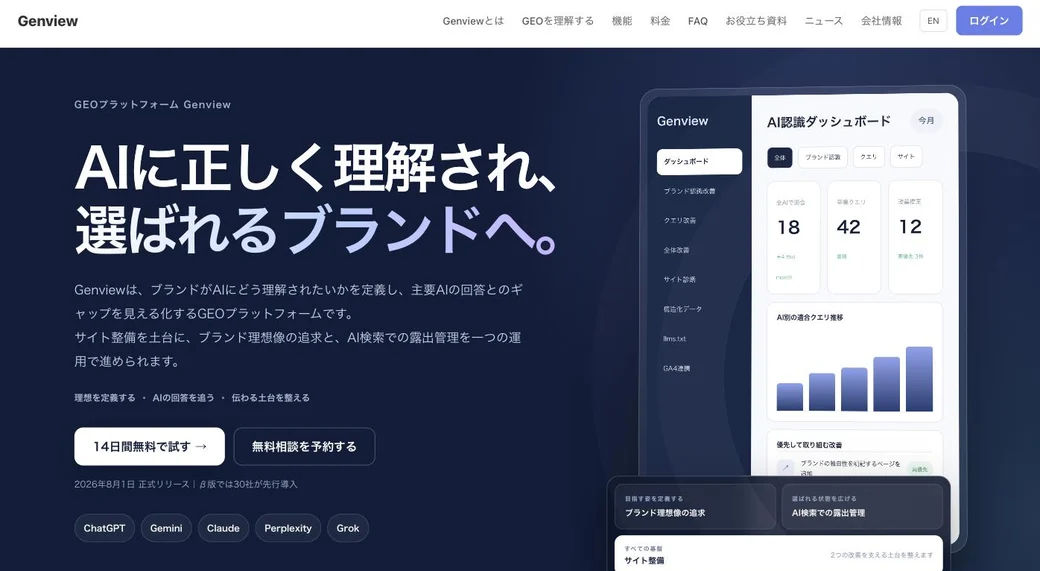
Source: Genview official site (the images below are from the same source)
ChatGPT, Gemini, Claude, Perplexity, Grok
(as of August 2026)
Try all Base features
Usage-based from the Base plan
Get your name — and the reasons to choose you — into AI answers
Genview aims for more than just having your name shown in an AI's answer. The goal is a state where your brand's features and strengths are explained correctly, you enter the shortlist, and the reasons and evidence (reference URLs) to choose you are shown too. The point is for prospects with no prior contact to recognize you as an "option" the moment they consult an AI.
Explained correctly
Your features, strengths, and target users are explained without error in AI answers.
Enter the shortlist
When a customer consults an AI, you come up as an option.
Reasons are shown
Not just the name, but why it fits, decision criteria, and reference URLs.
More winning queries
Not one question, but awareness, comparison, decision, and purchase.
The aim is to go beyond a name appearing — the reasons to choose you come through, and target queries keep widening.
What are GEO, AIO, and LLMO
GEO (Generative Engine Optimization) is a practice for optimizing a brand's visibility in AI search such as ChatGPT and Gemini. The same area is also called "AIO" or "LLMO" by different people. All are close concepts referring to optimization so that brands and information are correctly recognized, mentioned, and recommended on generative AI, and Genview covers this whole area.
Ads gain exposure in proportion to spend, and SEO improves mainly rankings and clicks on the search results page. GEO, by contrast, aims for a state where the brand is correctly understood in AI answers and continuously enters the comparison and recommendation shortlist. Behind this is a market shift: information gathering now completes within AI summaries and conversational search, reducing total clicks to sites, while users who arrive via AI referral are further along in comparison and consideration. (On its official site, Genview cites survey data such as a large drop in organic traffic in the US and the high value of visitors coming via AI search.)
Genview's three axes of improvement
To become more likely to be "mentioned, referenced, and recommended" by AI, Genview manages three things separately. The key is that it starts from "how you want to be seen," not "how you are seen now." Unlike typical tools that stop at scoring the current AI perception, it defines the ideal first and shows concrete steps to close the gap with reality.
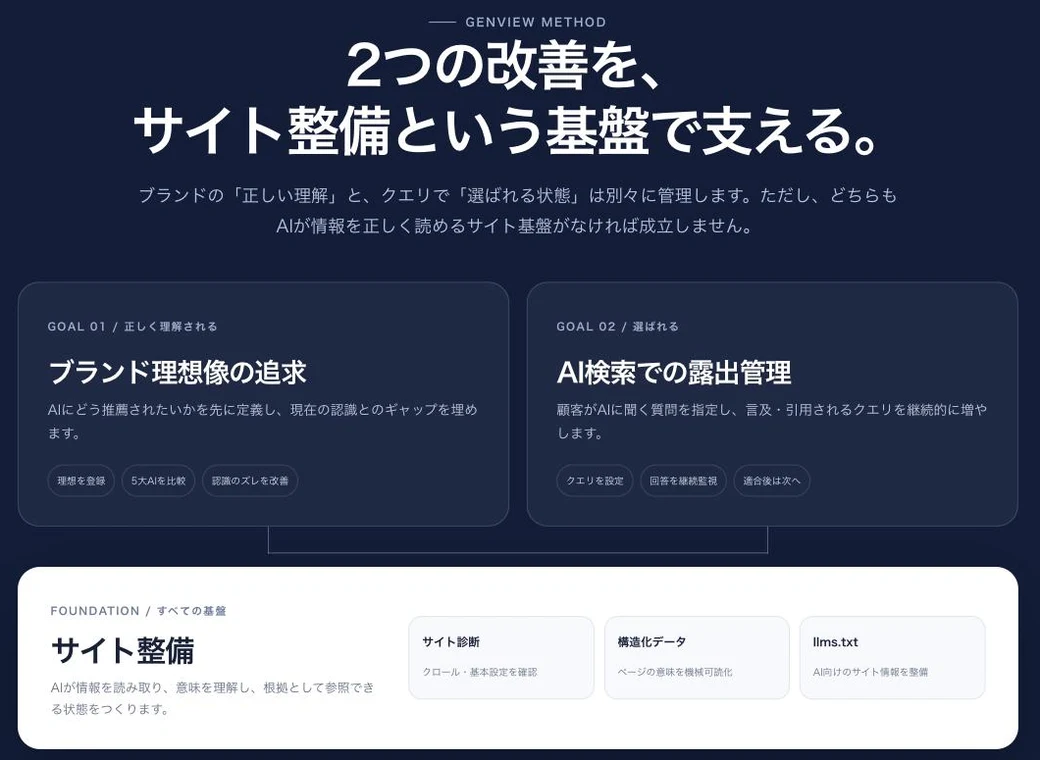
01Brand-perception improvement (understood correctly)
Define first how you want AI to recommend you, then close the gap with the current perception at the fact level. "Hallucinations" — where AI generates information that differs from the facts — are also treated as a gap between ideal and reality and corrected with evidence.
02Query improvement (being chosen)
For each question (query) a customer is likely to ask an AI, it continuously monitors the answers of major AIs and proposes steps to be mentioned or cited. Rather than relying on a proprietary composite score or sentiment analysis, it is designed to show actual answers, mention/citation counts, and fit on a real-number basis.
03Site readiness (the foundation for everything)
The two above cannot hold without a site foundation that lets AI read information correctly. It creates a state where AI can read the information, understand its meaning, and reference it as evidence.
How to use
It is designed so anyone can proceed by following on-screen guidance, without specialist knowledge. The first onboarding is free, and the dashboard includes an AI chatbot so staff can run it on their own.
-
Register in 30 seconds
Start with just Google login. No pre-purchase contract is needed, so you can begin right away.
-
Do the three initial setups
Follow the on-screen guidance for basic settings, query settings, and improvement-page settings — registering brand strengths, setting priority queries, and specifying monitored URLs.
-
Review the first diagnosis
Check AI mention/reference status and internal site issues together. The gap between ideal and reality is made visible.
-
Execute improvements
Using copy-paste text, code, and steps, start from the priority- and difficulty-tagged proposals. From queries that succeed (graduated queries), widen the scope to the next questions.
Features
It consolidates "measure," "improve," and "deepen" into one operating screen, so you can judge not only what is happening but what to fix next.
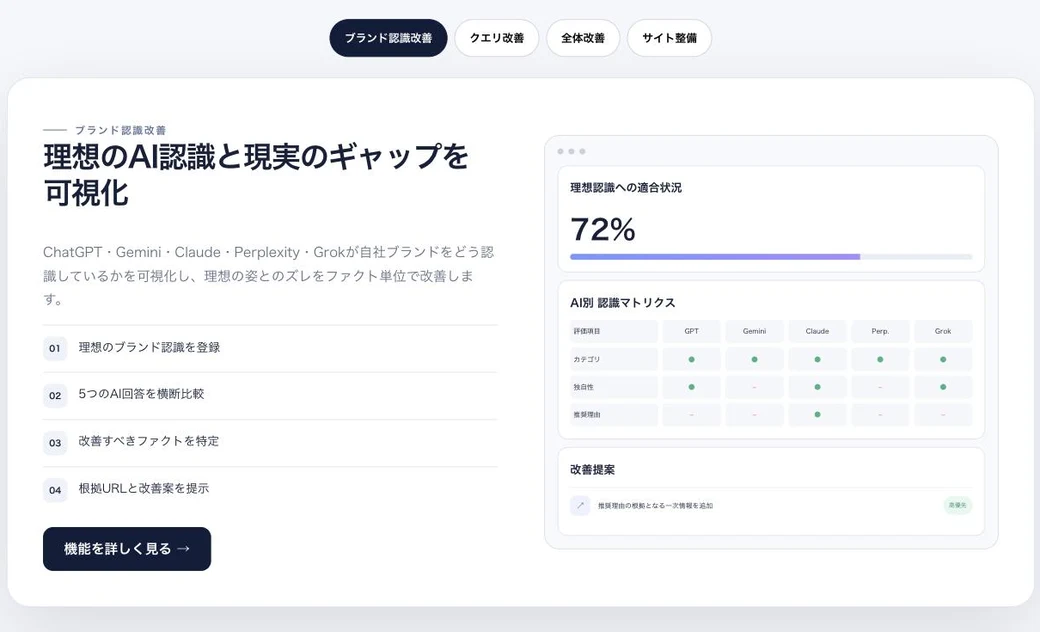
01Measure
- Brand-perception improvement — Identify the gap between ideal and reality
- Query improvement — Judge fit / misperception / no mention
- Site diagnosis — Cross-check the GEO technical foundation
- Overall improvement — Prioritize site-wide issues
02Improve
- Auto-generate schema — Create JSON-LD by priority
- Auto-generate llms.txt — Generate and validate in Japanese and English
- Query suggestions — Suggest questions customers are likely to ask
- Competitor comparison — Check the gap vs competitors inside AI answers
03Deepen
- GA4 integration — Visualize AI-driven traffic and results
- Graduated-query management — Switch successful questions to the next
- Funnel summary — Organize by TOFU, MOFU, BOFU
- Monthly report — Review actions and changes regularly
Pricing
There is just one plan. Tiered plans tend to bundle features you do not need and push prices up, so Genview uses a usage-based model on top of the Base plan, letting you freely add AIs, queries, monitored URLs, and users to match your scale. Amounts are excluding tax, and the first 14 days are free.
| Plan / add-on | Price (excl. tax) | Details |
|---|---|---|
| Base | ¥60,000/mo | Core package with all main features. ChatGPT & Gemini / 15 queries (daily monitoring) / 1 monitored URL / 3 users / site diagnosis, brand-perception & query improvement / schema & llms.txt generation / GA4 integration / free first onboarding |
| Add query | +¥2,000 | Per query, per month |
| Add AI | +¥20,000 | Per AI, per month (Claude / Perplexity / Grok) |
| Add monitored URL | +¥50,000 | Per URL, per month (per site/brand) |
| Add user | +¥5,000 | Per user, per month |
Base includes all main features, with ChatGPT and Gemini as standard. Claude, Perplexity, Grok, and additional queries/URLs/users are added as needed on a usage basis. A monthly case-study meeting and individual chat support from a representative can be arranged separately. Prices may change, so confirm the latest on the official site.
Pricing is based on the official pricing page (excl. tax) as of August 2026.
How it differs from other GEO / AI-search tools
Genview's trait is that it does not stop at "just measuring" the current AI perception, but defines the ideal and shows concrete steps to get there — down to code, copy, and alternatives — end to end.
Typical GEO tools / consultants
- Visualize mentions, ranks, and scores, then stop at measurement
- You learn where you stand
- Direction and implementation are left to you
Genview
- Define the ideal AI perception first
- Identify gaps at the fact level
- Provide improvement proposals (code, copy, alternatives) with priority and difficulty
| Aspect | Genview | Typical GEO measurement tools | AI search engines themselves |
|---|---|---|---|
| Role | Define ideal → visualize gap → execute | Visualize current scores/mentions | Where users ask and get answers |
| AIs | ChatGPT, Gemini, Claude, Perplexity, Grok | Varies by tool | Each service alone |
| Output | Proposals, schema, llms.txt, monthly report | Mostly reports | Answers |
| Best for | Companies continuously improving AI visibility | Companies just assessing status | Individuals/companies seeking info |
If you want to build a site that AI can easily cite, Readdy, a site builder with GEO features, is an option. For the AI search engines that are monitored, see Perplexity, ChatGPT, and Gemini. If you want to grasp how AI sees you now and then continuously operate toward a "chosen" state, Genview — which starts from the ideal — is a strong choice.
FAQ
Q. What kind of service is Genview?
A GEO platform that visualizes the gap between your "ideal AI perception" (how you want AI to recommend you) and what major AIs actually say, and proposes concrete improvements to brand perception, queries, and site structure.
Q. Which AIs are supported?
Five: ChatGPT, Gemini, Claude, Perplexity, and Grok. Base includes ChatGPT and Gemini; the others can be added as AI add-ons (¥20,000/mo per AI).
Q. Do I need technical knowledge or an engineer?
No specialist knowledge is needed for basic operation. Site diagnosis, structured data, and llms.txt can be checked and generated on screen, and proposals come with steps, difficulty, and code. Sales and marketing staff — not engineers — run it in practice.
Q. What can I do during the free period?
You can try all Base plan features free for 14 days — site diagnosis, brand-perception and query improvement, plus schema/llms.txt auto-generation and GA4 integration, the same content as the paid plan.
Q. How do I confirm the impact?
Via per-AI mention/reference/fit status, graduated-query count, before/after answer changes, and AI-driven sessions and landing pages through GA4. If you track conversions in GA4, you can also see whether AI-driven traffic led to inquiries.
Q. Does it handle AI "hallucinations"?
Yes. A hallucination is when generative AI produces information that differs from the facts. Genview checks whether AI answers contain misperceptions that differ from your actual situation, and where errors are found, it corrects them by preparing supporting evidence.
The provider
Genview is developed and provided by FID Ltd. (Nishi-Shinjuku, Shinjuku, Tokyo; founded 2011), which has offered CRM and marketing support for over 15 years. Its businesses include shopping-cart and CRM systems, order/shipping/delivery management, advertising and campaign management, analytics and reporting, web development, consulting, and outsourced operations — and Genview is built on that hands-on knowledge of e-commerce and marketing.
Information on this page is based on what was published on the official site as of August 2026. Features and pricing may change, so check the official site for the latest.