

LLMOinsight
: How to use it, features, and the business problems it solves
Add bookmark
What is LLMOinsight?
LLMOinsight is an AI search optimization (LLMO/GEO) platform from Letier, Inc. It continuously measures how your brand fares in answers from ChatGPT, Gemini, Claude, Perplexity, and Google AI Overview — exposure, recommendation position, citation sources, and the gap with competitors — and breaks the result into an AI score out of 100 (recommendation strength 40 points; recommendation consistency, citation quality, and recognition accuracy 20 points each). What sets it apart is fitting everything onto one screen: improvement proposals that line up current state, cause, competitor comparison, and next action for each score, plus target-answer design, initiative logging, content generation from your own primary sources, measurement of AI-driven traffic and conversions, and ChatGPT ad management. Four tiers — free Free, Standard at ¥9,800/mo, Business at ¥29,800/mo (both excl. tax), and Enterprise — with no minimum contract term. Managed operations and an LLMO initial-design package are also offered.
Business problems it solves



About "LLMOinsight"
What is LLMOinsight
LLMOinsight is an AI search optimization (LLMO/GEO) platform provided by Letier, Inc. (Minami-Aoyama, Tokyo). It continuously measures whether your brand shows up in answers from ChatGPT, Gemini, Claude, Perplexity, and Google AI Overview, how far up the list of recommendations it lands, and which sites are being used as citation sources — and it is built so that "why you are being chosen, and how to improve" can be handled on a single screen.
The company states that it was "the first LLMO analytics tool to launch in Japan" (with a note that this is based on the press releases of the various vendors). According to its official note, the service launched on December 21, 2024, absorbing the features and data of its predecessor service, "TierGEO."
cumulative users
surveyed
accumulated
supported
All figures are official statements as of August 1, 2026. The cumulative company count and the data volume are noted as including, alongside direct LLMOinsight users, users of the former TierGEO and companies that came in through advertising agencies and the like.
This is not an SEO tool with LLMO features bolted on afterward: it was designed for measuring AI search from the start, and within this category that is a difference in positioning. Putting improvement proposals, content generation, outcome measurement, and ChatGPT ad operations on the same screen rather than stopping at measurement is also a distinguishing feature compared with other Japanese tools.
Breaking "are we showing up in AI" down into a score out of 100
At the center of the analysis screen sits the AI score. Rather than only an overall score out of 100, it is displayed broken into four components: recommendation strength (40 points), recommendation consistency (20 points), citation quality (20 points), and recognition accuracy (20 points).
That turns the vague state of "we aren't showing up in AI" into a clear split: are you showing up but ranked low among the recommendations, does it fluctuate by model, is the quality of the sources being cited weak, or are you simply being recognized incorrectly? Because the right move changes after this split, this is exactly where the tool differs from ones that only track an overall score.
On the same screen you will find LLM share, showing exposure by major model; citation-source domain mix, showing the breakdown by source type (your own site, media, portals, reviews, blogs, and so on); competitor brands, showing brand share within AI answers; and a ranking from cited-media analysis of the sources actually referenced.
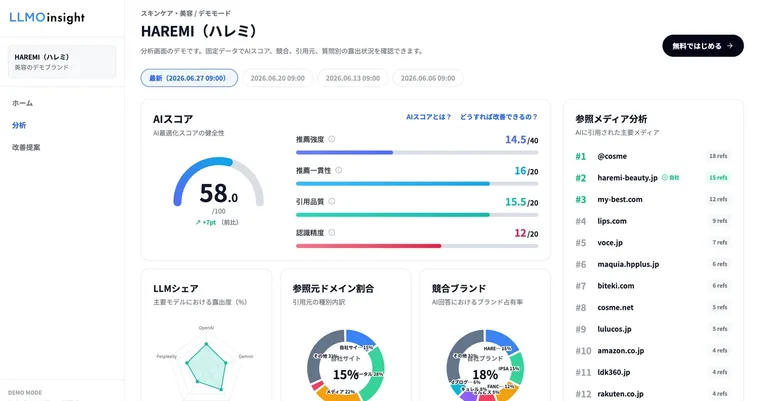
Cited-media analysis lists the domains an AI answer actually referenced, in order of how often they were referenced. Your own domain is labeled "own site," so you can see at a glance where your site ranks among the references and which third-party media are beating you. The outlets that show up here are precisely the ones to target for placements and interview coverage.
Line up competitors and pinpoint the questions you are losing
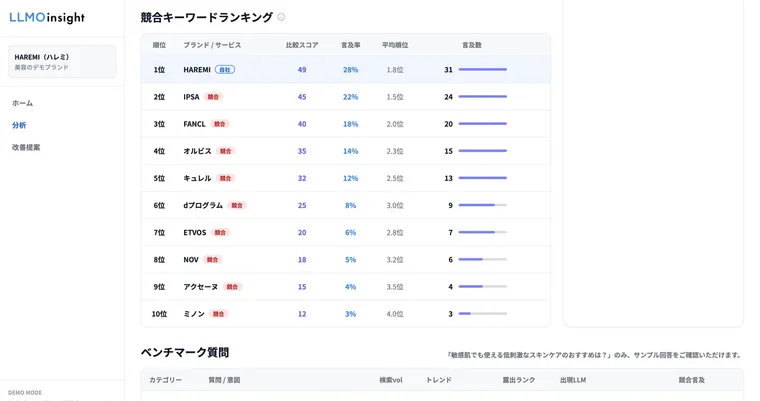
The competitor keyword ranking lines your brand up against competitors on four metrics: comparison score, mention rate, average position, and mention count. You can read even the mismatches between position and frequency — "we're No.1 but our mention rate is 28%," or "the No.2 competitor has a 22% mention rate yet an average position of 1.5, ahead of us."
Below that, benchmark questions lists, for each registered question, the category, intent, search volume, trend, exposure rank, the LLMs it appeared on, and how competitors are mentioned. Because you can name the questions you are losing, you can narrow the target of improvement from "the whole site" down to "this question."
The official note lays out an approach of splitting registered questions into three tiers: L1 (branded), L2 (comparison), and L3 (recommendation). The design is to measure not only questions containing your brand name, but comparison and problem-driven questions that never name you.
Because an AI's answer changes every time even for the same question, LLMOinsight lets you set the sampling count (how many times the same question is asked). Free allows 1 run, Standard up to 3, and Business up to 5; the more runs, the more stably you can grasp exposure rates and recommendation tendencies.
Improvement proposals that spell out the "next action"
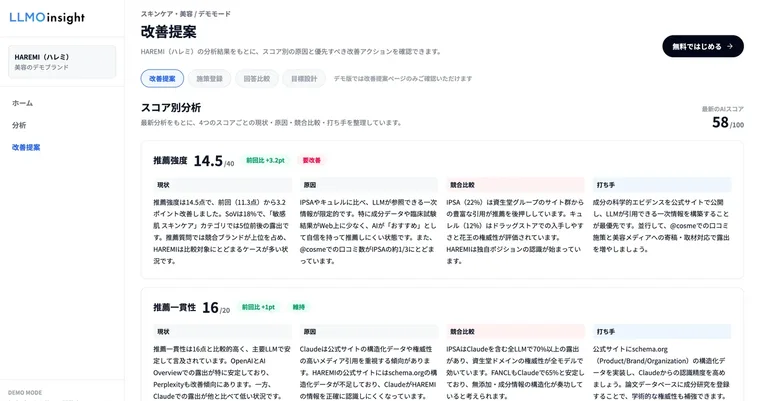
The improvement-proposal screen lays out current state, cause, competitor comparison, and next action in a single row for each of the four AI score components. Under a heading such as "recommendation strength 14.5 points (+3.2 pt vs. last time · needs work)," it explains in prose why the score is what it is, why competitors are stronger, and what to do about it.
For a cause such as "the primary information the LLM can reference is limited, and there is little ingredient data or clinical-trial results on the web," for example, it proposes at the level of "publish the evidence on your official site, and in parallel raise exposure through review campaigns and contributed articles and interviews in specialist media." Coming out in the shape of the task to start next, rather than an explanation of the score, is what separates it from measurement-centric tools.
Tabs on the same screen hold initiative logging (record the initiatives you ran and line them up against the score trend), answer comparison (put the current answer next to the ideal answer), and target-answer design (define up front the answer you are aiming for on each question).
Target-answer design is the feature that best expresses this product's thinking. Instead of "raise the mention rate," you first write the target answer — "for this question, this is how we want the AI to answer" — and then close the gap with reality. Combined with initiative logging, it lets you line up the moves you made against how the score moved afterward.
From exposure in AI answers through to traffic and conversions
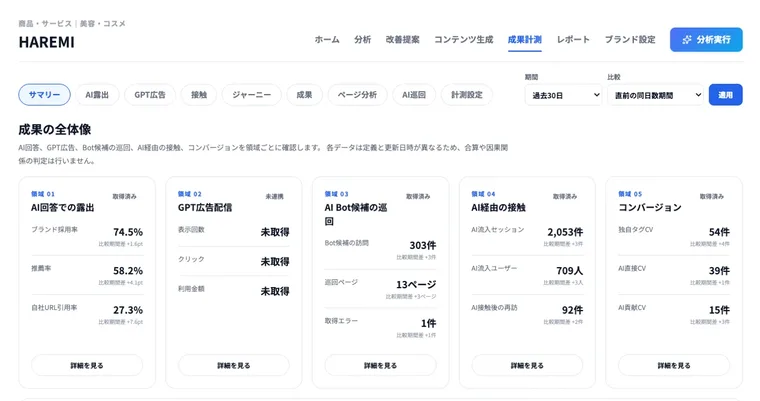
The outcome-measurement screen displays the effect of AI search optimization split into five areas: exposure in AI answers (brand adoption rate, recommendation rate, own-URL citation rate), GPT ad delivery, AI bot crawling (how many pages AI crawlers visited and whether fetch errors occurred), AI-driven contact (AI referral sessions, users, and return visits after contact), and conversions (proprietary-tag CV, AI-direct CV, AI-assisted CV).
The category worth noting is AI-assisted CV. It counts separately the conversions where someone came straight to the site from an AI answer and converted (direct CV) and those where someone converted later after contact with AI (assisted CV). Because the effect of AI search does not show up only as "arrive and buy on the spot," you end up undervaluing it without that split.
Beyond issuing its own tag, measurement can also pull in GA4 and ChatGPT ad results. The top of the screen states explicitly that "because each data source has a different definition and update time, we do not sum them or judge causality" — a design that avoids making the numbers look bigger than they are.
How to use
-
Create a free account
Sign up for the Free plan via "Start for free" on the official site. You can try your first analysis without registering a credit card.
-
Set up your brand and your questions
Register your brand information (company, brand, and product, along with their alternative names and spelling variants), then set the questions your customers are likely to ask AI as benchmark questions. The official recommendation is to build them across three tiers: branded (L1), comparison (L2), and recommendation (L3).
-
Run the analysis
Choose the models to use and the sampling count, then run the analysis. Free covers 6 questions with 1 sampling run on a fixed balanced model; Business goes up to 20 questions, 5 runs, and even lets you choose the latest models.
-
Check the AI score and the substance of the answers
Look at the overall score and the four-part breakdown, LLM share, citation-source domains, the competitor ranking, and the full text of the actual answers. Reading how you are being talked about and who is being cited first gets you closer to a next move than the score itself does.
-
Pick an initiative from the improvement proposals and log it
Decide which of the "next actions" in the improvement proposals to start on, and record it in initiative logging. Design a target answer where needed, and use content generation to turn your primary information into articles for the "ALTER" media outlet or your own site.
-
Re-measure and look at the difference
Analyze the same questions again and compare the score trend and changes in the answer text against the previous run. If you have installed the outcome-measurement tag, you can check AI-driven traffic and conversions on the same screen. The official FAQ notes that while tidying up the information on your own site and adding structured data are reflected relatively quickly, citations in third-party media and changes in brand recognition require continuous monitoring on the order of weeks to months.
Features
01Measurement and analysis
Visualizes how your company is treated inside AI answers, from both the metrics and the answer text.
- Precise AI scoring — Combines exposure volume, recommendation position, citation sources, and the gap with competitors, broken into four components: recommendation strength, recommendation consistency, citation quality, and recognition accuracy
- Competitor analysis — Displays competitors' exposure, recommendation position, and mention rate alongside a comparison score
- Citation-source analysis — Analyzes the domains and outlet types cited in AI answers to identify the sources that are trusted
- Answer comparison — Puts the current answer next to the ideal answer to organize how the AI perceives you
- Brand foundation — Organizes the relationships between company, brand, product, and alternative names, consolidating spelling variants so AI can understand you correctly
02Improvement and execution
Converts measurement results into tasks you can start on and content you can publish.
- Data-driven improvement proposals — Breaks down the factors behind a score drop and spells out which question, which LLM, and which citation source to start with
- Target-answer design — Designs the answer you are aiming for on each question, defining what "being recommended" looks like
- Initiative logging — Records the initiatives you ran so you can keep reviewing them against the score trend
- Content generation — Generates the structure and body of articles that AI is likely to cite, based on your primary information (Standard includes 2 per month, Business 8 per month)
- Multi-media distribution and ALTER placement — Adapts the generated content for multiple outlets, through to placement on the AI media outlet "ALTER"
03Outcome measurement and advertising
Confirms whether exposure in AI answers is turning into actual traffic and closed deals.
- Outcome measurement — Visualizes results from your own tag, GA4, and ChatGPT ads across five areas: exposure, advertising, bot crawling, contact, and conversions
- Journey and page analysis — Tracks page views, return visits, and the flow of behavior after arriving via AI
- ChatGPT ad management — Launched July 1, 2026. Manage campaigns, ad groups, and ads centrally within LLMOinsight, and use the analysis results to find the conversations worth targeting and the contexts you have not entered yet. It also proposes improvements to budget allocation, ad copy, and context hints
Pricing
There are four tiers, including the free Free plan. There is no minimum contract term, and you can cancel at any time (only the managed-operations service has a 6-month minimum). The following reflects the official pricing page as of August 2026, and all amounts are exclusive of tax.
| Plan | Monthly (excl. tax) | Brands | Questions | Sampling | Analysis models | Content generation | Members | Analysis history |
|---|---|---|---|---|---|---|---|---|
| Free | Free | 1 | 6 | 1 run | Balanced model (fixed) | None | 1 (no invites) | — |
| Standard | ¥9,800 | 1 | 10 | Up to 3 runs | Balanced model (fixed) | 2/month free | 1 (no invites) | 6 months |
| Business | ¥29,800 | 3 | 20 | Up to 5 runs | Latest models selectable | 8/month free | 20 | 2 years |
| Enterprise | Custom quote | Custom | Custom | Custom | Custom | Custom | Custom | Custom |
Free gives you a single analysis run, a single improvement proposal, and no outlet distribution — a slot for measuring your current state first. Standard and above make the number of analyses unlimited (usage-based billing), and outlet distribution expands to 3 outlets on Standard and all outlets on Business. Target design, outcome measurement, ChatGPT ad management, BYOK, and payment by bank transfer are offered on Business and above.
If you would rather not run it in-house, a separate managed-operations service is available.
| Menu | Price (excl. tax) | What's included | Terms |
|---|---|---|---|
| LLMO initial-design package | ¥100,000 one-time | Research into the market, competitors, question tendencies, and citation domains; a first measurement; design of benchmark questions and target answers; a plan for setting up the measurement environment; a 32-page brand strategy report; a Free account with initial setup | Can be used for the initial design alone |
| Expert-run LLMO managed operations | ¥600,000/month | Weekly AI answer measurement, a monthly report, expert research into answers, competitors, and citation status, support for initiatives such as site changes and content creation, and confirmation of AI-driven traffic and CV | 6-month minimum term |
| Case-study publication campaign | ¥300,000/month | The same support as the managed operations above | ¥100,000 initial-design fee required separately / 6-month minimum / cooperation in publishing the initiatives and results is mandatory |
How it differs from other LLMO/GEO tools
Japanese LLMO/GEO tools fall broadly into those centered on measurement, those that also carry improvement proposals, and those integrated with existing SEO and web analytics. LLMOinsight's distinguishing feature is that it leans toward putting measurement, improvement, content generation, outcome measurement, and ad operations on a single platform.
| Tool | Provider | Positioning | Monthly (excl. tax, per official listing) | Free tier |
|---|---|---|---|---|
| LLMOinsight | Letier (Japan) | Measurement + improvement + content generation + outcome measurement + ChatGPT ads | ¥9,800 / ¥29,800 | Free plan available |
| Genview | FID (Japan) | Improvement proposals from the gap with your ideal brand image (through structured data and llms.txt generation) | Base ¥60,000 + usage-based | 14-day free trial |
| DolphinX AIO | Media Reach (Japan) | Measurement + generation and management of improvement initiatives + GA4 integration | ¥30,000 / ¥50,000 / ¥100,000 | 14 days free (no card required) |
| Mieruca GEO | Faber Company (Japan) | Measurement + integration with an SEO tool and consulting | ¥49,800 / ¥99,800 (excl. tax) | Free trial available |
| AKARUMI | ipe (Japan) | Measurement across wide analysis axes (with bundled LLMO consulting) | Not disclosed (3 plans) | Free trial of all features |
On price alone, LLMOinsight, starting at ¥9,800/mo, sits near the bottom of the range among Japanese tools. That said, Standard covers 10 questions, 3 sampling runs, and 1 brand, and target design and outcome measurement start at Business. If you have many questions to track, or you want to measure conversions driven by AI, it is closer to reality to treat Business at ¥29,800/mo as the baseline.
A side-by-side comparison of 14 tools by supported AI, features, and pricing is collected in LLMO/GEO Optimization Tools Compared. For the terms themselves, see the explanations of LLMO, GEO, and AI Visibility.
Frequently asked questions (FAQ)
Q. Can I use it for free?
There is a Free plan, and you can try your first analysis without registering a credit card. It allows 1 brand, 6 questions, 1 sampling run, and 1 improvement proposal, and does not include content generation or outlet distribution. That is enough to grasp your current state, but tracking continuously requires Standard or above.
Q. Which AI does it support?
Five: ChatGPT, Gemini, Claude, Perplexity, and Google AI Overview. However, the models available and how freely you can choose them differ by plan: Free and Standard are fixed to the "balanced" model, and choosing the latest models becomes possible from Business.
Q. How long before AI answers change?
The official FAQ says it depends on the initiatives, the characteristics of the industry, and how quickly the sources AI references are updated. Tidying up the information on your own site and implementing structured data may be reflected relatively quickly, while citations in third-party media and changes in brand recognition require continuous monitoring on the order of weeks to months.
Q. What is the sampling count?
It is the setting for how many times the same question is put to the AI. Because an AI's answer changes every time even for the same question, a single result is not enough to judge whether you are showing up. Measuring multiple times and looking at the ratio lets you grasp exposure rates and recommendation tendencies stably. Free allows 1 run, Standard up to 3, and Business up to 5.
Q. Can I cancel partway through?
There is no minimum contract term; cancel by the prescribed method before your next renewal date and billing stops from the following cycle. Note, however, that refunds and pro-rated settlements after payment for customer-side reasons are not provided. Only the managed-operations service has a 6-month minimum term.
Q. What kind of company provides it?
Letier, Inc. Per its statement based on the Act on Specified Commercial Transactions, its address is 4-18 Minami-Aoyama, Minato-ku, Tokyo, its managing officer is Daiki Yamabe, and its contact is support@llmo-insight.jp (phone 03-6824-5507, weekdays 10:00–18:00). Alongside LLMOinsight, it operates "ALTER," a media outlet that distributes brands' primary information in a form AI can easily reference.
The information on this page is based on content published on the official site as of August 2026. Please check the official site for the latest specifications and pricing.