
KIBIT Eye
: How to use it, features, and the business problems it solves
What is KIBIT Eye?
KIBIT Eye is an email and chat audit tool from FRONTEO, Inc. (listed on the TSE Growth Market), built on its in-house AI engine "KIBIT". It reads data from email, Microsoft Teams, LINE WORKS, call-audio transcripts and more, detects signs of misconduct such as cartels, bribery, harassment and information leaks from context, and scores them so that people review the highest-risk items first. Models can be built from about 20 pieces of training data, and the reasons for each judgment are shown as highlights. Adopted by Mitsubishi UFJ Morgan Stanley Securities. Implementation starts from ¥3,000,000 (including PoC development, model building and evaluation; official page as of November 2026), with full operation priced by quote.
Business problems it solves

About "KIBIT Eye"
What is KIBIT Eye?
KIBIT Eye is an email and chat audit tool that uses AI to detect early signs of misconduct such as cartels, bribery and harassment in large volumes of email and chat data, provided by FRONTEO, Inc. (listed on the Tokyo Stock Exchange Growth Market). It runs on "KIBIT", an AI engine developed in-house by FRONTEO.
The AI scores risks that can only be read from context and that keyword searches miss, so that people review the highest-risk items first. Compared with traditional audits in which people read everything or spot-check a sample, it aims to reduce oversights while lightening the review workload.
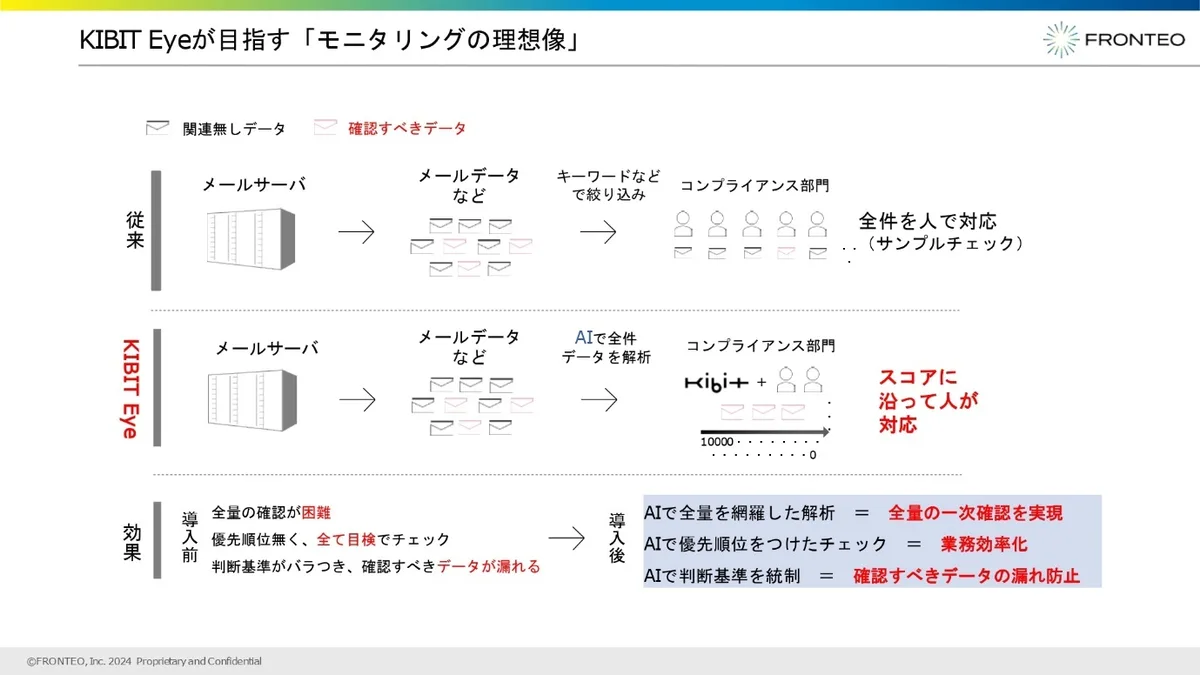
Source: KIBIT Eye official page and case study (Mitsubishi UFJ Morgan Stanley Securities) (same for the images below)
How to use it
The "implementation flow" on the official page has five phases. It is not a self-service tool; it is an enterprise deployment that starts with discussions with FRONTEO.
- Needs assessment FRONTEO interviews you about your current audit setup and issues, and defines the data volume, the scope of monitoring and the goals you want to achieve.
- Quotation A plan is selected, optional features and support scope are fixed, and the return on investment (ROI) is simulated.
- PoC (proof of concept) The AI's performance and the feasibility of the intended workflow are verified. According to the FAQ, many companies check accuracy with their real data and move to production once satisfied.
- System implementation, team setup and trial operation The workflow and monitoring conditions are finalized, a system environment reflecting them is built, and trial operation begins.
- Full operation and expansion A dedicated customer success contact supports operation, and the scope and targets of monitoring are expanded while scoring accuracy is reviewed.
In daily use, KIBIT Eye scores emails and chats, and reviewers check the high-score items first on screen and enter the monitoring results. Results can be downloaded from the same screen.
Features
01Finding risk from context
It judges risk from the content of documents rather than keyword matches.
- AI scoring — KIBIT analyzes not only send/receive dates, senders, recipients and subject lines but also the body and attachments (where text can be extracted), and ranks items for review
- Learning from little training data — The company says you can start with as few as 20 pieces of training data. Because models are built 100% from the customer's own data, the official FAQ states that hallucinations do not occur
- Strong in Japanese — The algorithm originates in Japanese-language fraud investigations and handles homophones, variant kana endings, abbreviations and internal jargon, and can learn company-specific expressions. It also handles emails that mix several languages
- Highlighting the reasons — For each item it shows which parts the AI judged suspicious
02Running the audit process
Reviewers and data scope can be narrowed to match internal rules.
- Filtering with advanced search — Combines scores and search to narrow down what people need to check by eye
- Review scope per reviewer — You can specify the range each reviewer can see
- Exclusions — Specific addresses or domains, such as whistleblowing or harassment reporting desks, can be excluded from monitoring
- Simple operation — After login it goes straight to the data review screen, where results can be entered and downloaded
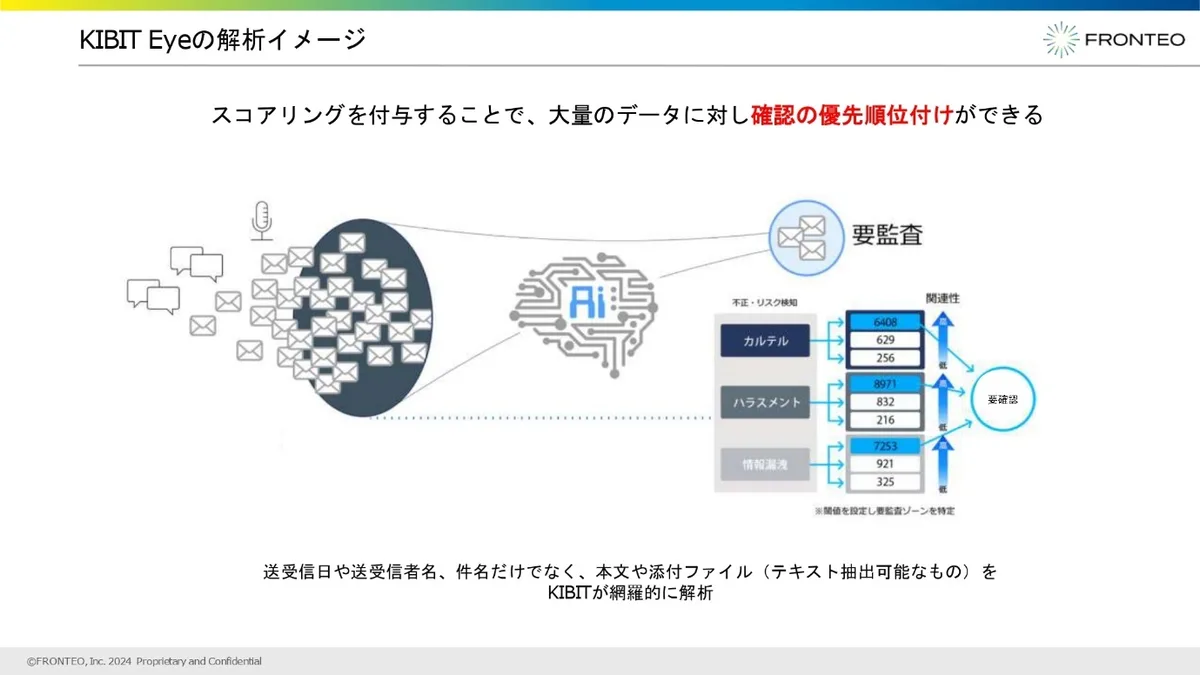
Data sources and risks it detects
The communication tools listed on the official page as having a track record with KIBIT Eye are email, call-audio transcripts, Microsoft Teams, LINE WORKS and Bloomberg.
Target risks include quality fraud, antitrust violations (cartels), bribery, harassment, information leaks, accounting fraud, the Pharmaceuticals and Medical Devices Act, and the Financial Instruments and Exchange Act. The FAQ says it can detect misconduct even when it is not written explicitly, citing a case in which it found data linked to a cartel among many invitations to after-work drinks. On phishing and scam emails written by generative AI, the answer is that detection may be possible with a model trained on emails created by generative AI.
Pricing
The official page shows a guide to the implementation cost.
| Item | Amount | Includes |
|---|---|---|
| KIBIT Eye implementation cost | From ¥3,000,000 | PoC development; model building and evaluation using recall rate and precision; report |
- Whether tax is included is not stated
- Plans are created according to each company's requirements, and amounts for full operation, such as monthly fees, are not published. They are set individually at the "quotation" phase of the implementation flow
- A test (PoC) using real data is available before production (official FAQ)
Track record and reputation
According to FRONTEO's official site, its compliance-support solutions are used by 100% of Japan's megabank groups and 80% of the five major securities companies, and solutions using KIBIT have been used by more than 300 companies.
As a KIBIT Eye case study, an interview with Mitsubishi UFJ Morgan Stanley Securities is published. The company's Corporate & Markets Compliance Department introduced KIBIT Eye several years ago and runs full-volume monitoring using AI screening, while adding models and expanding the tools it monitors.
"In the investment banking division, we score tens of thousands of emails a day with KIBIT Eye and review the high-scoring ones. Because KIBIT shows the basis for its scoring on screen, we prioritize based on that, and in the end a person makes the judgment." (Mitsubishi UFJ Morgan Stanley Securities Co., Ltd., Corporate & Markets Compliance Department; translated from Japanese)
The same interview also mentions, as an issue that emerged after adoption, the hope of being able to tune pre-designed models flexibly based on knowledge gained in operation.
Other products in the KIBIT family include KIBIT Knowledge Probe, used for monitoring negotiation records (Ashikaga Bank case), and KIBIT Libria, used to reduce accident and disaster risk (Gakunan Construction case).
What to check before adopting
Because it monitors internal email, the official FAQ advises stating the monitoring in your privacy policy and work rules to establish a legal basis, and discussing it with your legal department, a labor and social security attorney and outside counsel. It also notes that a growing number of companies notify employees in advance that monitoring is in place. The FAQ adds that no customer has decided disciplinary action based on AI results alone; all make decisions after human review and interviews.
Pros and cons
Pros
- AI that reads context can find risks that keyword searches struggle to catch
- Because every item is scored, you can move from spot checks to "first-pass review of everything, with people checking from the highest scores"
- The basis for each judgment is highlighted, making it easier for auditors to explain
- Models can be built from about 20 pieces of training data and handle Japanese phrasing and internal jargon
Cons
- Implementation starts at ¥3,000,000, and full operation is priced by quote
- Adoption goes through interviews, a quotation and a PoC, so there are several steps before use begins
- Since it handles employees' email, internal preparation such as updating work rules and the privacy policy is required
How it differs from other legal and compliance AI
KIBIT Eye audits internal communications to find signs of misconduct. It differs in data and purpose from AI that handles contracts or legal consultations.
| Item | KIBIT Eye | LegalForce | MNTSQ |
|---|---|---|---|
| Main purpose | Detecting signs of misconduct in email and chat | Detecting risks and omissions in contracts before signing | Unifying everything from legal consultations to post-signing contract management (CLM) |
| Data handled | Email, Teams, LINE WORKS, call-audio transcripts, etc. | Contracts | Contracts and legal consultations |
| Main users | Compliance and audit departments | Legal departments | Legal departments |
| Pricing | Implementation from ¥3,000,000 (official page) | Contact for pricing (individual quote) | Individual quote |
Details of other products are as of the dates checked on each product page.
For researching laws and case law, also compare Legalscape.
FAQ
Q. How much does KIBIT Eye cost? A. The official page lists an implementation cost "from ¥3,000,000" (PoC development, model building and evaluation, and a report). Plans are created to order, and full operation is priced by quote.
Q. Can I try it before adopting? A. A test (PoC) that checks accuracy with your real data is available. The FAQ says many companies confirm the accuracy and move to production once satisfied.
Q. Which tools' data can it audit? A. Email, call-audio transcripts, Microsoft Teams, LINE WORKS and Bloomberg are listed as having a track record.
Q. Does it handle Japanese abbreviations and internal jargon? A. Yes. Its algorithm originates in Japanese-language fraud investigations, handles homophones, variant kana endings, abbreviations and internal jargon, and can learn company-specific expressions.
Q. Are emails to the whistleblowing desk monitored too? A. Specific addresses or domains, such as reporting desks, can be excluded from monitoring.
Q. Do we need to notify employees before monitoring internal email? A. The official FAQ says monitoring should be stated in the privacy policy and work rules to establish a legal basis, and recommends discussing it with your legal department, a labor and social security attorney and outside counsel.
Q. Which company provides it? A. FRONTEO, Inc. (head office: Meisan Takahama Building, 2-12-23 Konan, Minato-ku, Tokyo; Tokyo Stock Exchange Growth Market, securities code 2158). It was founded in August 2003, and the official page cites more than 20 years of experience in fraud investigation (digital forensics).
The information on this page is based on what was published on the official website as of November 2026. Please check the official website for the latest specifications and pricing.