
LLMO/GEO Tools Compared: 12 Best Picks for 2026 (Domestic & Overseas) — by Supported AI, Features, and Pricing
A thorough comparison of LLMO/GEO optimization tools that help your brand get cited and recommended in AI search (ChatGPT, Gemini, and more), split into 8 Japanese tools (Genview, DolphinX AIO, AKARUMI, Mieruca GEO, SUPER ACT, User Insight, BringRitera, LLMOinsight) and 4 overseas tools (Profound, Peec AI, OtterlyAI, AthenaHQ), by supported AI, feature type, pricing (monthly / annual), and free tiers. Includes a 14-tool comparison table (adding the GEO-ready production tools Writesonic and Readdy), a three-line verdict, picks by goal, six axes for choosing, price ranges, free options, and an FAQ on LLMO vs. GEO and the metrics for measuring results — based on official listings as of August 2026.
"What's the best CRM?"—the place where users type that question is starting to shift from Google search to ChatGPT and Gemini. In this "AI search," where people receive an AI-summarized answer, a handful of services are recommended by name instead of ten links being lined up. Whether your own company's name makes it into that answer will shape awareness, comparison, and purchasing decisions from here on out.
The work of getting correctly cited and recommended in AI answers is called "LLMO (Large Language Model Optimization)," "GEO (Generative Engine Optimization)," or "AIO," and dedicated measurement and improvement tools have surged in number since the start of 2026. That said, even within the single label "LLMO tool," the scope varies widely: some only measure mention rates, some also handle the improvement work, and some are integrated with SEO and web analytics. Get this distinction wrong and you can easily end up, even after signing a contract, in a state of "I can see the numbers, but I don't know what to do next."
In this article, we do a cross-comparison of the 12 major LLMO/GEO optimization tools actually in use in Japan and abroad (9 Japanese, 4 overseas), by supported AI, feature type, and pricing, and lay out how to choose without regret along with options suited to your scale and goals. The comparison table also includes two GEO-ready tools that support you from the "production side"—building content and sites that AI is likely to cite (Writesonic and Readdy)—so that all 15 tools can be compared at a glance in a single table. Pricing, supported AI, and free tiers are based on what each official site stated as of August 2026.
The verdict | In three lines first
Individuals and SMBs who first want to learn, at low cost, how their company appears to AI should start with BringRitera, which has a free plan, OtterlyAI from $29/mo, or SUPER ACT at ¥15,000/mo. With a free tier or roughly ¥10,000–20,000 a month, you can begin measuring your mention rate across the major AI today.
Mid-sized to large companies that want to run "measure → improve → verify" in-house, in Japanese should look at DolphinX AIO, which goes as far as generating improvement proposals and integrating with GA4, or Mieruca GEO and User Insight, which can be run as one with your existing SEO and web analytics. They come with domestic support and a track record from listed companies, which also makes internal approval easier.
Companies whose main battleground is English-speaking markets, or that have enterprise requirements such as multi-engine coverage, SSO, or SOC 2 should look at Profound, AthenaHQ, and Peec AI. On top of measuring 8–9 engines, they offer execution agents and even misinformation (hallucination) detection.
If in doubt, the sequence that avoids regret is to first measure "how your company appears right now" on a free tier or trial, and then decide. The detailed reasoning and what each tool contains are explained below.
LLMO/GEO optimization tool comparison list [15 tools]
First, the big picture. We've lined up 15 tools—the 9 Japanese and 4 overseas major tools, plus 2 GEO-ready production tools—by provider, supported AI, feature type, pricing, free tier, and Japanese-language support. Everything is per the official statements as of August 2026; pricing separates the monthly price on a month-to-month contract from the per-month equivalent when billed annually (annual contract). Where the official site lists no amount, we've marked it "Not disclosed." Japanese tools are marked as excl. tax or tax incl.; overseas tools are in US dollars.
| Tool | Provider (country) | Supported AI | Feature type | Monthly (month-to-month) | Annual billing (per month) | Free tier / trial | Japanese support | Last checked |
|---|---|---|---|---|---|---|---|---|
| Mieruca GEO | Faber Company (Japan, listed on TSE Standard) | ChatGPT, Gemini, AI Mode, AI Overviews | Measurement + SEO integration (Mieruca SEO, bundled consulting) | Single site ¥49,800 / multiple sites ¥99,800 (excl. tax, separate setup fee) | Not disclosed | Free trial available (duration undisclosed), no free plan | Yes | 2026/8/18 |
| User Insight | User Local (Japan, listed on TSE Prime) | ChatGPT, Gemini, Claude, Grok, Perplexity + AI Overviews | Measurement + improvement reports + web analytics integration | Not disclosed (pageview-based, quote required) | Not disclosed | Not stated | Yes | 2026/8/18 |
| AKARUMI | ipe (Japan) | ChatGPT, Gemini, AI Overviews, Perplexity, Claude (varies by plan) | Measurement (+ bundled LLMO consulting) | Not disclosed (3 plans—Light / Standard / Expert—contact for pricing) | Not disclosed | Free trial available (all features) | Yes | 2026/8/18 |
| DolphinX AIO | Media Reach (Japan) | ChatGPT, Gemini, Claude, Perplexity, AI Overviews, AI Mode, Copilot (up to 7; daily measurement covers 4 as standard) | Measurement + generation and management of improvement initiatives + GA4 integration | Light ¥30,000 / Pro ¥50,000 / Business ¥100,000 (excl. tax, no setup fee) | ¥27,000 / ¥45,000 / ¥85,000 (12-month contract) | 14-day free trial (no card required) | Yes | 2026/8/18 |
| SUPER ACT | Platta (Japan) | ChatGPT, Gemini, Claude, Grok, Perplexity | Measurement + initiative management (checklists) | Standard ¥15,000 (excl. tax) + additional measurement slot ¥6,800 | Not disclosed | Not stated | Yes | 2026/8/18 |
| BringRitera | BringFlower (Japan) | ChatGPT, Gemini, Claude, Perplexity, AI Overviews, AI Mode | Measurement + AI writing and rank tracking (SEO integration) | From ¥3,300 (tax incl., Standard; Light is ¥550) | From ¥2,970 (tax incl.; Light is ¥495) | Free plan available (no card required) | Yes | 2026/8/18 |
| Genview | FID (Japan) | ChatGPT, Gemini (standard) + Claude, Perplexity, Grok (add-ons) | Measurement + improvement proposals (through structured data and llms.txt generation) | Base ¥60,000 (excl. tax) + usage-based (additional AI ¥20,000 / query ¥2,000, etc.) | Not disclosed | 14-day free trial | Yes | 2026/8/18 |
| LLMOinsight | Letier (Japan) | ChatGPT, Gemini, Claude, Perplexity, AI Overview (model selection on Business and above) | Measurement + improvement proposals + content generation + outcome measurement + ChatGPT ad management | Standard ¥9,800 / Business ¥29,800 (excl. tax; analysis is usage-based) | Not disclosed | Free plan available (Free, no card required; 6 questions, 1 run only) | Yes | 2026/8/27 |
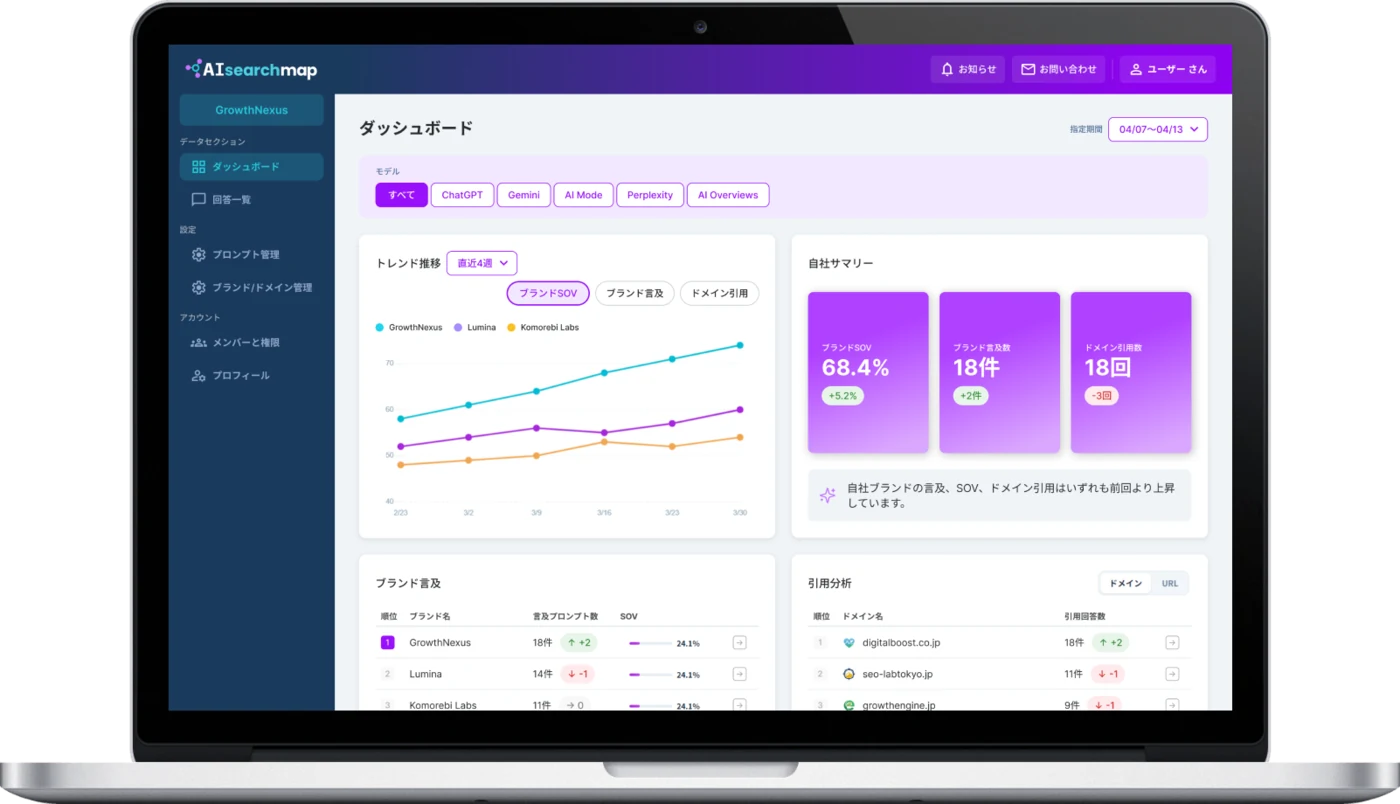
| AIsearchmap | CINC (Japan, listed on TSE Growth) | ChatGPT, Gemini, Perplexity, AI Mode, AI Overviews (ChatGPT only on the free plan) | Measurement (share of voice, cited domains) | Enterprise from ¥50,000 (quoted individually) | Not disclosed | Free plan (all features, ChatGPT only, 25 prompts) | Yes | 2026/9/3 |
| Profound | Profound (US) | ChatGPT, Perplexity, Gemini, Grok, Copilot, DeepSeek, AI Overviews, AI Mode, Claude (9; Starter gets 1, Growth gets 3) | Measurement + execution agent (full-stack) | Starter $99 / Growth $399 / Enterprise custom | $82.50 / $332.50 | Free trial on Growth, no free plan | No (English UI) | 2026/8/18 |
| OtterlyAI | OtterlyAI GmbH (Austria) | ChatGPT, AI Overviews, Perplexity, Copilot (4 standard) + Claude, AI Mode, Gemini (add-ons) | Measurement + GEO audit and improvement proposals | Lite $29 / Standard $189 / Premium $489 / Enterprise from $1,000 | $25 / $160 / $422 | 7-day free trial (no card required), free GEO tools available | No (English UI) | 2026/8/18 |
| Peec AI | Peec AI GmbH (Germany) | Choose 3 from ChatGPT, AI Mode, AI Overviews, Copilot, Perplexity, Gemini (up to 11 on Enterprise) | Measurement (Visibility, Position, Sentiment) | Starter $95 / Pro $245 / Advanced $495 / Enterprise custom | $80 / $205 / $420 | Free trial available | No (English UI) | 2026/8/18 |
| AthenaHQ | AthenaHQ (US) | ChatGPT, Perplexity, Gemini, AI Overviews, AI Mode, Claude, Copilot, Grok (free tier covers 5) | Measurement + improvement proposals + misinformation detection + copilot | Essential free / Starter $295 / Enterprise custom | Starter $245 | Free plan available ($25 in credits) | No (English UI) | 2026/8/18 |
| Writesonic | Writesonic (US) | ChatGPT, Gemini, AI Overviews (10 platforms on Enterprise) | Measurement + AI article generation and site audits (SEO integration) | Not disclosed (only annual-equivalent prices shown; estimated from the stated savings: $99 / $249 / $499) | Starter $79 / Basic $199 / Growth $399 | Free trial (no card required) | No (English UI) | 2026/8/18 |
| Readdy | INTERACTIVE LINK PTE. LTD. (Singapore) | No measurement (generates sites that are easy for AI to read) | Site building (GEO Optimization / AI Readable Sites) | Starter $25 / Pro $40 / Agency $120 / Agency Pro $199 / Ultimate $1,299 | $15 / $24 / $72 / $119 / $779 | Free plan available (250 credits/mo, 2 projects) | Yes (official site has a Japanese version) | 2026/8/18 |
"Feature type" indicates whether the tool centers on measuring mentions and citations (Measurement), also handles generating improvement ideas and managing initiatives (through to improvement), or is integrated with SEO, web analytics, or article production (SEO integration). "No" under Japanese support for overseas tools means the UI and official site are English-only; measuring with Japanese-language prompts is possible on most of them.
What are LLMO/GEO optimization tools?
LLMO/GEO optimization tools are tools that measure how much, and in what way, your brand is mentioned and cited in AI search such as ChatGPT, Gemini, Perplexity, and Google AI Overviews, and connect that to improvement. What they have in common is the flow of (1) continuously collecting AI answers to anticipated questions (prompts), (2) visualizing your own and competitors' mention rates and citation sources, and (3) showing what to fix to become more likely to be cited.
Whereas SEO tracks "ranking in search results," LLMO/GEO tracks "whether your name appears in AI answers together with its supporting evidence." The backdrop is that, as zero-click behavior reduces site traffic itself, the question becomes whether you can move to the side that gets recommended by AI. The metrics measured here—"mention rate," "share of citations," and the like—are collectively called AI Visibility.
Register anticipated questions
Dozens to hundreds of questions your customers are likely to ask AI, such as "What's the best XX?" or "Compare XX"
Measure AI answers at fixed intervals
Collect answers daily from ChatGPT, Gemini, AI Overviews, and others. Record whether you're mentioned, your position, citation-source URLs, and sentiment
Compare against competitors
Line up mention rates and share of citations against competitors to identify which questions you're losing on and who is being cited
Improve and re-measure
Put conclusions first, add FAQs and structured data, get placed in external media, and so on, then confirm the effect through how the metrics move
Tools differ in "how far they go." They can be broadly grouped into those centered on measurement (01–03), those that also generate improvement ideas and manage initiatives (04), and those that build 03–04 into existing SEO or web analytics.
How to choose without regret | 6 decision axes
Just scanning the comparison table from top to bottom won't produce a deciding factor. If you decide your own side's conditions first and then return to the table, your candidates will naturally narrow to two or three.
Axis 1 | "Measurement only" or "through to improvement"
This is the first thing to decide. Do you just want to grasp your AI visibility in numbers, or do you also want proposals on what to fix, and even content generation? Some tools center on measurement (Peec AI, SUPER ACT, AKARUMI, and others), while others go as far as generating improvement ideas and managing initiatives (DolphinX AIO, Genview, Profound, AthenaHQ, and others). The fewer people you have running operations, the better the latter "gives you even the next move" type suits you.
Axis 2 | Range of supported AI
ChatGPT, Gemini, and Google AI Overviews are essentially must-haves, but whether you also want to cover Claude, Perplexity, Grok, AI Mode, and Copilot depends on your business. Overseas players are broad, at 8–9 engines, while Japanese tools tend to focus on the main 4–6. One thing to watch: on many tools, the number of "supported AI" differs from the number of "AI you can measure on your plan" (Profound's Starter covers ChatGPT only, Peec AI has you pick 3, OtterlyAI treats Claude and Gemini as add-ons, and on Genview everything from Claude onward is an add-on too). Prioritize the AI your own customers actually use, and check that those AI are included in the plan you're signing up for.
Axis 3 | Mentions or citations—which do you look at?
"Your brand name coming up in the answer (mention)" and "your own site being referenced as supporting evidence (citation)" are two different things. The former is closer to awareness, the latter closer to content SEO, and whether you can track both separately affects how easy improvement becomes. Tools that even rank citation sources make it easier to act, because you can see where you should aim to get placed.
Axis 4 | Integration with existing operations
If you already run SEO, GA4, and web analytics, tools that connect seamlessly with them have the advantage. Mieruca GEO integrates with Mieruca SEO, User Insight with web analytics, and DolphinX AIO, Genview, and AthenaHQ with GA4, letting you add AI search optimization while keeping your existing setup. If you want article production integrated as well, BringRitera and Writesonic are candidates. This axis is most effective for organizations that don't want to add more tools.
Axis 5 | Language and support
Japanese tools offer a strong Japanese-language UI, domestic support, and hands-on guidance, while overseas players have an English UI but richer engine coverage and enterprise features (SSO, multi-region, audit logs). Measuring with Japanese-language prompts is possible on overseas tools too, but if you want analysis of citation sources aimed at the Japanese market (domestic media and comparison sites), or want to consult on initiatives in Japanese, a Japanese tool is the sure choice.
Axis 6 | Pricing structure and contract terms
Look beyond the monthly figure to the billing unit (number of prompts, credits, pageview-based), minimum contract term, setup fee, and annual-billing discount to avoid surprises after adoption. For example, Mieruca GEO has a separate setup fee, DolphinX AIO requires a contract of 6 months or more, Genview is a base fee plus usage-based charges, and AthenaHQ is credit-based (1 credit = 1 AI answer). The prompt cap translates directly into "how many questions you can track daily," so count the questions you want to track first. The safe path is to first check "how you currently appear" on a free tier or trial before proceeding to a full contract.
[Japan] 9 tools chosen for Japanese UI and domestic support
The strength of Japanese tools is that you can operate in Japanese, with abundant onboarding support and domestic case studies. We introduce them roughly in order of track record and name recognition.
Mieruca GEO | From SEO leader Mieruca, visualizes mentions/citations by AI model
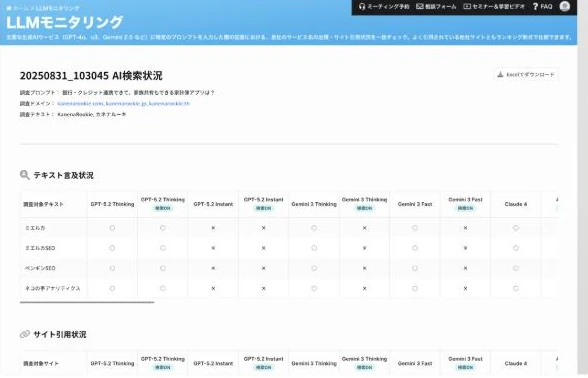
This is the GEO/LLMO optimization tool from Faber Company (listed on the TSE Standard market), maker of "Mieruca SEO," an SEO tool used by 1,700 companies. Its core "LLM Monitoring" visualizes your own and competitors' text mention status and site citation status by AI model, in an O/X matrix for specified prompts.
Its strength is that you can operate it seamlessly alongside your existing SEO assets. You can track both search and AI search with the same setup, and it also offers bundled GEO/AIO/LLMO consulting that puts the analysis data to work. Being provided by a listed company, it's also an option that's easy to get approved internally.
User Insight (AIO/LLMO optimization) | Integrated with web analytics, AIO features at no extra cost
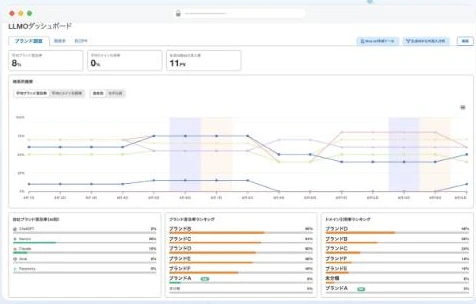
This is a comprehensive digital marketing tool from User Local (listed on the TSE Prime market), which builds AIO/LLMO optimization features on top of web analytics. From the "LLMO Dashboard" that lists citation and coverage rates across 5 major AI, it provides an optimization report that surfaces improvement points from a URL input, and even llms.txt generation.
Its biggest feature is that you can track not just the "quantity" of citations but the "quality"—the behavior of users who arrived via AI. What's more, the AIO/LLMO features come at no extra cost, and SEO and web engagement features are included in the same plan. It's used by over 1,000 companies including Fujitsu and SUBARU.
 AKARUMI | Wide analysis axes that turn AI search into a "management metric"
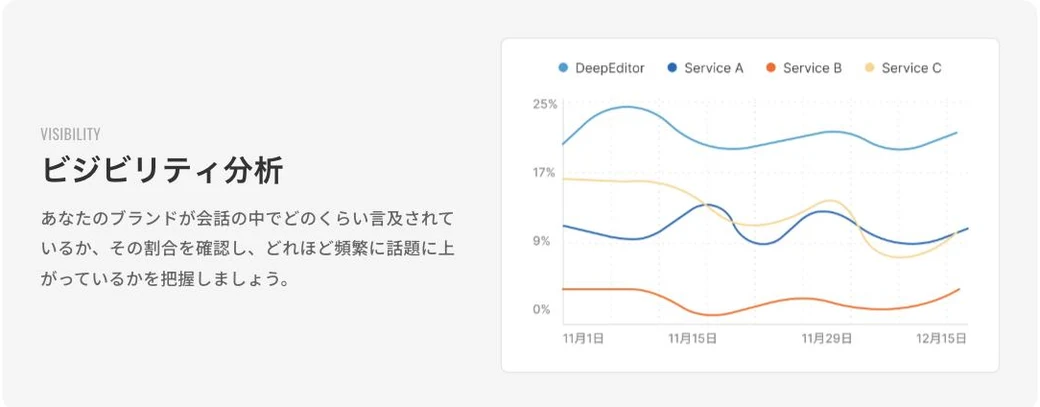
This is the GEO/LLMO analytics platform from ipe, which has a track record of SEO/LLMO consulting engagements with over 500 companies. It lets you analyze AI perception from multiple angles—visibility (share of mentions), positioning (mention ranking), sources (citation origins), and even AI crawler access status.
Under the banner of "turning the black box of AI search into a management metric," its hallmark is letting you grasp your standing with data rather than intuition. It also offers bundled consulting for strategy design and execution support based on the analysis data, staying alongside you beyond mere visualization. Supported AI varies by plan: Light covers ChatGPT and Gemini, while Expert unlocks all 5 engines.
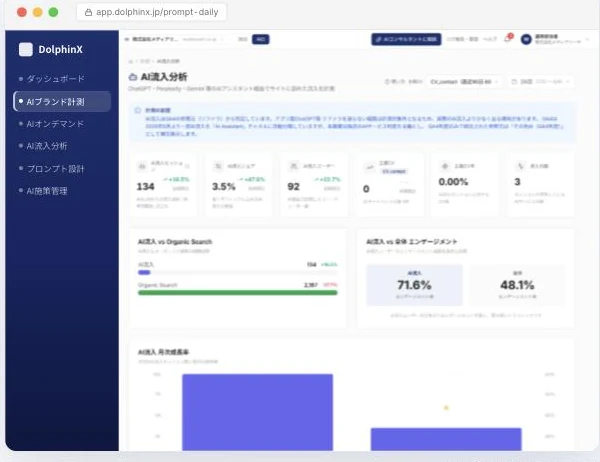
 DolphinX AIO | Analyzes the content of answers, through to generating action plans
This Japanese tool from Media Reach analyzes not just whether you appeared but the full text of AI answers, the reasoning process, and citation sources (auto-classified into 16 categories), pinpointing "why you aren't being chosen" from the inside. It's designed to capture the probabilistically varying nature of AI answers as tendencies—for example, throwing the same question 10 times in a row to measure the probability of exposure.
Its distinguishing point is that it "doesn't stop at measuring": an AI consultant chat presents improvement ideas on the spot, and you can manage them as initiatives and even judge their effectiveness. GA4 integration also lets you visualize AI-driven traffic and conversions.
 SUPER ACT | Overall score and "context analysis" that break down the reasons you're chosen
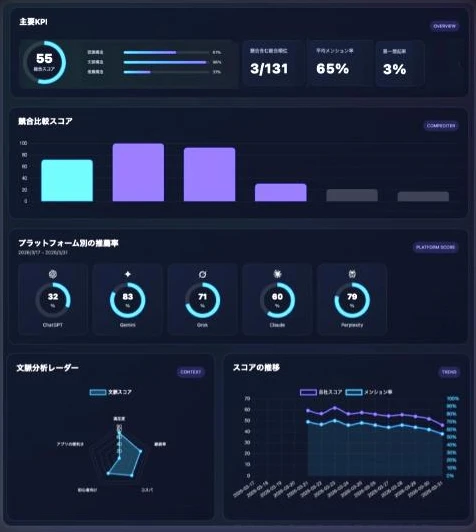
This LLMO analytics tool from Platta visualizes mention rate, sentiment, and recommendation rate as an overall score across 5 major AI. It also supports citation-source URL rankings and cross-analysis by brand/product.
Its features are context analysis that breaks down "the reasons AI chooses you," and initiative management via systematized checklists. It has a track record of adoption by major and well-known brands such as Marutomo and Nifty Lifestyle. At ¥15,000/mo it's the most affordable of the Japanese tools, and that includes measurement across 5 AI and a team of up to 5 people.
 BringRitera | AI writing and LLMO measurement in one, with a free plan
This is BringFlower's "SEO/LLMO platform," distinguished by integrating article creation and measurement. While its core "LLMO Compass" measures trends in mention rate, citation sources, and branded search, a single tool also covers search-ranking and AI Overviews measurement (from ¥0.38 per keyword), AI writing, and image generation.
It has a free plan, and even the paid tier starts at ¥2,970/mo (tax incl., billed annually)—among the lowest around. Highly rated too—No.1 in satisfaction on ITreview user reviews, and the only SEO-category pick among Nikkei's "55 AI startups expected to shine"—it suits individuals through SMBs who want to start from article production to measurement at low cost.

 Genview | Ideal-image-based improvement that starts from "how you want to be seen"
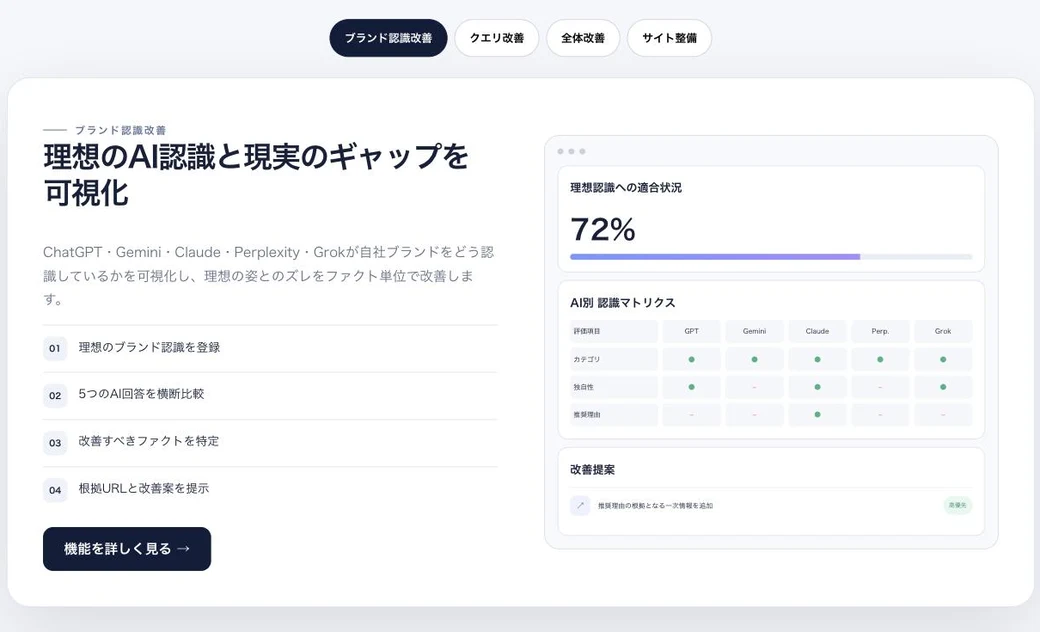
This is the GEO platform officially released in August 2026 by FID, which has handled CRM and marketing support for over 15 years (30 companies adopted it early in the beta). Its feature is starting not from "how you're seen now" but from "how you want to be seen." It first defines your ideal brand perception, then presents improvement proposals (down to code, copy, and alternatives) that close the gap with AI answers on a fact-by-fact basis.
Across three axes—brand-perception improvement, query improvement, and site preparation (structured data, automatic llms.txt generation)—it goes seamlessly from measurement to concrete measures rather than stopping at measurement. It's a relatively new service, but it suits teams that want to work backward from an ideal image.
 LLMOinsight | Measurement, improvement, content generation, and ChatGPT ads on one screen
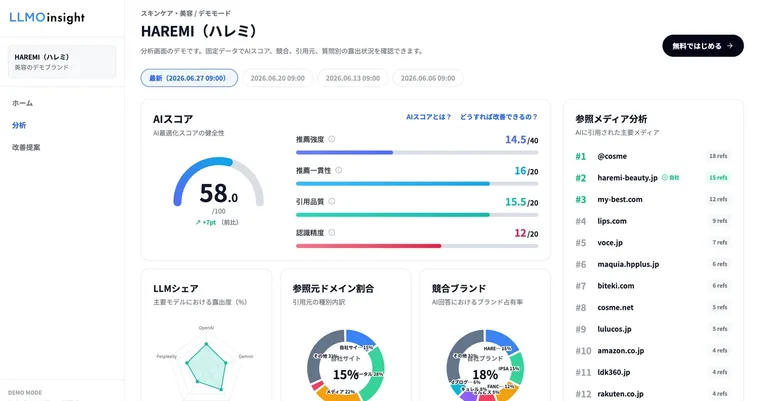
This is an AI search optimization platform from Letier, Inc. The company states that it was the first LLMO analytics tool to launch in Japan (noted as being based on the press releases of the various vendors). Over 15,000 companies have used it cumulatively, with over 69 million citation records accumulated (both as of August 1, 2026; cumulative figures that include former TierGEO users and companies coming in through agencies).
Its distinguishing feature is that it breaks the AI score down into a full breakdown out of 100. Split into recommendation strength (40 points), recommendation consistency (20), citation quality (20), and recognition accuracy (20), it separates "we aren't showing up" into whether your position is low, whether it fluctuates by model, whether the quality of your citation sources is weak, or whether you are being recognized incorrectly. Improvement proposals take the form of current state, cause, competitor comparison, and next action lined up side by side for each score, arriving at the granularity of the task to start on next.
Content generation, measurement of AI-driven traffic and CV (counting AI-direct CV separately from AI-assisted CV), and ChatGPT ad management launched in July 2026 all sit on the same screen — which is what sets it apart from other Japanese tools.
 AIsearchmap | Share of voice and citation sources, with every feature free
An AI-search monitoring tool from CINC Inc. (listed on the TSE Growth market), the company behind the SEO tool Keywordmap. It was released free of charge in May 2026, and an enterprise plan for companies followed in July.
The metric at its centre is SOV (share of voice): how many times the AI named you versus your competitors, expressed as a share. The dashboard leads with brand SOV, brand mentions and domain citations, each with a week-on-week delta, and below sit two rankings — the brands named most and the domains cited most. When you are absent, it tells you who was named instead and which sites the answer rested on.
What stands out is that the free plan carries every feature. It is limited to ChatGPT and 25 prompts, but you can register up to 20 competitors and export to CSV. Prompts are generated from nothing more than your company name and domain, so no measurement design is required. Help with acting on the findings is arranged separately; the tool itself stays focused on measurement.
[Overseas] 4 tools for multi-engine, enterprise use
Overseas players have an English UI but lead in engine breadth and enterprise features. They become candidates if you have English-speaking markets or large-scale operations in view.
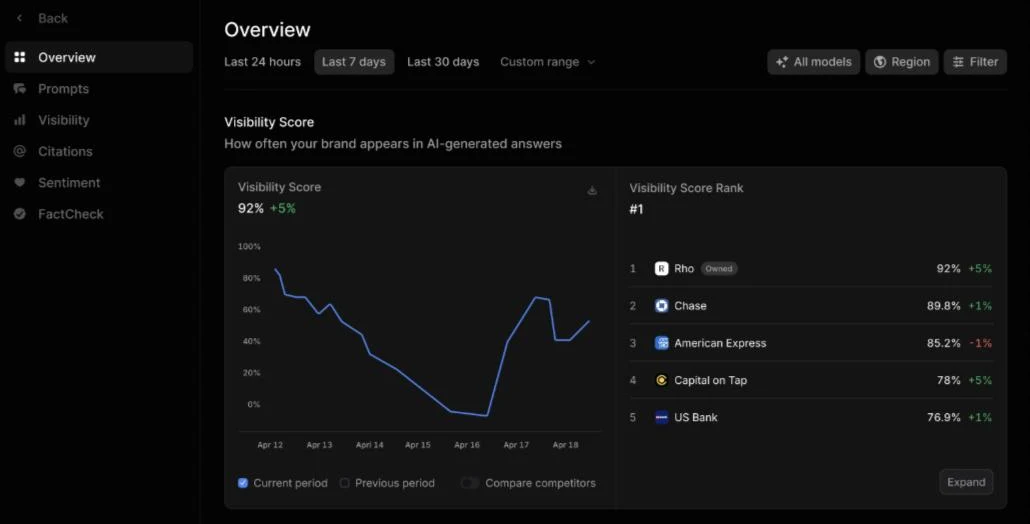
 Profound | The category leader in AI search visibility, executing via agents
This is a full-stack platform from the US, regarded as the category leader among AI search visibility tools. On top of "Answer Engine Insights," which measures exposure, citations, and sentiment, it includes an agent that autonomously executes AEO-optimized content, letting you run everything from demand sensing to measurement, execution, and verification in a single loop.
At 9 engines its coverage is the broadest, and it meets enterprise requirements such as SOC 2 and SSO. Note, however, that the range you can measure varies by plan: Starter covers ChatGPT only, and Growth covers 3 engines. The UI is in English, making it suited to teams that want full-scale operations centered on English-speaking markets.
 OtterlyAI | Affordability from $29/mo, plus the precision to track citation links
This is an AI search monitoring & optimization tool from Austria, used by over 30,000 marketers and selected for Gartner's "Cool Vendors in AI for Marketing 2025." At from $29/mo, it's among the cheapest of the overseas players, yet because it analyzes actual AI search rather than just LLM output, it can track even the citation links attached to answers.
Prompt research, content audits (predicted scores for citation potential), and GEO optimization proposals are all in one. 4 engines are standard, with Claude, AI Mode, and Gemini as add-ons. It serves as an entry point when you want to start affordably yet still keep tabs on your citation status.
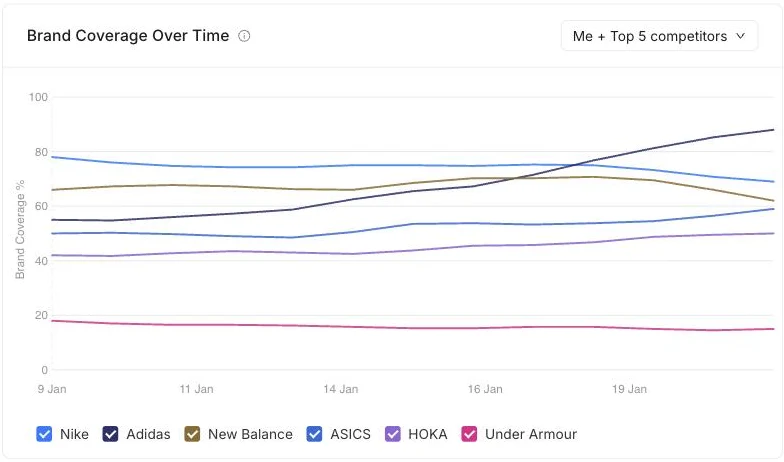
 Peec AI | Simple, with unlimited users on every plan
This is "AI search analytics for marketing teams" from Germany, used by over 3,000 brands and agencies including Zalando and n8n. Narrowing to three metrics—Visibility, Position, and Sentiment—its design of running "set up → visualize → act" simply has won support.
Since users are unlimited on every plan, its strength is that teams and agencies can use it without worrying about headcount. It also supports Looker Studio, API, and MCP integration. On self-serve plans you choose 3 of the 6 supported models, while Enterprise expands to up to 11 models.
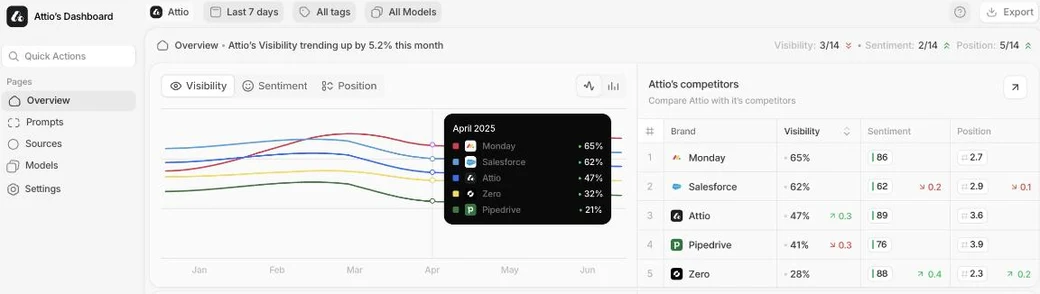
 AthenaHQ | A command center with hallucination detection and a copilot
This is an AEO/GEO command center from the US, backed by Y Combinator, featured in Forbes/WSJ, and used by teams including Fortune 500 companies. It not only visualizes SoV, citation sources, and mention rates across 8 AI, it also detects where AI misunderstands or hallucinates about your company and presents a prescription (AthenaHQ Content) to increase your citations.
It's rich in enterprise-operation features—an agent-style copilot "Ask Athena" that answers questions based on your own AEO/GEO data, plus SOC 2 Type 2, SSO, and multilingual support. You can try it from a free tier (5 models).
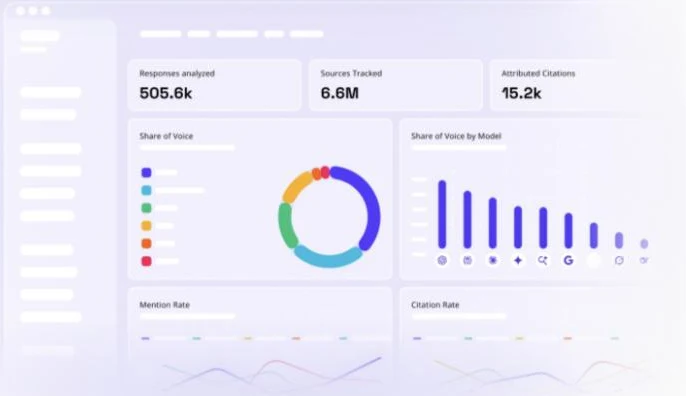
[Related] 2 tools that approach GEO from the "production side"
The 12 tools so far were on the side that measures "how you appear to AI." On the other hand, tools that build the very content and sites that AI is likely to cite are also an option as an entry point to optimization. Here's a supplement on the two included in the comparison table.
 Writesonic | An "AI search growth engine" that combines measurement with AI article generation and site audits
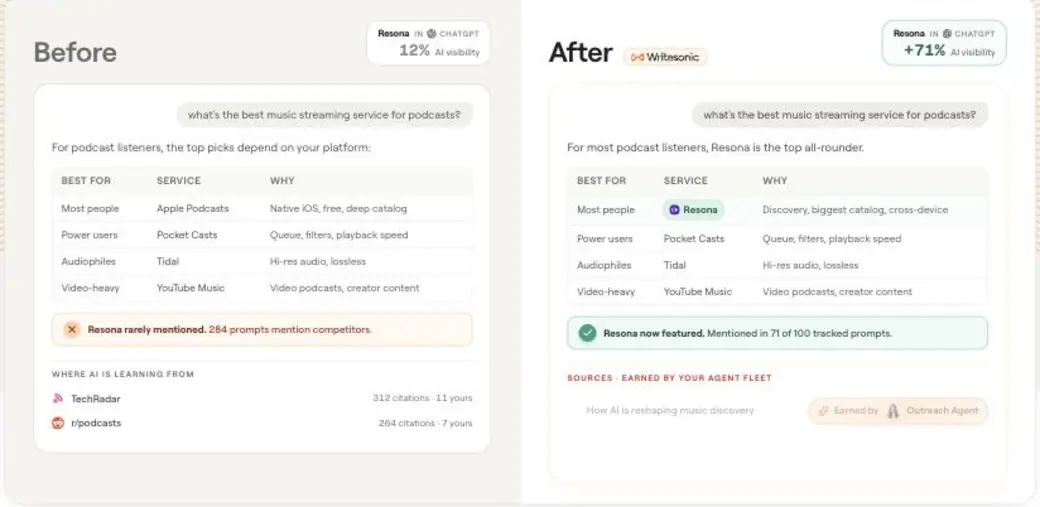
This US-based tool has been reborn from its former AI writing tool (Chatsonic) into a GEO/SEO platform. It pinpoints which prompts get competitors recommended on ChatGPT, Gemini, and AI Overviews, and its distinguishing point is that you can run AI article generation, site audits, and improvement via an AI agent (Action Center) from the same screen. It's used by more than 10,000 marketing teams worldwide.
The pricing page shows only the annual-equivalent monthly prices (Starter $79 / Basic $199 / Growth $399); the month-to-month prices are not disclosed. The UI is in English, and there is no Japanese site.
 Readdy | A site builder that generates sites that are easy for AI to read
This is an AI site builder that lets you generate, edit, and publish websites just by giving written instructions, and on top of the usual SEO features it comes with AI-search-oriented features called "GEO Optimization" and "AI Readable Sites". Its role is to assemble sites in a structure that generative AI can easily summarize and cite; it has no function for measuring how AI cited you after publishing (pair it with the tools above for measurement).
The official site has a Japanese version, and you can try it from the free plan (250 credits/mo, 2 projects). It is operated by INTERACTIVE LINK PTE. LTD., a Singapore company.

Recommendations by goal
You want improvement ideas, not just measurement
- DolphinX AIO — improvement-idea generation + initiative management + GA4
- Genview — improvement proposals from the gap with your ideal image
- Profound / AthenaHQ — execution agents, misinformation detection
- LLMOinsight — current state, cause, and next action presented by score
Integrated with SEO, web analytics, and article production
- Mieruca GEO — seamless with Mieruca SEO
- User Insight — integrated with web analytics, no extra cost
- BringRitera / Writesonic — article production and measurement in one
You want to try at low cost first
- BringRitera — free plan to ¥2,970/mo
- OtterlyAI — $29/mo, 7-day free trial
- SUPER ACT — 5 AI measured for ¥15,000/mo
- AthenaHQ Essential — 5 models on the free tier
- LLMOinsight — free tier available, Standard at ¥9,800/mo
Multi-engine, enterprise
- Profound — 9 engines, SSO/SOC 2
- AthenaHQ — 8 models, SOC 2 Type 2, multilingual
- Peec AI — unlimited users, up to 11 models on Enterprise
Price ranges | How much per month does it take to get started?
Arranging the official pricing of the 14 tools by price band gives the following (as of August 2026; overseas tools in US dollars, Japanese tools marked excl. tax or tax incl.).
| Price band (per month) | Applicable plans | Suitable scale |
|---|---|---|
| Free | BringRitera Free / AthenaHQ Essential ($25 in credits) / Readdy Free / LLMOinsight Free (6 questions, 1 run only) | Individuals, first grasping the current state |
| Up to ¥10,000 | BringRitera Standard ¥2,970 (tax incl., billed annually) / OtterlyAI Lite $29 / Writesonic Starter $79 (billed annually) / Peec AI Starter $95 / Profound Starter $99 / LLMOinsight Standard ¥9,800 (excl. tax) | Individuals to small teams |
| ¥10,000–50,000 | SUPER ACT ¥15,000 (excl. tax) / LLMOinsight Business ¥29,800 (excl. tax) / DolphinX AIO Light ¥30,000 (excl. tax) / OtterlyAI Standard $189 / Peec AI Pro $245 / AthenaHQ Starter $295 | Marketing departments at SMBs to mid-sized companies |
| ¥50,000–100,000 | Mieruca GEO single site ¥49,800 (excl. tax) / DolphinX AIO Pro ¥50,000 (excl. tax) / Genview Base ¥60,000 (excl. tax) / Profound Growth $399 / Writesonic Growth $399 / OtterlyAI Premium $489 / Peec AI Advanced $495 | Mid-sized to large companies, multiple brands |
| ¥100,000 and up / quote required | Mieruca GEO multiple sites ¥99,800 / DolphinX AIO Business ¥100,000 / User Insight (pageview-based) / AKARUMI (3 plans) / each vendor's Enterprise (OtterlyAI from $1,000) | Large companies, enterprise |
When comparing prices, look beyond the monthly figure and line up "how many prompts and how many engines that plan lets you track." Even within the same ¥10,000–50,000 band, there's a wide range: SUPER ACT covers 10 prompts, LLMOinsight Business 20 questions (up to 5 sampling runs), DolphinX AIO Light 20 daily, OtterlyAI Standard 100, and Peec AI Pro 150. The more questions you want to track, the more a higher tier or usage-based pricing (Genview, BringRitera) can end up cheaper. Because yen conversions shift with exchange rates, it's safest to compare overseas tools in dollars as-is.
Free tools and trials at a glance
If all you want is to confirm "how your company appears right now," the following free tiers are more than enough to get started.
- Free plans (no time limit) — BringRitera (Free plan, no card required), AthenaHQ (Essential, $25 in credits, 5 models), Readdy (Free, 250 credits/mo), LLMOinsight (Free, no card required — though analysis is a one-time run of 6 questions)
- Time-limited free trials — DolphinX AIO (14 days, no card required), Genview (14 days), OtterlyAI (7 days, no card required), Writesonic (no card required), Peec AI (duration undisclosed), Profound (Growth plan)
- Free trials by application — Mieruca GEO (apply via form, duration undisclosed), AKARUMI (all features can be tried)
- No free tier stated on the official page — User Insight (quote required), SUPER ACT
In addition, OtterlyAI publishes free GEO tools such as AI keyword research and AI Crawler Simulation. Ways to measure for free without a tool are summarized in the FAQ below.
Frequently asked questions (FAQ)
Q. What's the difference between LLMO and GEO?
They refer to almost the same effort; the difference is in naming. LLMO (Large Language Model Optimization) means "optimization to be correctly understood and mentioned by large language models," while GEO (Generative Engine Optimization) means "optimization to be cited and recommended by AI search that generates answers (generative engines)"; GEO is a term proposed in a 2023 paper by researchers at Princeton University and others. In Japan LLMO is the common label, while overseas GEO and AEO (Answer Engine Optimization) are more common, and every tool in this article covers this domain.
Q. What is AIO?
It's used with two meanings depending on context. One is "optimization to be cited in AI Overviews (AIO) (the AI-generated overview shown at the very top of Google search)"; the other is short for "AI Optimization," a general term for optimization aimed at AI overall, just like LLMO/GEO. In Japanese tools, "AIO optimization" is mostly used in the latter sense (which includes the former), and User Insight and DolphinX AIO carry AIO in their names.
Q. How can I measure for free?
Even without a tool, the following three steps give you a minimum grasp of the current state. (1) Write out 20–30 questions your customers are likely to ask AI, put the same questions to ChatGPT, Gemini, Perplexity, and Google AI Overviews, and record in a spreadsheet whether your company came up, in what position, and which citation-source URLs appeared (answers change every time, so repeat the same question several times and look at the ratio). (2) In GA4, filter sessions whose referrer includes chatgpt.com, perplexity.ai, gemini.google.com, and the like, and track AI-driven traffic and conversions. (3) Replace the same questions with automated measurement using the free plans listed above (BringRitera, AthenaHQ Essential) or a free trial. Manual measurement realistically tops out at about once a month, so if you plan to track continuously, moving to a tool early is the efficient route.
Q. What metrics measure effectiveness? What are "share of citations" and "mention rate"?
The effect of LLMO/GEO is measured with metrics collectively called AI Visibility (share of citations / mention rate). Mention rate is the proportion of your registered anticipated questions for which your brand name appeared in the AI's answer. Share of citations (Share of AI Voice / Share of Citations) is the proportion your company accounts for among the answer's citation-source links or all mentions, indicating your relative standing versus competitors. On top of these, the basic approach is to combine mention position (where in the list you appear), sentiment (how you're described), and AI-driven traffic and conversions (GA4), and compare the trends before and after your initiatives. Because AI answers vary probabilistically, judge by the trend of daily measurements rather than a single result.
Q. Should I choose a Japanese or an overseas tool?
If you value a Japanese UI, domestic support, and how you appear in the Japanese market (citation-source analysis of domestic media and comparison sites), Japanese tools are strong; if you value multi-engine coverage and enterprise features (SSO, multi-region), overseas tools are the front-runners. If you want unified operation with SEO and web analytics, tools that connect seamlessly with existing assets—like Mieruca GEO and User Insight—are efficient. Measuring with Japanese-language prompts is possible on overseas tools too.
Q. Where should I start?
(1) Write out 20–30 anticipated questions, (2) measure your current mention rate and citation sources on a free tier or trial, (3) look at the competitor pages and external media being cited, then fix your own pages' structure (conclusions first, FAQs, structured data) and external placements, (4) re-measure with the same questions—in that order. The glossary entry for "GEO (Generative Engine Optimization)" summarizes the key points of writing that gets cited.
Summary
Exposure in AI search will shape awareness, comparison, and purchasing from here on. If you're unsure which tool to choose, thinking through it in the following order makes it easier to narrow down.
- You want improvement, not just measurement → DolphinX AIO, Genview, Profound, AthenaHQ, LLMOinsight
- You want unified operation with SEO, web analytics, and article production → Mieruca GEO, User Insight, BringRitera, Writesonic
- You want to try at low cost first → BringRitera, OtterlyAI, SUPER ACT, AthenaHQ Essential, LLMOinsight Free
- Multi-engine, enterprise → Profound, AthenaHQ, Peec AI
- You're about to build a site that AI will readily cite → Readdy
In every case, many tools offer free tiers or trials. First measure "how your company currently appears in the major AI," grasp your current state, and then choose the tool that fits your setup.
Related reading
- LLMO / GEO (Generative AI Search Optimization) category — the latest listing, including the 14 tools in this article
- Glossary: LLMO (Large Language Model Optimization) / GEO (Generative Engine Optimization) / AI Overviews (AIO) / AI Visibility (share of citations / mention rate)
- 13 AI Tools That Solve Marketers' Challenges — tools for content production, advertising, and analytics beyond measurement
- 7 AI Tools That Solve Writers' Challenges — efficiently produce articles that AI is likely to cite
- 10 Platforms Where You Can List and Promote AI Tools for Free — getting placed in external media that AI readily uses as citation sources
The information in this article is based on content published on each official site as of August 2026 (the 12 tools other than LLMOinsight were checked on August 18, 2026, and LLMOinsight on August 27). Pricing and features are subject to change, so please check each official site for the latest details.
AI tools featured in this article


Related articles
[2026 Edition] 13 AI Tools to Solve Marketers' Challenges | Organized by Use Case and Workflow
A curated, category-by-category selection of the latest AI tools that tackle marketers' everyday challenges — content creation, social media management, report generation, and more. [Latest 2026]
![[2026 Edition] 13 AI Tools to Solve Marketers' Challenges | Organized by Use Case and Workflow](/_next/image?url=%2Fimages%2Farticles%2Fai-tools-for-marketers.png&w=3840&q=75 "[2026 Edition] 13 AI Tools to Solve Marketers' Challenges | Organized by Use Case and Workflow")
[2026 Edition] 7 Essential AI Tools for Writers | Full Coverage from Auto-Writing and Image Generation to Reference Management
A guide to 7 cutting-edge AI tools that streamline the full writing pipeline — auto-drafting articles, generating images, and organizing reference lists. The 2026 edition for writers who want both speed and quality, featuring tools like Writesonic and Canva.
![[2026 Edition] 7 Essential AI Tools for Writers | Full Coverage from Auto-Writing and Image Generation to Reference Management](/_next/image?url=%2Fimages%2Farticles%2Fai-writing-tools-for-writers.png&w=3840&q=75 "[2026 Edition] 7 Essential AI Tools for Writers | Full Coverage from Auto-Writing and Image Generation to Reference Management")