

Legal Brain
: How to use it, features, and the business problems it solves
Add bookmark
What is Legal Brain?
A legal-specialized AI agent from Bengo4.com for attorneys and corporate legal departments. Ask in natural language and it searches across statutes, court precedents, specialist books, and guidelines via its proprietary LegalGraph database, returning organized legal issues with links to the underlying sources.
Business problems it solves

About "Legal Brain"
What is Legal Brain
Legal Brain is the name of an AI foundation technology specialized for the legal domain, developed by Bengo4.com, Inc. The official notation is LegalBrain (one word), and the product built on it is the "LegalBrain Agent." The agent launched on May 23, 2025, with legal research as its first function.
The underlying technology, Legal Brain 1.0, is officially described as "an AI foundation technology that comprehensively learns legal data such as statutes, court precedents, guidelines, and specialist books, achieving advanced language understanding specialized for Japanese legal context." The starting point is that it is not a general-purpose large language model tuned for legal work, but something built for the Japanese legal context.
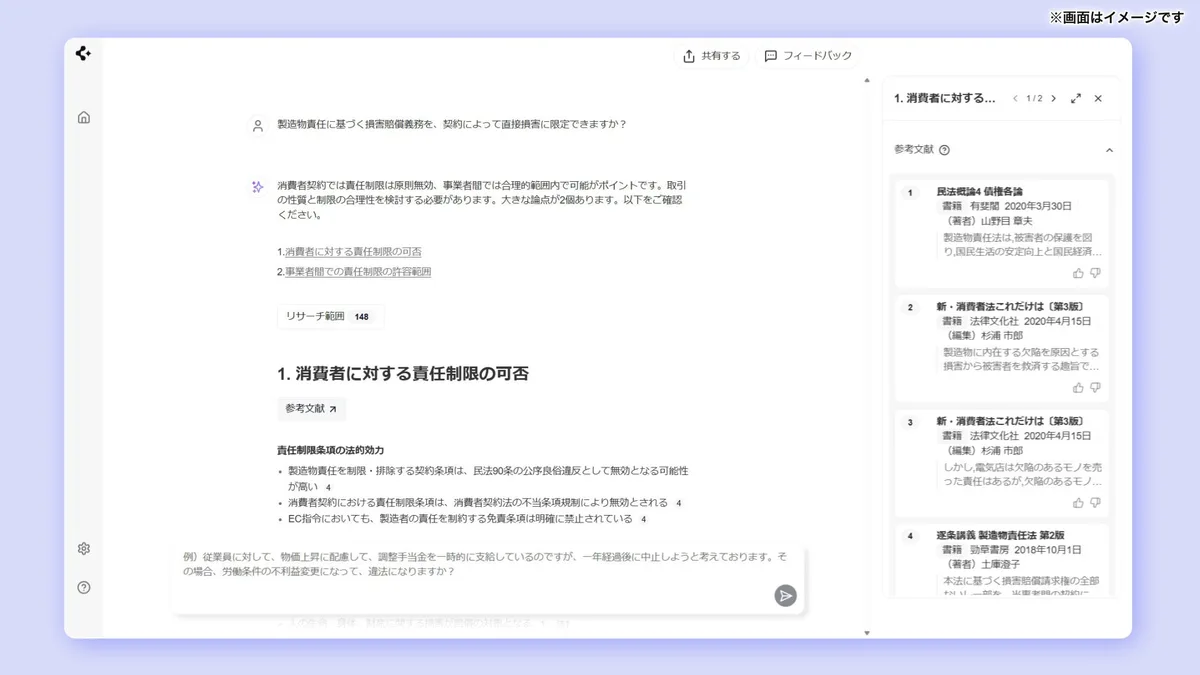
Source: Bengo4.com, Inc. press releases (the diagrams below are from the same source)
Attacking the assumption that "AI gets things wrong" through citations
What kept AI out of legal work was not accuracy so much as how you verify an answer. When article numbers and case citations come back in a plausible-looking form, you end up researching from scratch to confirm them.
Legal Brain is described as generating answers based only on trustworthy sources, thereby suppressing to the greatest extent possible the hallucinations that were a problem with general-purpose LLMs. The footnote markers at the end of each statement in the screen above, and the reference list in the right pane showing title, author, and publication date, reflect that design. The "research scope 148" indicator shows how many documents the answer was drawn from.
Using general-purpose generative AI for legal research
- The scope of training data is unknown
- Citations of statutes and cases cannot be verified
- You end up researching from scratch anyway
- No way to tell a hallucination apart
Legal Brain
- The scope of the data set is published
- Each statement carries a footnote and reference
- The number of documents searched is shown
- Answers are generated only from trustworthy sources
The background the company cites is survey data (November 2024) showing that 54.5% of legal staff name "understaffing" and 52.7% name "sheer volume of work" as their challenges. Research is high in volume yet specialized enough that it is hard to outsource.
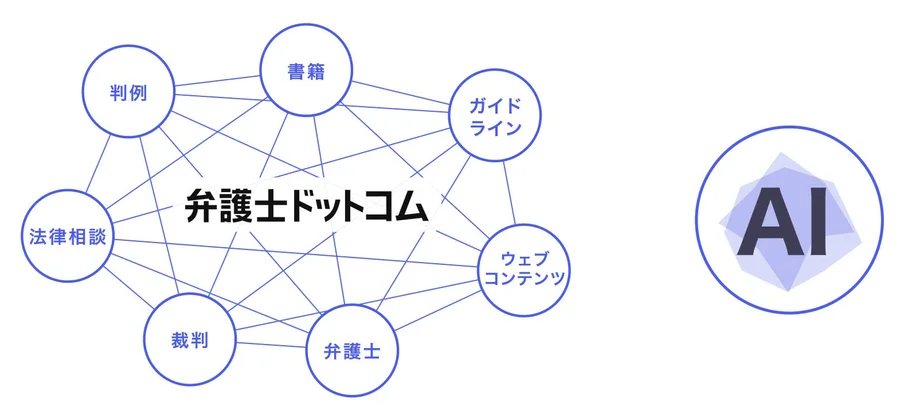
The data Bengo4.com has accumulated, turned into a graph
At the core of Legal Brain is a proprietary database called LegalGraph.
On top of a body of statutes and guidelines, it adds court precedent data, legal specialist books, legal consultation records, and information from attorneys, and is built by graphing the relationships between those data. Rather than a search index that merely aggregates documents, it retains the connections between an article and a precedent, or a precedent and its commentary — this is what separates it from ordinary full-text search.
What stands out is that it includes more than 1.4 million legal consultation records. This comes from the legal consultation service Bengo4.com has run for years — not a kind of data a competitor can assemble quickly. Commentary articles from the legal media outlet "BUSINESS LAWYERS" are also included.
What happens between the question and the answer
The official architecture diagram makes clear that this is not the kind of product that simply throws a question at an AI and has it write an answer.
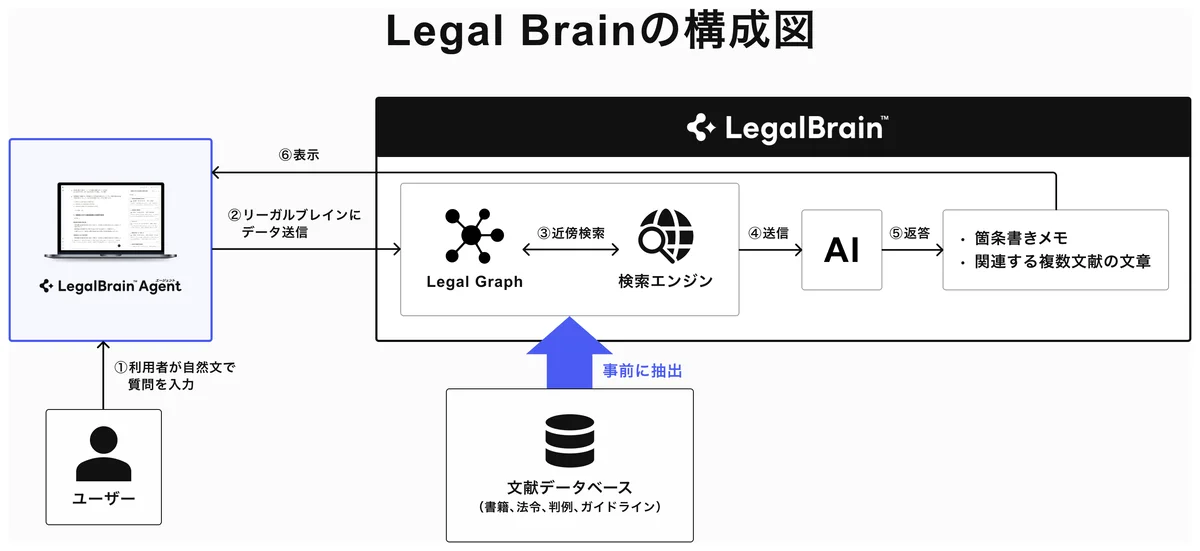
The flow works as follows.
- The user enters a question in natural language
- That input is sent to Legal Brain
- Legal Graph and the search engine exchange data through nearest-neighbor search, narrowing down related documents
- The narrowed set of documents is sent to the AI
- The AI returns bullet-point notes and passages from multiple related documents
- The result is displayed in the agent
Information is extracted in advance from the document database (books, statutes, precedents, guidelines) and handed to the search engine. In other words, the AI does not compose text freely — the structure identifies the documents first, then has the model organize based on them. That ordering is what makes citations possible.
Legal Brain is not the name of a single product
One more thing worth knowing: Legal Brain is not a standalone product but a foundation technology supporting several Bengo4.com services. The official site lists the following as the service lineup built around Legal Brain.
01LegalBrain Agent
The product covered on this page. An integrated AI agent aimed at streamlining complex legal work, launched with legal research as its first function.
02Hanrei Hisho
One of Japan's largest case law search services. It covers 11 legal journals and includes AI-assisted search.
03Bengo4.com LIBRARY / BUSINESS LAWYERS LIBRARY
Research services covering legal books — the former for attorneys, the latter for corporate legal departments. Both support AI full-text search and summarization.
04Chat Legal Consultation
A free 24/7 AI legal consultation chat based on legal consultation data. A consumer-facing service.
An integrated AI legal research tool powered by Legal Brain had already launched on August 30, 2024, with two functions: "extraction and organization of legal issues" and "information gathering." The 2025 agent is an extension of that line.
How to use
-
Apply for access
Make an inquiry or apply through the official site. It targets attorneys, law firms, and corporate legal departments, and contracts are made at an organizational level.
-
Enter your question in natural language
Type the issue as prose. There is no need to reformulate it into keywords or learn search operators. In the screen shown above, the sentence "Can liability for damages based on product liability be directly excluded by contract?" is entered as-is.
-
Review the organized legal issues
The AI extracts the legal issues and presents them structured as bullet points. In the example above, it breaks the question into "whether liability can be limited toward consumers" and "the permissible scope of liability limitation between businesses."
-
Go to the primary sources through the references
Each statement carries a footnote, and the right pane lists references with title, author, publisher, and publication date. Checking the primary source here is part of a single unit of work.
-
Share the results
Research results can be saved and shared within your team, accumulating as knowledge per matter.
Features
01Research
Extracts relevant legal information across sources from a natural-language question.
- Natural-language research — Ask in prose, and the AI infers your research intent and extracts relevant information
- LegalGraph cross-search — Searches statutes, precedents, specialist books, guidelines, consultation records, and commentary by following their relationships
- Extracting and organizing legal issues — Breaks the question into its constituent issues and structures them as bullet points
02Verify
The design prioritizes putting what is presented into a verifiable state.
- Explicit citations — Each statement carries a footnote, and references show title, author, and publication date
- Research scope indicator — Shows how many documents an answer was drawn from
- Hallucination suppression — Designed to generate answers only from trustworthy sources
03Share
Keeps research from ending as one person's work and retains it as organizational knowledge.
- Saving and sharing results — Share research output within the team
- Multi-user access — Designed for use at law firm or legal department level
Pricing
Pricing is not published; it is quoted individually. No amounts appear on the official site, and figures are presented through an inquiry.
| Category | Details |
|---|---|
| Pricing model | Not disclosed (individual quote) |
| Contract unit | Organization (law firms, corporate legal departments) |
| Target users | Attorneys, law firms, corporate legal departments |
| Launch | May 23, 2025 (LegalBrain Agent) |
| How to apply | Inquiry via the official site |
As of August 2026, the official site does not state amounts or whether a free trial is available. Please confirm directly with the provider when considering adoption.
Adoption and reception

Publicly disclosed adopters include Anderson Mori & Tomotsune, Mizuho Bank, and Mizuho Securities — a combination of one of Japan's leading law firms and megabank-affiliated legal departments, showing that adoption has begun in areas with the least tolerance for incorrect answers.
According to the November 11, 2025 announcement, Anderson Mori & Tomotsune verified the tool's usefulness in a trial and then began full-scale use across all attorneys and paralegals. What the trial rated highest was "the answer accuracy and reliability essential to legal practice" — specifically, that hallucinations are suppressed by generating answers only from trustworthy sources, and that citations are explicit enough to make verification easy.
Wataru Shimizu, a partner attorney at the firm, commented: "The assumption that generative AI makes mistakes and cannot be used as a research tool is now a thing of the past."
Going forward, the company is running a parallel proof of concept for multi-agent coordination, and plans to move to a seamless usage environment via Mirai Translate's AI platform.
How it differs from other legal tech
Legal tech divides by what it makes more efficient. Legal Brain is centered on research — the process of finding out — which is a different scope from products built primarily around contract review.
| Aspect | Legal Brain | Contract review AI | Case and literature databases |
|---|---|---|---|
| Primary use | Legal research (finding out) | Clause checking in contracts (confirming) | Searching cases and literature (locating) |
| Input | Natural-language question | Contract file | Keywords and filters |
| Output | Bulleted legal issues plus references | Risk flags and suggested edits | A list of matching documents |
| Handling of sources | Footnotes and references per statement | Points to the relevant clause | The documents themselves |
| Data scope | Statutes, precedents, books, guidelines, consultation records, commentary | Templates and clauses by contract type | Cases and literature |
| Pricing | Not disclosed (individual quote) | Varies by product | Varies by product |
In the same research space, Legalscape offers a service built around a legal literature database, where the range of documents covered and the search experience are the main points of comparison. For contract review, LegalForce, OLGA, and LeCHECK apply; because their purpose does not overlap with the "finding out" that Legal Brain handles, they are often used together.
Information on this page is based on what was published on the official site and in press releases from Bengo4.com, Inc. as of August 2026. Please check the official site for the latest specifications and pricing.


![[2026 Edition] Top 5 AI Tools for Legal Teams | Automating Contract Review and Legal Research](/_next/image?url=%2Fimages%2Farticles%2Fai-legal-tools-top-picks.png&w=3840&q=75 "[2026 Edition] Top 5 AI Tools for Legal Teams | Automating Contract Review and Legal Research")