

Maliang Writer
: How to use it, features, and the business problems it solves
What is Maliang Writer?
Maliang Writer (Chinese name: 马良写作) is an AI writing platform for long-form fiction, operated by the UK company KOVEX TECHNOLOGIES LTD with technical operations handled by a Shanghai company. It continues your novel in the flow and voice of earlier chapters, keeps a chapter-by-chapter story archive of character states, possessions, foreshadowing and timeline, offers a three-level outline (whole book, volume, chapter), and shows AI edits as a paragraph-by-paragraph comparison you can keep or revert. You can pick separate AI models (DeepSeek, Gemini, Claude and others) for discussion and for prose. The free trial gives 1,000 credits a month; paid plans showed as US$19.99–US$99 per month from Japan (excl. tax, November 2026). The website and docs are available in Japanese, but the product screens are in Chinese only (Simplified and Traditional).
Business problems it solves


About "Maliang Writer"
What is Maliang Writer?
Maliang Writer (Chinese name: 马良写作) is an AI writing platform for long-form novels. In a single novel project it combines continuation writing that picks up the flow and voice of earlier chapters, a "story archive" that records how characters, settings, foreshadowing and the in-story timeline change chapter by chapter, a three-level outline (whole book, volume, chapter), and an editor that shows AI edits paragraph by paragraph so you can keep or revert each one.
The official site describes it as "a collaboration between people and AI, not one-click generation": the AI drafts and organizes, and the author decides where the story goes. It is operated by KOVEX TECHNOLOGIES LTD, registered in England and Wales (company number 17432572, incorporated 2 September 2026). Server hosting, technical operations and customer support are provided by Shanghai Oukean Culture Media Co., Ltd. (上海欧克安文化传媒有限公司) in mainland China. Development started in March 2025.
The official website, pricing page and documentation can be read in Japanese, and the home page shows a demo image of the writing screen with Japanese labels. However, the product screens are in Chinese only (Simplified and Traditional). The documentation (updated March 2026) says that "the product screens are currently Chinese only"; when we opened the subscription screen from Japan the only language options were Simplified and Traditional Chinese, and /ja/subscription on the Japanese site also leads to the Chinese screen (checked 24 November 2026). The demo image with Japanese labels on the home page is made for the Japanese site; the Chinese site shows the same screen in Chinese.
Reissued monthly from your sign-up date
Whole book, volume, chapter
Shown from Japan, excl. tax (24 Nov 2026)
Snapshot as of 25 Sep 2026
Chapter-by-chapter records for the parts of a long novel that tend to break
The problem the official site sets out is that "the real difficulty of writing a long novel with AI starts from chapter 30". Writing one good chapter is not hard; staying consistent with earlier events, keeping characters steady and preserving your style over hundreds of thousands of characters is. Maliang Writer therefore splits the steps where long novels tend to fall apart and handles them separately.
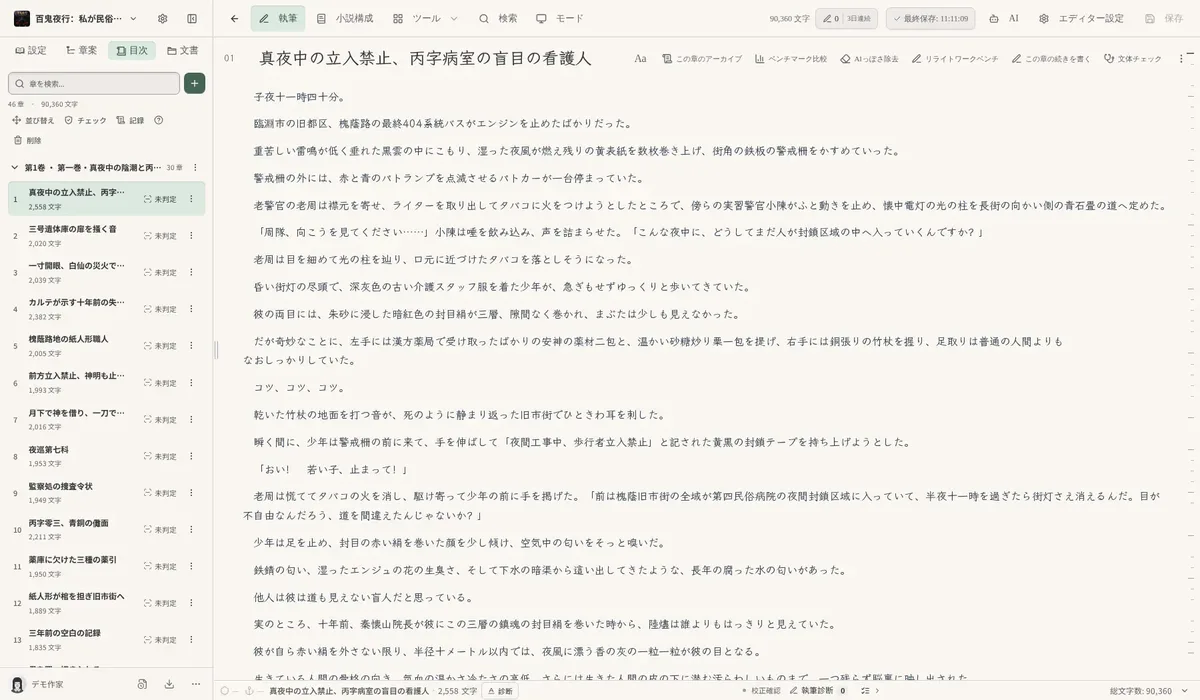
Source: demo image on the home page (Japanese version) of the Maliang Writer official site. The actual product screens are in Chinese
- Story archive — Each time you finish a chapter, it records character states, possessions, numerical balances, foreshadowing, in-story dates and more, based on the text. Only facts written in the text are recorded; anything that conflicts with existing settings is listed as "needs confirmation", and the author decides which version is correct
- Reads the previous chapter before continuing — Before writing the next part, it loads the ending of the previous chapter, the chapter outline, and the current records of the characters and settings that appear in the chapter. If the chapter outline and the text already written disagree, it first tells you where they diverge
- Matches your style — It writes to the sentence length, paragraphing and tone of your earlier text. The official site notes that how closely it can reproduce your style depends on the amount of sample text, and recommends preparing several chapters you wrote yourself
Compare AI edits paragraph by paragraph before you accept them
When the AI changes the chapter you have open, the editor shows a before-and-after comparison, and you choose for each paragraph whether to keep it or revert it. If the result of one exchange is not what you wanted, you can undo that whole round and return the manuscript to its state before the message was sent (this also reverts any manual edits made afterwards, so the scope is shown on screen before you run it).
You can rewrite an instruction and resend it, or branch into a new chat from an earlier point in the conversation to try a different approach. With @ you can reference chapters, characters and settings in the book to tell the AI what to follow this time, and when the story could go in different directions, the AI asks first and offers options before it starts writing.
Pick separate AI models for discussion and for prose
Maliang Writer supports several large language models (LLMs), and you can choose one model for discussing the plot and organizing outlines and another for writing the prose. The Terms of Service give DeepSeek, Google Gemini and Anthropic Claude as examples, and the Privacy Policy says that, depending on the models offered at the time, providers include DeepSeek, Moonshot AI (Kimi), Alibaba Cloud (Qwen), MiniMax, Google (Gemini), Anthropic (Claude) and OpenAI (GPT). Models differ in writing quality, speed and credit consumption, and the credits used by each call are recorded so you can check them at any time.
There is a mode where a single main assistant does the work and a mode where several AIs split the roles. According to the official FAQ, in multi-agent mode the main assistant you talk to discusses the plot and assigns tasks, a dedicated writer produces the prose, and after a chapter is finished an archivist updates the character records, foreshadowing and timeline based on the text.
How to use it
- Sign up and start from the home screen Register from "Start writing" on the official site. Type a story idea into the input box in the middle of the home screen and a novel is created, taking you straight to the writing screen. To continue a manuscript you already have, use "Import novel" (this requires an active subscription, and only .txt files can be imported).
- Open your novel in "My novels" and create a volume and a chapter The first steps in the official docs are five: log in → open "My novels" → open the novel's writing screen → create volume 1 → create chapter 1. The docs advise not to build the whole world up front, but to first create a starting point you can write from.
- Settle the chapter-1 outline, then have the prose written Summarize the genre and reader expectations, the protagonist's position, the conflict in chapter 1 and the hook to leave at the end in one sentence, settle the chapter blueprint (setup, reversal, hook), and then expand it into prose. The official docs recommend splitting the work into small steps, because asking the AI for the plot, settings and prose all at once tends to make the output unstable.
- Save what has been decided and keep writing Save the positions of the protagonist and main characters, the world rules and the foreshadowing at the end of chapter 1 to the novel's materials. From then on, the story archive is updated each chapter, and continuations are written using those records.
- Check the finished chapters Polish the manuscript with chapter diagnosis, typo and character-name checks, chapter-ending diagnosis and rewriting to reduce the AI feel. Pacing analysis scores each chapter so you can find the weak ones.
Note: the official documentation (in Japanese) states that "the product screens are currently Chinese only" and shows its screenshots in the Chinese interface. Check button and menu names against the images as you go.
Features
01Planning and outlines
Build the skeleton of the story, only at the levels you need.
- Three-level outline — Create a whole-book outline, volume outlines and chapter outlines as needed. Chapter outlines spell out who sees what in each scene, how they judge it and what they say, and the prose follows them
- World and setting management — Register power systems, geography, factions and character settings in a structured way. Supports revealing settings volume by volume and hiding settings from the AI to avoid spoilers
- Character settings — Go beyond personality tags and define what a character wants, what they fear, and how they think and speak when something happens
- Learning from hit novels — AI analyzes the pacing, payoff design and plot structure of popular works so you can adopt them as writing patterns
02Writing and revising
Write on from the previous chapter, then check what you wrote.
- Continuation writing — Loads the previous chapter's ending, the chapter outline and the latest records of characters and settings, then writes the next chapter in the voice of your earlier text. Also works on imported novels
- Paragraph comparison and undo — Accept or restore AI changes paragraph by paragraph. You can also undo a whole exchange or branch into a new chat from an earlier point
- Chapter diagnosis and rewriting to reduce AI feel — Chapter diagnosis, typo and character-name checks, chapter-ending diagnosis. Each issue comes with its location and how to fix it
- Style clones (文风分身) — Slots for registering your own writing style: 1 on the free trial, 3–8 on paid plans
03Records and consistency
Keep a long story from contradicting itself.
- Story archive — Records the current state of characters and settings, a numerical ledger, foreshadowing and the timeline for each chapter. Contradictions are listed as "pending confirmation" for the author to decide. A whole-book archive can also be created later for an existing novel
- Knowledge graph — A relationship map of the people, places, items and events extracted from written chapters. Ask "What is the relationship between A and B?" and jump to the relevant passage (paid-plan feature)
- Whole-book consistency check — A report that checks the consistency of the whole novel. Pro and above include one per month; otherwise it is paid for with credits
04Free tools and public library on the site
Useful for groundwork even outside the app.
- Novel-writing tools — Novel naming (including Western-style and Japanese-style names), character settings, whole-book outline, openings, foreshadowing and payoff, titles and synopses, chapter titles, text formatting, duplicate-chapter check, novel-to-script conversion and more
- Public library — In a snapshot as of 25 September 2026 it holds 12,287 books (2,684 with full analysis), plus chapter-ending statistics covering the first 25 chapters of 2,330 popular web novels. The official site states that it shows only analysis items and statistics and does not reproduce the text
Pricing
AI features consume credits. When we opened the subscription page from Japan, prices were shown in US dollars (checked 24 November 2026; prices exclude tax, and applicable tax is added).
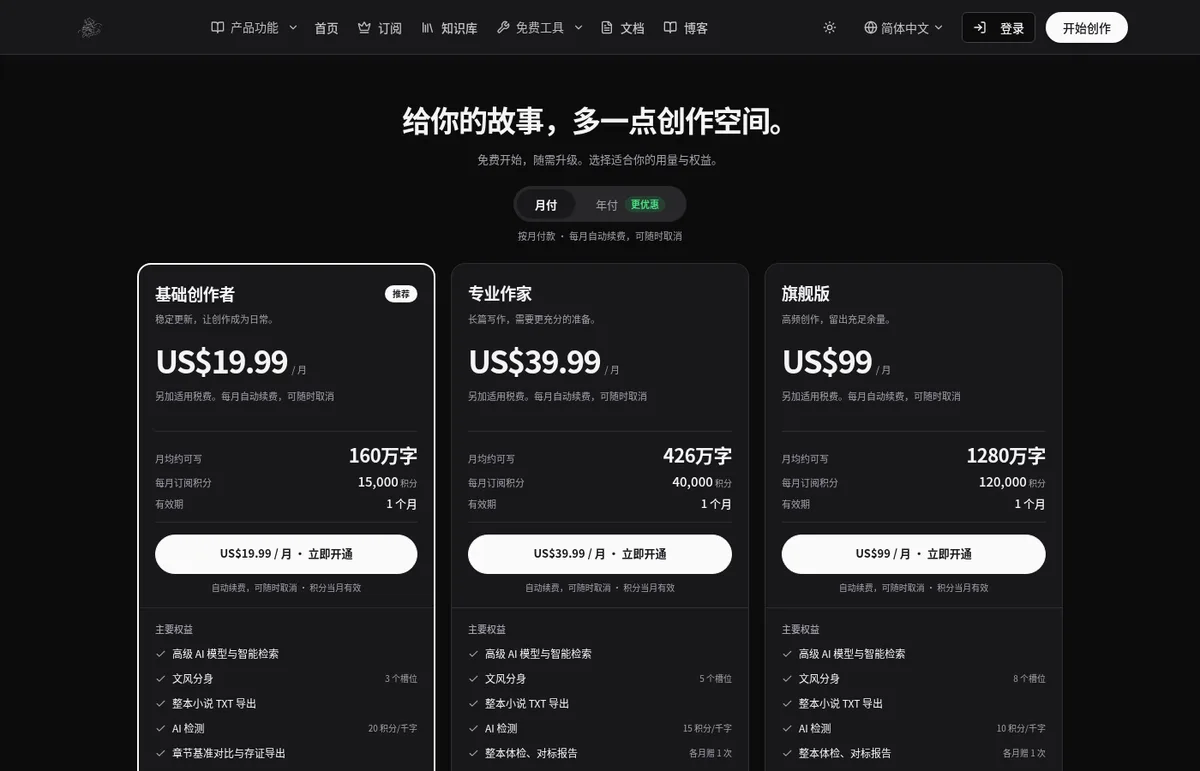
Source: Maliang Writer subscription page (viewed from Japan on 24 November 2026; the screen is in Chinese)
| Plan | Monthly | Yearly | Monthly credits | Main differences |
|---|---|---|---|---|
| Free trial | US$0 | — | 1,000 (reissued monthly from sign-up date, valid 1 month) | Basic models. TXT export one chapter at a time, 1 style-clone slot, one trial AI detection (up to 3,000 characters) |
| ベーシッククリエイター (Starter) | US$19.99 | US$199 | 15,000 | All advanced models, whole-novel TXT export, knowledge graph, 3 style-clone slots, AI detection at 20 credits per 1,000 characters |
| プロフェッショナルライター (Pro) | US$39.99 | US$399 | 40,000 | Adds one whole-book consistency check and one hit-novel benchmark report per month, 5 style-clone slots, AI detection at 15 credits per 1,000 characters |
| フラッグシップ (Max) | US$99 | US$990 | 120,000 | 8 style-clone slots, AI detection at 10 credits per 1,000 characters, detection history kept indefinitely |
| Extra credits (one-time) | Price |
|---|---|
| 2,500 credits | US$4.99 |
| 5,500 credits | US$9.99 |
| 15,000 credits | US$24.99 |
| 32,000 credits | US$49.99 |
- Subscription credits are valid only in the subscription month in which they are issued (a month counted from your billing date) and do not roll over. Yearly plans also issue credits once a month. Credit-pack credits do not expire while your account is open
- According to the home page, answering the new-user survey gives an extra 400 credits (no expiry)
- The Japanese pricing page (/ja/pricing/) lists prices in Chinese yuan (CNY 69–299 per month) as values from the "public plan API" as of 20 November 2026. The Terms state that the currency of prices depends on the app's language and region and that some markets are shown in USD, so check the actual amount on the order screen
- Purchases from outside mainland China are sold through Stripe's affiliate Sold through Link, LLC ("Link"), which acts as reseller and merchant of record. Your statement shows a description starting with "LINK.COM*"
- Subscriptions renew automatically. You can cancel at any time in "Manage subscription & billing" on the Subscription page or at link.com, and you keep the plan until the end of the period already paid. There is no refund for the rest of the current period (UK and EU consumers have a 14-day right to cancel)
How your manuscript and data are handled
How it differs from other novel-writing AIs and chat AIs
| Aspect | Maliang Writer | NovelShaft | Sudowrite | ChatGPT / Claude (general chat AI) |
|---|---|---|---|---|
| Main use | Serializing long novels. Genre examples are those common in Chinese web novels (xianxia, "system" stories, infinite-flow). Chapter records keep the story consistent | Growing Japanese and English novels with manuscript, settings and discussion in one project | Creative support for English novels and fiction | General writing help and generation |
| Interface language | Product screens in Chinese only (Simplified and Traditional). Website and docs can be read in Japanese | Japanese and English | Mainly English | Japanese available |
| Consistency with settings and earlier chapters | The story archive records character states, possessions, foreshadowing and timeline per chapter and flags contradictions as "needs confirmation" | Discuss with reference to the project's materials (plots, characters, timeline, relationship maps) | Register characters and settings in the Story Bible | No dedicated record-keeping for novels |
| Handling AI changes | Accept or restore paragraph by paragraph; undo a whole exchange | Can be declined before applying, and undone across the project afterwards | Choose whether to adopt generated text | Copy answers into your own manuscript |
| Pricing | Free trial. Paid plans US$19.99–US$99 per month (shown from Japan, excl. tax) | Free US$0; paid US$15–90 per month | US$10–44 per month (credit-based) | Free plan available; paid plans are monthly |
If you want to use a Chinese large language model directly, see the DeepSeek page as well. If you value features for Japanese novels such as vertical writing and ruby, NovelShaft fits; if you value record-keeping and consistency for a long-running Chinese web-novel serial, Maliang Writer fits.
FAQ
The information on this page is based on what was published on the official site as of November 2026. Please check the official site for the latest specifications and pricing.