

Jev
: How to use it, features, and the business problems it solves
Add bookmark
What is Jev?
Jev is the first System One model from TypeSafe AI, released on 15 September 2026. Unlike an LLM it generates no text: give it a state (text or JSON) and it returns typed values — Choice (classification), Score (rating) and Noul (a 0–1 truth value) — each with probabilities and a calibrated confidence. Because no string comes back, there is nothing to parse and nothing to validate. Vendor-published figures are 70–500 ms end to end and $0.042 per million input tokens, with output tokens free. Questions in one request are evaluated in parallel, so stacking them barely changes latency — which suits support triage, LLM guardrails and RAG re-ranking, where the same judgement repeats at volume. In early access behind a waitlist as of September 2026; the docs state that CJK scripts are accepted with lower accuracy than English.
Business problems it solves

About "Jev"
What Jev is
Jev is a System One model released on 15 September 2026 by TypeSafe AI, based in San Francisco. Rather than generating text like an LLM, it does one thing: given a state (text or JSON), it returns typed judgements with probabilities attached.
What comes back is a label like "technical", a level like 1.6, a probability like 0.92. No string is generated, so there is no parsing step and no retry loop for malformed output. It is built for the same judgement repeated at volume — support triage, LLM guardrails, RAG re-ranking.
As of 19 September 2026 it is in early access behind a waitlist, with developers invited in order.
What "System One model" means
The name comes from Daniel Kahneman's Thinking, Fast and Slow: System 1 is fast and automatic, System 2 slow and deliberate. TypeSafe's argument is that today's LLMs are all built toward System 2, while most of the judgement a production system needs is System 1 work.
"Which team owns this ticket." "Is this urgent." Until now, every one of those meant wheeling out the chain-of-thought machine.
Classifying with an LLM
- You get a string. JSON mode still needs validation
- It can invent a label you never defined
- No probabilities, so hesitation is invisible
- Sequential sampling: seconds to tens of seconds
- More questions: slower and more expensive
Classifying with Jev
- You get a typed value. Nothing to parse
- Answers cannot leave your defined set
- A distribution and confidence always come with it
- Parallel evaluation: 70–500 ms
- More questions: response time barely moves
TypeSafe says this behaviour required a new architecture, a new sampler, and a training algorithm it calls RLCD (Reinforcement Learning for Calibrated Decisions). Its stated reasoning: RLHF optimised for human preference, and the side effects — mode dropping, overconfidence, unreliability — are what force a human back into the loop. Jev goes the other way.
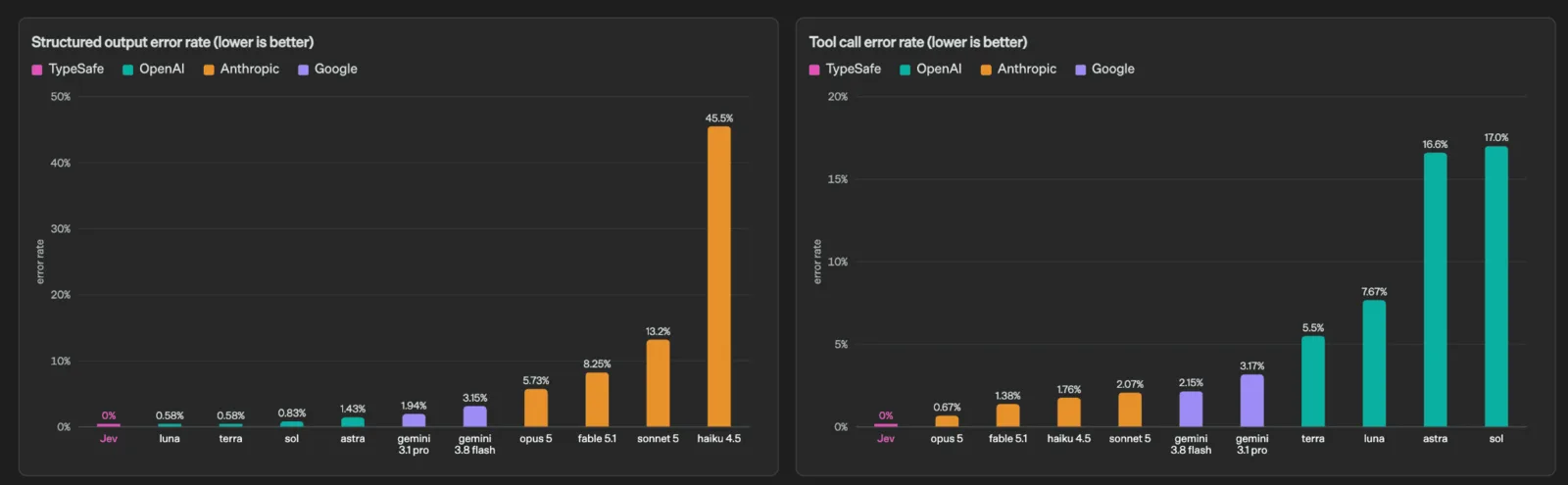
How often the type broke (left: structured output, right: tool calls; lower is better). Source: TypeSafe AI blog
These are the two charts TypeSafe publishes. On structured output error rate: Jev 0%, GPT-5.6 Luna 0.58%, Claude Haiku 4.5 45.5%. On tool call error rate: Jev 0%, Claude Opus 5 0.67%, GPT-5.6 Sol 17.0%. What is measured here is whether the answer came back in the type you specified — not whether the judgement was right. These numbers are why the retry path never quite goes away, even in JSON mode.
Vendor-published figure
Output tokens are free
State capped at 32k
Led by DCVC, Sept 2026
Three question types decide what you get back
There are only three. That constraint is exactly why the output type cannot break.
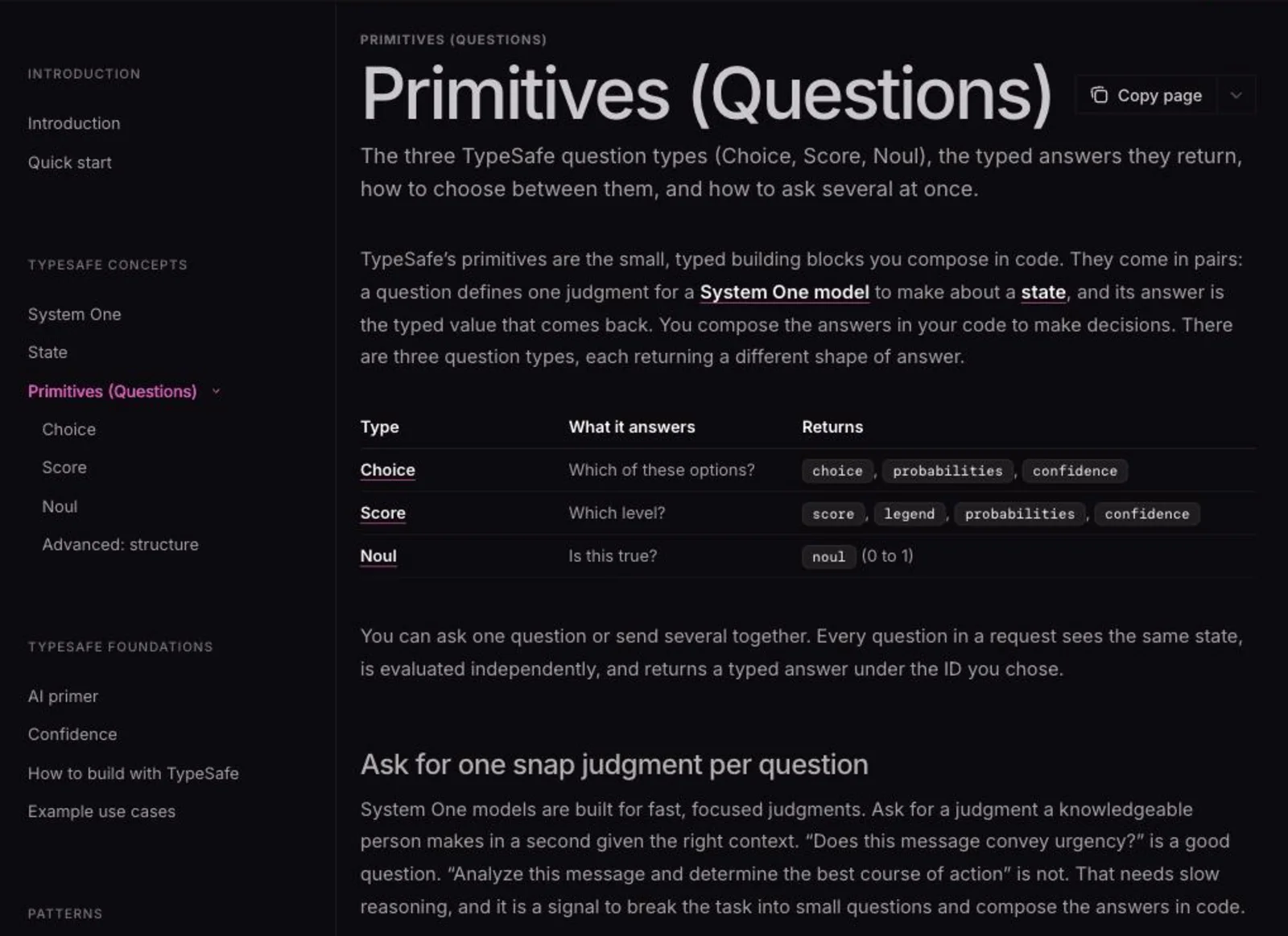
The Primitives page in the official docs; the left nav lists Choice, Score and Noul alongside Confidence and Patterns. Source: TypeSafe AI documentation
01Choice — pick one from a fixed set
Unordered classification: ticket routing, document type, language detection.
- choice — the selected key
- probabilities — the distribution across every option
- confidence — how peaked that distribution is (0–1)
02Score — rate along ordered levels
Scales where each position means something: bug severity, customer frustration, skill level.
- score — lands between levels (e.g. 1.6)
- legend — the level-to-number table
- probabilities / confidence — as with Choice
03Noul — how likely is this statement to be true
Jev's own type. A yes/no question that returns a probability rather than a boolean.
- noul — near 1 is yes, near 0 is no, near 0.5 means it cannot tell
- no confidence field — the probability is the confidence
The docs warn against confusing Score and Noul. "Intermediate skill" is not a Noul of 0.5; that reads as "I cannot tell whether this is true."
Stacking questions costs nothing in latency
This is where the design pays off. Every question in a request is evaluated in parallel, and the docs state that adding questions "typically doesn't add any latency to the response."
That licenses speculative fan-out: send the questions that only matter on one branch too. If the ticket turns out to be a feature request, throw the bug-severity answer away — you still spent one round trip where an LLM would have spent two.
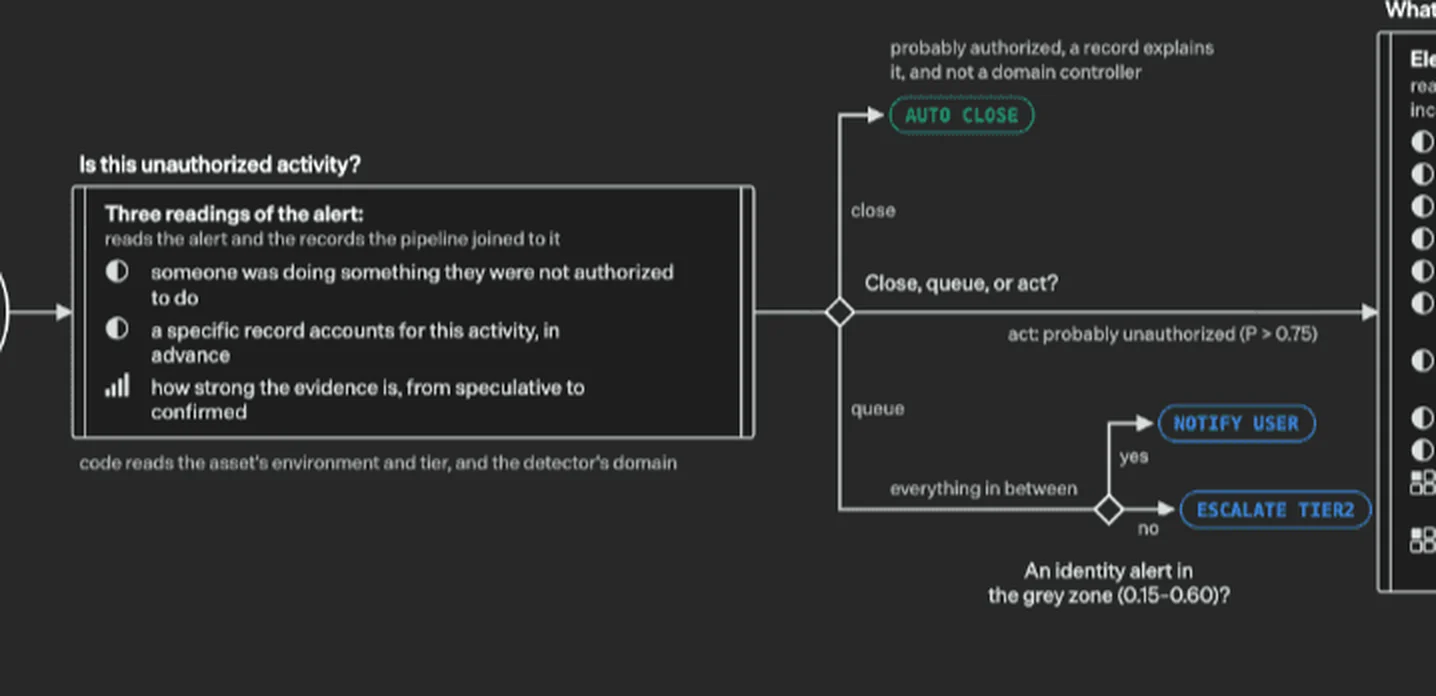
Part of the incident triage pipeline TypeSafe publishes. The probability thresholds (P > 0.75, 0.15–0.60) are the branch conditions themselves. Source: TypeSafe AI blog (excerpt)
The security-alert example TypeSafe publishes is the clearest implementation of this. One alert gets two Bool questions about whether the activity was authorised and one Score question about how strong the evidence is, and then: act above 0.75, auto-close below 0.15, and in between (0.15–0.60) either notify the user or escalate to Tier 2. The thresholds are the operating policy.
How to use it
-
Join the waitlist
Sign up via "Join Waitlist" on the official site. As of September 2026 Jev is in early access, with TypeSafe saying it is inviting developers "as quickly as we can."
-
Create an API key
Create an account at
console.typesafe.aiand generate a key. It is shown exactly once. The environment variable isTYPESAFE_API_KEY. -
Work out your wording in the Playground
The console Playground takes a state as plain text on the left and questions as JSON on the right, and reports measured latency. Settle
instructionsandcriteriahere before installing anything. -
Call it from an SDK
Python is
pip install typesafe-sdk; JavaScript/TypeScript isnpm install @typesafe-ai/sdk(Node.js 20+).from typesafe_sdk import Choice, Noul, Score, TypeSafeClient client = TypeSafeClient() response = client.system_one( state=ticket, questions={ "department": Choice( instructions="Which team should handle this", criteria={ "billing": "Payment or subscription issues", "technical": "Bugs or integration problems", "sales": "Pricing or account questions", }, ), "frustration": Score( instructions="How frustrated the customer appears", criteria=["Calm", "Frustrated but civil", "Very angry"], ), "is_urgent": Noul( instructions="The message conveys urgency or time-sensitivity", ), }, ) print(response.answers["department"].choice) # "billing" print(response.answers["frustration"].score) # 1.035 print(response.answers["is_urgent"].noul) # 0.999 -
Set thresholds on confidence
Use the returned
confidenceto split automatic action from human review. The published starting points are: above 0.9 act automatically, 0.5–0.9 confirm or flag, below 0.5 do not act. The real point is to scale the threshold with the consequence of the action. -
Let a coding agent do the rewrite
TypeSafe publishes an agent skill. For Claude Code:
claude plugin marketplace add typesafe-ai/skillsthenclaude plugin install typesafe@typesafe-ai. It is useful for finding brittle parsing code in an existing repo and converting it. TypeSafe notes that "agents aren't great at writing questions, so expect to edit collaboratively with them."
Features
01Model and I/O
- jev-1.13.0 / jev-latest / jev-preview — the Jev 1.13 line is the only published model as of September 2026
- State formats — string, JSON object, or array of strings. Conversation threads go in as an array
- Text only — no images, audio or video
- Calibrated confidence — Choice and Score always carry a confidence derived from the distribution
02What developers get
- HTTP API — `POST https://api.typesafe.ai/v1/systemone`, Bearer token auth
- Python SDK — sync and async clients, retry policy, typed exceptions
- JavaScript / TypeScript SDK — return types inferred from question definitions
- Agent skill — loads the three question types and the design patterns into Claude Code and other agents
03Published architectural patterns
- Speculative fan-out — send branch-only questions in the same call
- Confidence-gated routing — split automatic, confirm and human paths on certainty
- Composite scoring — break a complex judgement into atomic scores
- Intent routing — classify intent and difficulty, then route to the right LLM
04Official cookbooks
- LLM guardrails — jailbreaks, prompt injection and self-harm signals inbound; policy violations outbound
- Citation checking — verify a claim actually appears in the source document
- RAG passage filtering and re-ranking — score retrieved text and drop the noise
- Hierarchical classification, date extraction, function calling — deep taxonomies, relative dates, natural language to typed functions
Pricing
Usage-based on input tokens only; output tokens are free (the docs say "too cheap to meter").
| Item | Detail |
|---|---|
| Input price | $42 per billion tokens (= $0.042 per million) |
| Output price | Free |
| Free allowance | $5/month shown on the console billing page (reported September 2026) |
| Rate limits | 250,000 tokens/second, 1,200 requests/minute (adjusted dynamically, may change without notice) |
| Context | 64,000 tokens per request; state plus the longest question capped at 32,000 |
| Availability | Early access, waitlist |
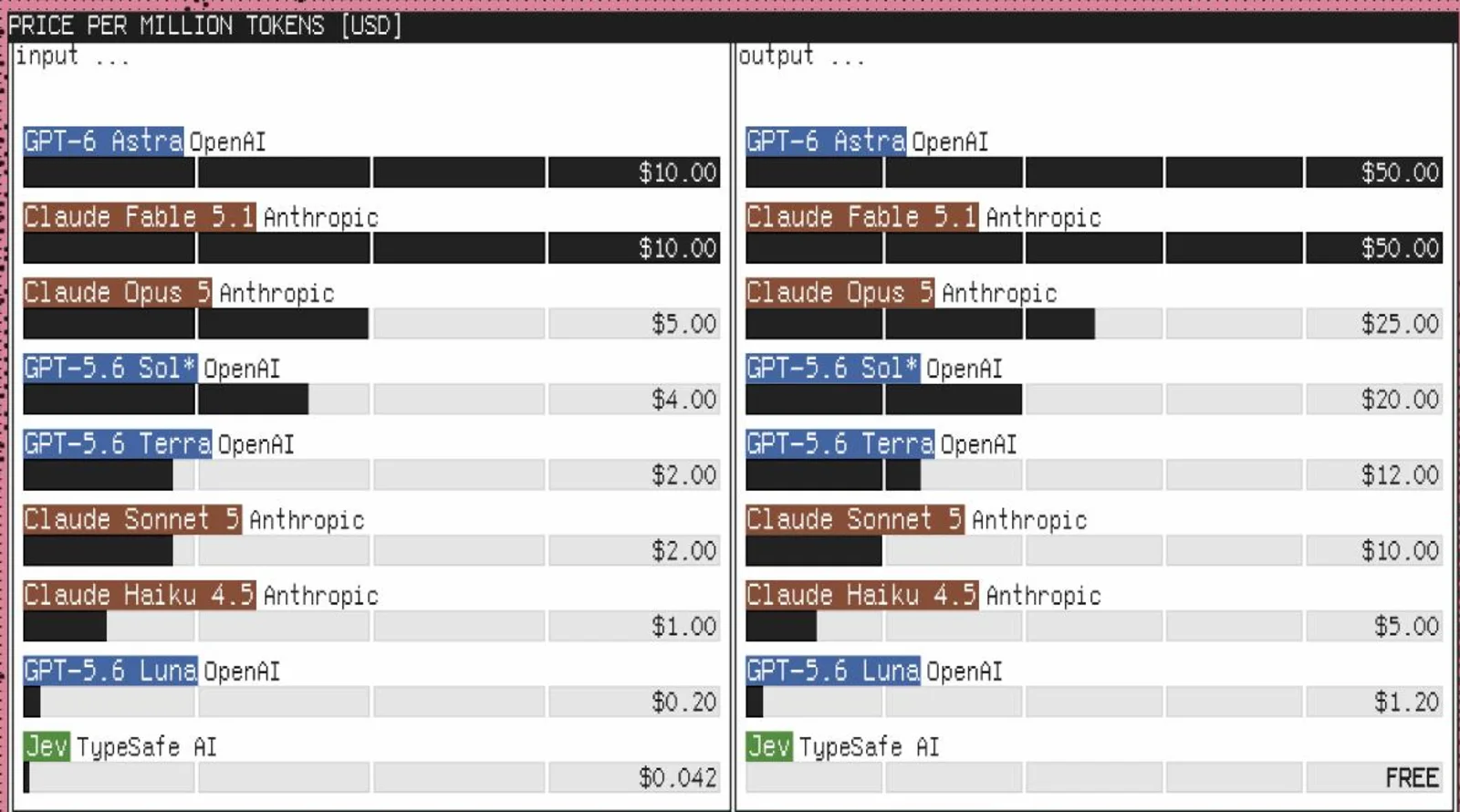
The comparison the official site leads with. In the output column on the right, only Jev reads FREE. Source: TypeSafe AI
The official site claims "238x lower input price than Claude Fable 5.1" and "193.6x faster, 444.6x cheaper" on System One workflows, alongside a single-task measurement of $0.000081 in 0.114s for Jev versus $0.013880 in 8.566s for LLMs.
Every one of those figures is TypeSafe's own measurement. They come from a self-designed evaluation frame called "workflow evals" rather than an existing ground-truth benchmark, the four workloads are not published, and no third-party verification exists yet. The order of magnitude is visible in the price list, but the ratio on your own workload is yours to measure.
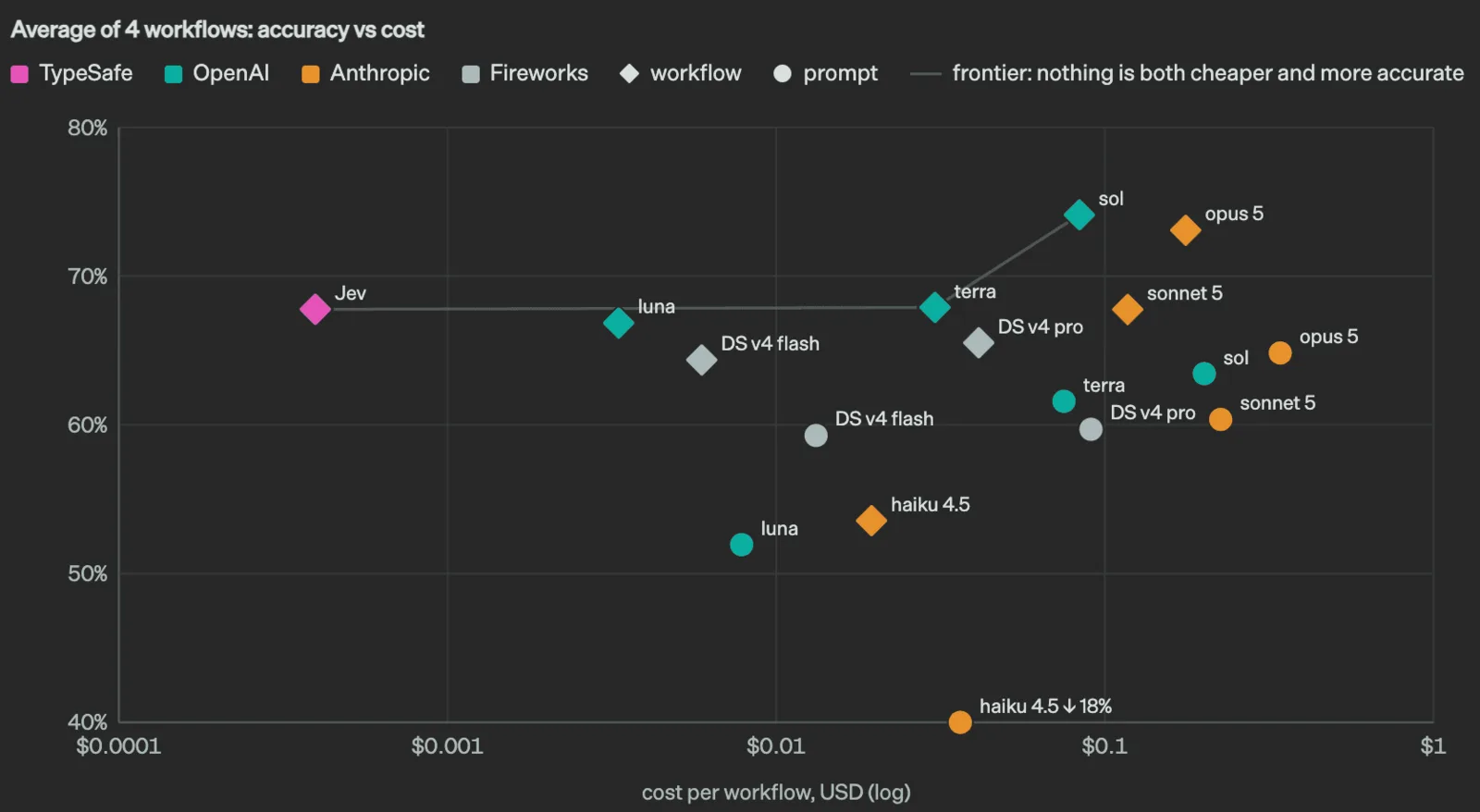
Accuracy against cost; the x axis is dollars per workflow on a log scale. Source: TypeSafe AI blog
This chart places Jev more honestly than any ratio does. Jev is not the most accurate model. Averaged over the four workflows it lands around 68%, about six points short of GPT-5.6 Sol at roughly 74%. Where Jev sits is the same accuracy band for two orders of magnitude less money: Luna reaches ~67% at ~$0.003 and Terra ~68% at ~$0.04, while Jev gets ~68% at ~$0.0004.
So the question is not whether Jev is smart. It is whether this particular workload is worth six accuracy points. If your design already routes the uncertain cases to a person, cheaper wins; if a single miss is expensive, staying on Sol is the safer call.
Using it on non-English input
Non-English state is accepted, but the docs state that CJK scripts have lower accuracy than English. English is Jev's first language and where it performs best. Documentation and console are English-only; there is no localised UI or support.
Hands-on tests in Japanese returned 0.97–0.98 on urgency judgements, so it does work. But "it works" and "it is accurate enough to ship" are different claims. The order to follow:
- Write instructions and criteria in English — leave the state in its original language, give the directions in the model's strongest language
- Measure once against labelled data — 100–300 past items with human labels
- Start with a high threshold and keep people in the loop — automate only above 0.9 at first
Where it struggles
TypeSafe documents Jev 1.13's failure modes itself, on a page called model-jaggedness. Read it before shipping.
| Weakness | What actually happens |
|---|---|
| Reads literally | Scoping words, negations and implied conditions are taken at face value |
| Cannot count | Characters, occurrences and list lengths are unreliable; error grows with size |
| Weak numeric precision | Poor with hex and RGB values; cannot reliably judge whether two values are close |
| Weak on dates and times | Reads dates as text, not ordered quantities. Ordering and durations are unreliable |
| Struggles with double negatives | Conflicts between instructions and criteria cause confusion |
| Degrades on bloated state | Accuracy falls as the state fills with irrelevant content |
| Vulnerable to adversarial input | Injected instructions and misleading framings inside the state affect it |
Also, mathematical relationships between related questions are not guaranteed: ask "is A" and "is not A" as two Nouls and the probabilities need not sum to 1. If you need that, collapse them into one Choice.
And it cannot generate text — TypeSafe states it was not trained to, and that forcing it through chaining is poor and slow.
The company behind it
TypeSafe AI is based in San Francisco and emerged on 15 September 2026 after two years in stealth, with a $40 million seed round led by DCVC (Forbes reported a valuation near $200 million).
That the person who co-invented RLHF is now building in the opposite direction — citing RLHF's overconfidence and unreliability as the reason — is part of why the launch drew the attention it did.
How it compares to other AI models and APIs
Jev does not replace a general-purpose LLM. It exists to move one slice of the work out of it.
| Jev | General-purpose LLM (Claude / ChatGPT / Gemini) | |
|---|---|---|
| Output | Typed value plus probabilities | Prose (a string) |
| Parsing / validation | Not needed | Needed even in JSON mode |
| Response time | 70–500 ms | Seconds to tens of seconds |
| Input price (per MTok) | $0.042 | $0.20–$10 |
| Output price | Free | ~5x input |
| Suited to | Classification, scoring, yes/no | Generation, long reasoning, dialogue |
| Non-English | Accepted, lower accuracy than English | Production-grade |
- Claude — handles writing and long reasoning; Jev sits on either side of it for guardrails and output verification. A complement, not a competitor
- ChatGPT — for classification and extraction alone there is GPT-5.6 Luna at $0.20 per million input tokens. The gap is roughly 5x on price, plus output billing and the parsing step. If you are already on OpenAI, check the cheap model first
- Dify — the LLM node deciding a workflow branch is exactly a decision with known options; moving it to Jev takes that step from seconds to milliseconds
- Claude Code — with the official skill installed, it can find brittle parsing in a repository and convert it into Jev calls
Frequently asked questions
QIs Jev free to use?
It is usage-based, but the console billing page shows $5/month of free usage (reported September 2026). At $0.042 per million input tokens, that covers a great many calls. A waitlist invitation is required.
QCan it generate or summarise text?
No. TypeSafe states Jev was not trained to generate text. Generation is the LLM's job; Jev handles the judgements around it.
QCan I send images or PDFs?
No. State is text only, in one of three shapes: string, JSON object, or array of strings. Run OCR or transcription first.
QWhat does "zero hallucinations" mean here?
It means the type cannot break: undefined labels never appear and numbers stay in range. It is not a claim that the judgement is correct. Output-format guarantees and accuracy are separate things.
QWhere should I start?
Pick one place in production where you send work to an LLM and parse JSON out of the response, then run ten of those inputs through the Playground and see whether the judgements agree. That is Jev's territory.
Information on this page reflects what TypeSafe AI published on its site, documentation and blog as of 19 September 2026. Jev is in early access; specifications, pricing and rate limits may change. Check the official site for current details.


![What Jev Is [September 2026]: The AI That Generates No Text — How System One Models Work, Pricing and Use Cases](/_next/image?url=%2Fimages%2Farticles%2Fjev-typesafe-ai-guide.png&w=3840&q=75 "What Jev Is [September 2026]: The AI That Generates No Text — How System One Models Work, Pricing and Use Cases")