

shortshort
: How to use it, features, and the business problems it solves
Add bookmark
What is shortshort?
shortshort turns long talks, podcasts and courses into vertical 9:16 shorts cut on complete sentences. From a video of up to 3 hours, AI picks self-contained 15–90-second passages, crops them to follow the speaker and adds word-by-word captions for MP4 export. Pricing is based on minutes of source video rather than the number of shorts, and you get 60 free credits (1 hour's worth) at sign-up.
Business problems it solves


About "shortshort"
What is shortshort?
shortshort is a web service that takes a single long-form video, such as a talk, podcast, online course or webinar, and uses AI to pick out the best moments and turn them into vertical (9:16) short videos. Developed and operated in France, it launched publicly in September 2026.
The segments it picks are 15–90-second stretches that begin and end on complete sentences, found after transcribing the video word by word. Each segment is cropped to a vertical frame that follows the faces on screen, given word-by-word captions synced to the audio, and exported as a 1080×1920 MP4. Every AI suggestion can be edited before rendering, and pricing is based on the length of the source video in minutes, not on the number of shorts.
Up to 2GB · MP4 / MOV / WebM
±25% of target to fit sentence breaks
Same no matter how many shorts you make
1 hour's worth · no card required
Cut at sentence breaks, not by the second
Chop a video mechanically at a fixed number of seconds and the speaker's sentences tend to get cut off midway. A clip that ends just short of the conclusion never gets its point across to the viewer. shortshort was built around exactly this problem, and its stated ground rule is that a clip should "start where a thought starts and end where it ends."
The AI first transcribes the entire video from its audio, then reads that transcript to find segments that make sense when quoted on their own: a question and its answer, a claim and its example, and so on. Each segment starts on the first word of a sentence and ends on the last. Rather than cut a sentence in half, it lets the length drift up to about 25% from the target. With a 30-second target, each short lands between 22.5 and 37.5 seconds.
Cutting at exactly the target length
- Cuts at the 30-second mark, even mid-sentence
- The payoff of the story can end up outside the clip
- Clips often open mid-sentence, too
How shortshort cuts
- Starts on the first word of a sentence and ends on the last
- With a 30-second target, lands on the end of a sentence somewhere within 22.5–37.5 seconds
- Shorts from the same video are separate, non-overlapping segments
Make 10 shorts from one video and you get 10 different moments; you never get the same scene simply reframed a few different ways. Each short comes with an AI-generated title, so you can scan the titles to decide which ones to use.
The speaker stays centered, even in landscape recordings
Most recordings of talks and podcasts are landscape (16:9), and converting them straight to vertical leaves the speaker pushed to the edge of the frame or cut off. shortshort tracks the faces on screen, places a 9:16 crop window over them, and moves the window as the speaker moves. When the recording cuts between cameras, scene detection repositions the window.
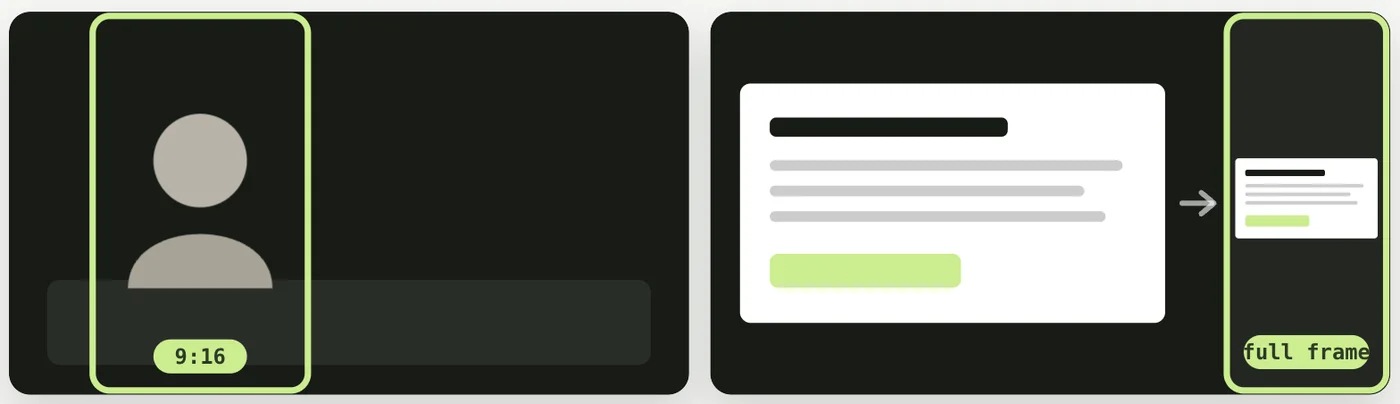
Source: shortshort official website (also applies to the screenshots below)
Slides, screen shares and wide shots of the whole venue, on the other hand, lose content when cropped to vertical. These shots are detected automatically and fitted into the vertical frame scaled down in full, with space added above and below. That's why the text on a speaker's slides stays readable instead of being cut off.
Zoom for emphasis is capped at 1.0–1.6× the original footage, with a single zoom level per shot. The cap is there to keep the image from turning grainy from over-enlargement, and it's the same on every plan. Frame position and zoom are fully automatic, with no manual controls to move them. If a segment doesn't frame the person you want, the intended fix is to adjust the segment's range or pick a different segment.
Captions appear word by word, in step with the voice
Caption timing is taken from the audio itself rather than estimated from an average speaking rate. Once a segment is chosen for a short, just that segment is transcribed a second time and every word gets a fresh timestamp. Words that can't be matched on the second pass fall back to the first-pass timing and are marked as "estimated," so you can see which parts are exact and which are approximate before rendering.
There are four caption styles to choose from.
Caption colors and fonts can be changed per video on every plan, and you can also import an SRT file prepared for the source video and use its text for the captions. Captions stay in the language spoken in the video and are not translated.
How to use it
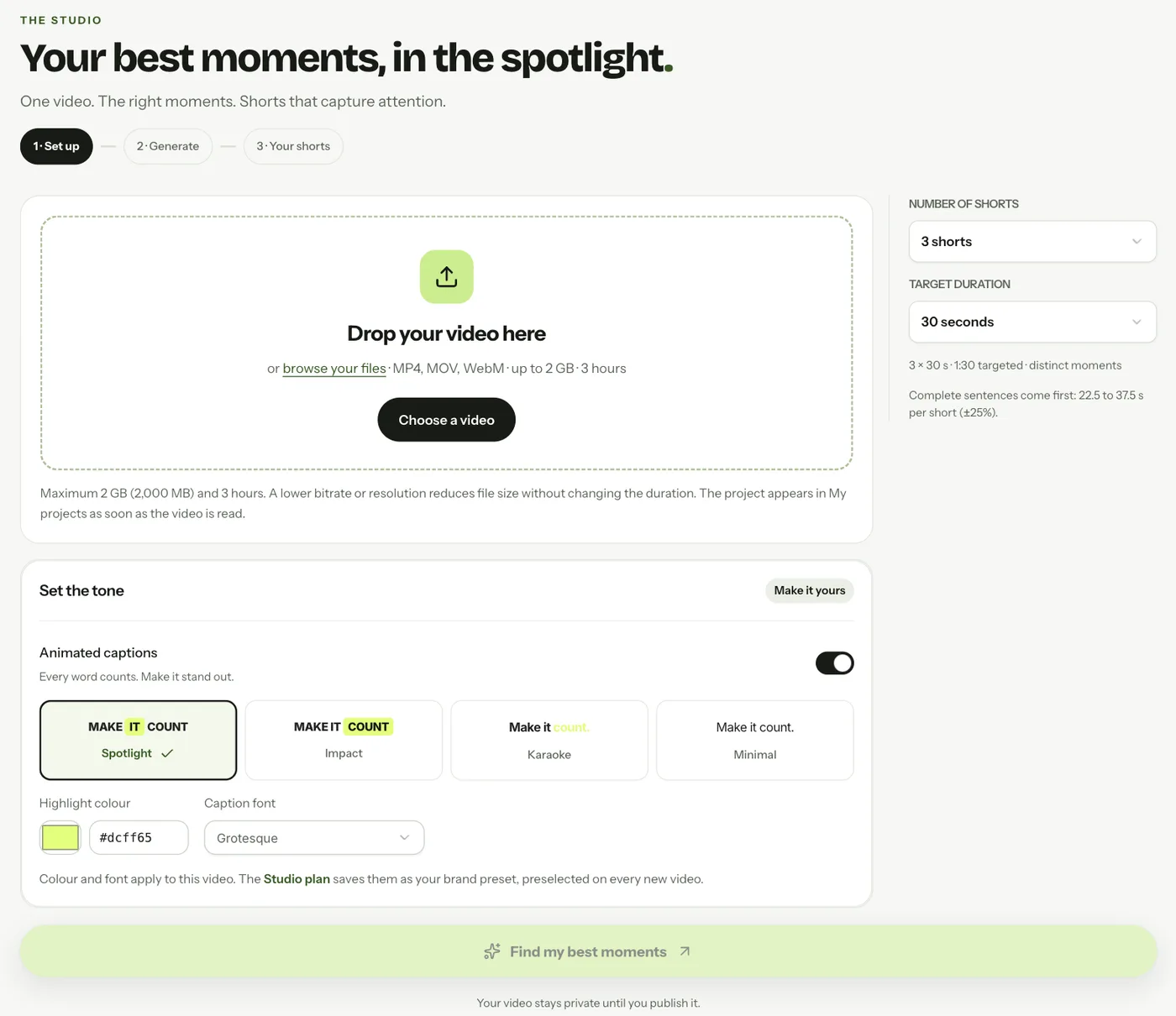
According to the official site, the hands-on time from upload to export is "about two minutes." The only settings are how many shorts to make, how long each one should be, and how the captions look.
-
Prepare your video file
MP4, MOV or WebM files are accepted, up to 3 hours and 2GB each. Links from YouTube and similar sites can't be imported, so you'll need a file on your own device. For files over 2GB, the official site suggests lowering the bitrate or resolution to shrink the file without changing its length. You can only upload videos you hold the rights to, and the terms of service ask you to confirm the rights to any music, footage and people that appear in them as well.
-
Choose the number of shorts, their length and the captions
Drop the file into the studio and choose how many shorts to make (up to your plan's limit), the target length of each (15–90 seconds), and the caption style, color and font. AI analysis requires a free account and uses 1 credit per minute of source video. If you only want to pick segments yourself and export them without AI, you can do that without an account.
-
Wait for the AI to process the video
Processing runs through eight stages: "upload → waiting for a processing slot → preparing the video → selecting highlights → aligning speech timing → tracking subjects and reframing → adding emphasized words → rendering and saving." On Free and Starter you keep the tab open while you wait; on Creator and Studio processing continues on the server, so you're free to close the tab.
-
Review and refine the suggestions
Each short arrives as an editable "suggestion." You can change four things: the segment's start and end points, the caption text and emphasized words, the caption style, and the title. Rendering doesn't start until you press the button, so you can go through and fix every suggestion first, then export only the ones you want.
-
Export and post it yourself
Each short is exported as a 1080×1920, 30fps MP4 (H.264). On Free and Starter, rendering happens in the browser, so keep the tab open in an up-to-date version of Chrome. You can download shorts one at a time, or use bulk download to get every short in a ZIP, two versions each: with and without captions. Posting to TikTok, YouTube Shorts and Instagram Reels is up to you, using the downloaded files.
Features
01Clip
Picks out segments from long videos that make sense on their own.
- Sentence-level segment selection — Transcribes the whole video and suggests 15–90-second segments made of complete sentences, fitting the length to the end of a sentence within ±25% of the target
- Non-overlapping suggestions — Selects up to 20 separate, non-overlapping segments from a single video (depending on plan)
- Title suggestions — The AI gives each short a title, making it easier to decide which ones to use
02Go vertical
Crops landscape recordings to 9:16 with the speaker in the center.
- Face tracking — Places the 9:16 frame over faces on screen and moves it as they move
- Scene detection — Repositions the frame when the recording cuts to a new shot
- Full-frame preservation — Keeps slides, screen shares and wide shots whole instead of cropping them, with space added above and below
- Emphasis zoom — Uses a single zoom level per shot, within 1.0–1.6× the original footage
03Add captions
Spoken words appear on screen right as they're spoken.
- Word-by-word timing — Re-transcribes the selected segment and takes each word's timing from the audio. Words that can't be matched are marked "estimated"
- Four styles — Spotlight, Impact, Karaoke, Minimal
- Colors and fonts — Changeable per video on all plans. On Studio, they can be saved as one brand preset per account that's preselected for every new video
- SRT import — Use an SRT file timed to the source video for your captions
04Finish and export
Refine the suggestions, then export only what you need.
- Editor — Change the segment, caption text and emphasis, style and title. Manual editing without AI works even without an account
- MP4 export — 1080×1920, 30fps, H.264. Captions are burned into the video
- Bulk download — Get every short in a ZIP, two versions each: with and without captions
- Server-side rendering — Creator and Studio. Processing continues even after you close the tab, and finished shorts are kept in your library
- Edit plan JSON export — Studio. Exports segments, framing keyframes and per-word timing as JSON for use with a renderer on your own servers
- Community — A public gallery where published shorts can be viewed alongside their source videos and transcripts
Supported input and output
Pricing
Pricing is measured in minutes of source video. Each minute of source video sent for AI analysis uses 1 credit, and the cost stays the same no matter how many shorts you make from it. A 56-minute talk costs 56 credits whether you make 3 shorts or 20. Editing and MP4 export don't use any credits.
| Plan | Monthly price (excl. VAT) | Monthly credits | Shorts per video | Key differences |
|---|---|---|---|---|
| Free | €0 | 60 credits on sign-up (1 hour's worth) | 3 | No credit card required. Exported shorts carry a small watermark and are listed in the public gallery (Community) |
| Starter | €12 (€115 billed annually) | 240 (4 hours' worth) | 5 | No watermark. Shorts can be kept private instead of being listed in the gallery. Rendering happens in the browser |
| Creator | €29 (€278 billed annually) | 800 (13 hr 20 min worth) | 10 | Everything in Starter, plus server-side rendering, priority processing and add-on credit purchases |
| Studio | €79 (€758 billed annually) | 3,000 (50 hours' worth) | 20 | Everything in Creator, plus brand presets (caption colors and fonts), edit plan JSON export and priority support |
On Creator and Studio, you can buy extra credits if you run short during the month.
| Add-on credits | Price (excl. VAT) |
|---|---|
| 200 credits (3 hr 20 min worth) | €9 |
| 600 credits (10 hours' worth) | €24 |
| 2,000 credits (33 hr 20 min worth) | €69 |
- Prices shown exclude VAT (value-added tax). Annual billing is 20% cheaper than monthly billing
- On Starter, this works out to €0.05 per minute of source video
- Unused credits roll over to the next month and never expire. Add-on credits and the 60 sign-up credits are used only after your monthly credits run out
- If a generation fails, the credits it used are refunded
- Payment is by card (Stripe). You can cancel anytime and keep using the service until the end of the period you've paid for. Any remaining credits stay in your account after you cancel
(Based on the official pricing page and terms of service as of September 2026)
Video data and visibility
When you hand recordings of talks or courses to an outside service, it's worth checking up front where they're stored and who can see them. shortshort's privacy page spells out where data is stored and the path it takes for AI analysis.
The public gallery also doubles as a showcase where you can compare real source videos side by side with the shorts made from them. On the other hand, shorts exported on the free plan stay in the gallery, so if you're working with recordings of internal meetings or training sessions that shouldn't be seen outside your organization, switch to a paid plan and set them to private before exporting.
Features deliberately left out
shortshort focuses solely on cutting vertical shorts out of long videos. To "save you the trouble of trying," the official site publishes a list of what it doesn't support.
- Dubbing and translation (captions stay in the spoken language)
- Automatically added B-roll, music or on-screen titles (the output is a crop of the original footage with captions on top)
- Direct posting to TikTok, YouTube or Instagram (you download the MP4 and post it yourself)
- Aspect ratios other than 9:16, or exports above 1080×1920 at 30fps
- Importing from YouTube or other links
- A "virality score" that predicts views (the AI picks self-contained segments, and you decide which ones to use)
- A public API or shared team workspaces
How shortshort differs from other AI clipping tools
shortshort isn't the only AI tool that cuts shorts from long videos. Where these tools differ is in how they decide what to clip, and how much of the work after clipping they take on.
| Aspect | shortshort | OpusClip | Klap |
|---|---|---|---|
| How clips are chosen | Self-contained, sentence-based segments (fitted to sentence ends within ±25% of the target) | AI picks highlights and ranks them with a virality score | AI extracts highlights |
| Vertical cropping | Face tracking; slides and wide shots are kept whole | Subject-tracking reframe (ReframeAnything) | Auto-reframe |
| Captions | Word by word, 4 styles, in the spoken language | Animated captions | Auto-captions in 52 languages |
| Dubbing | No | Yes | AI dubbing (29 languages) |
| Social posting | Download the MP4 and post it yourself | Direct and scheduled posting | Direct and scheduled posting |
| Pricing unit | Minutes of source video (1 minute = 1 credit) | Credit-based | Videos and clips per month |
| Cheapest paid plan | Starter, €12 a month (excl. VAT) | Starter, $15 a month | Basic, $29 a month ($14 a month billed annually) |
| Free trial | 60 credits on sign-up (1 hour's worth), no card required | Free plan (with watermark) | Try one video for free |
quso.ai and WayinVideo (formerly Videohunt.Ai) also turn long videos into shorts, as all-in-one tools that pair clipping with scheduled posting or video search. If you'd rather edit an entire video the way you'd edit text, that's the territory of transcript-based video editors such as Vrew and Descript.
Frequently asked questions
This page is based on information published on the official website as of September 2026. Please check the official website for the latest specifications and pricing.