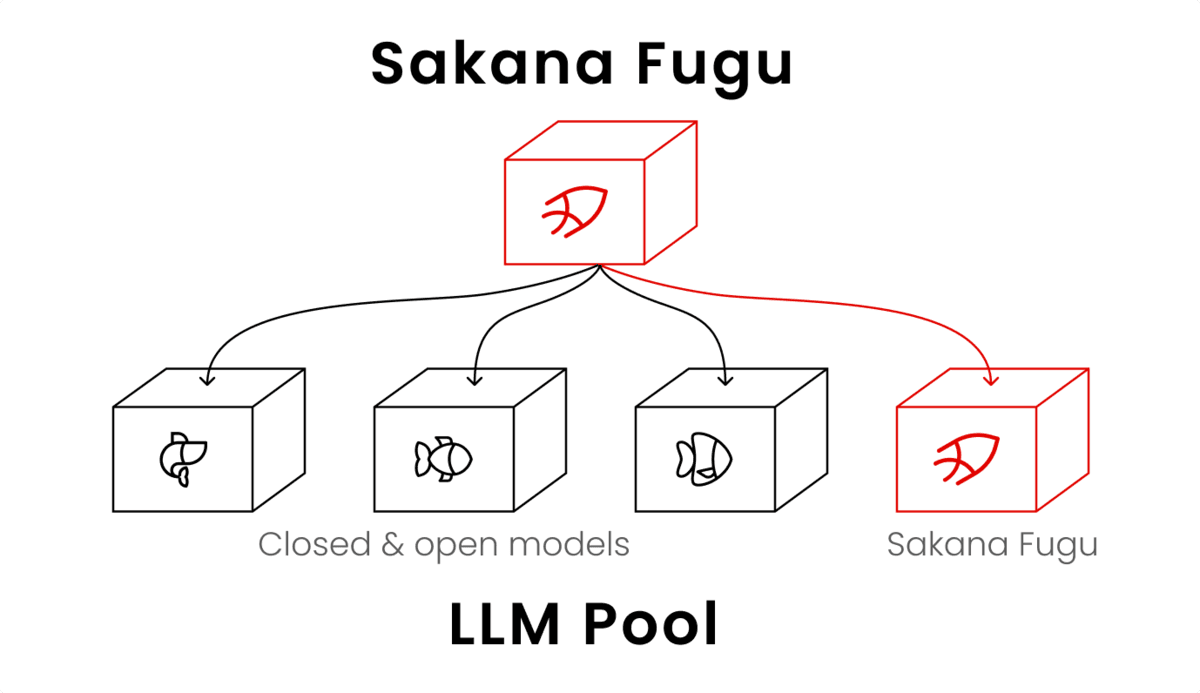

Sakana Fugu
: How to use it, features, and the business problems it solves
Add bookmark
What is Sakana Fugu?
A multi-agent platform from Japan's Sakana AI that dynamically orchestrates several specialist LLMs behind a single API, behaving as if it were one model. Pricing runs on two tracks — $20/$100/$200 monthly plans and token billing, with Fugu Ultra at $5 input / $30 output per 1M tokens (rising to $10/$45 above a 272K context). There is no free tier, and orchestration tokens count toward the bill.
Business problems it solves


About "Sakana Fugu"
What is Sakana Fugu
Sakana Fugu is a multi-agent platform that dynamically bundles multiple specialist LLMs internally, orchestrates them, and serves them as a single API. Built by Japan's Sakana AI, its concept is to "deliver a multi-agent system as a single model API." You send a request to one endpoint, and internally the roles are divided, delegated, verified, and integrated automatically — it behaves as if it were one high-performance model.
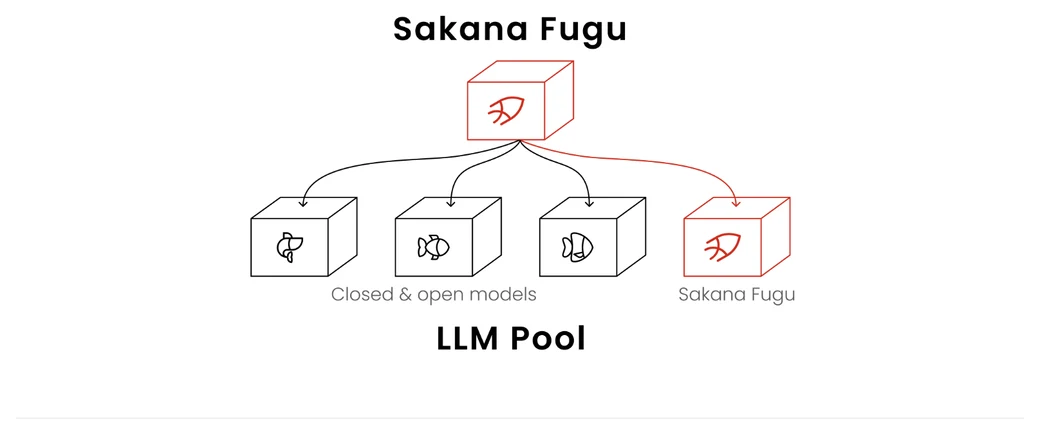
Source: Sakana AI Fugu official site (the image below is from the same source)
Use a multi-agent system as "one model"
- Multi-agent orchestration: Internally bundles multiple specialist LLMs dynamically, handling role assignment, delegation, verification, and integration automatically. You treat it as a single API.
- Avoid vendor dependence: If a particular provider restricts access, it reroutes to another model and keeps going — embodying the "AI sovereignty" that Sakana champions.
- OpenAI-compatible API: Use it from existing OpenAI-compatible clients just by swapping the endpoint and model name. Also usable via OpenRouter, Vercel, opencode, and more.
- Grounded in the latest research: It is built on two ICLR 2026 papers that learn model orchestration — "TRINITY" (an evolutionary LLM coordinator) and "Conductor" (learning to marshal agents in natural language). Rather than being wired by hand, the system itself learns how to compose and coordinate specialist agents per task.
Three models
You can choose among three models by purpose (all available via the OpenAI-compatible API).
- Fugu — The standard model balancing performance and latency. For everyday coding, code review, and responsive chatbots.
- Fugu Ultra — Coordinates a broader pool of specialist agents to maximise answer quality on hard, important problems. For Kaggle, paper reproduction, security analysis, patent research, and the like.
- Fugu Cyber — Specialised for cybersecurity. For workflows where depth and precision matter — security analysis, vulnerability research, threat detection.
Performance (benchmarks)
Across coding, reasoning, and science benchmarks, it posts scores that match or surpass single frontier models (such as Fable 5 and Mythos Preview).
On the coding metric SWE Bench Pro, Fugu 59.0 / Fugu Ultra 73.7 are published — above the compared frontier models (54.2–69.2).
Pricing
Pricing has two pillars: a monthly subscription and token-based billing. Sakana AI is a Japanese company and its console and pricing page are offered in Japanese, but billing is in US dollars.
Subscription (monthly)
| Standard | Pro | Max | |
|---|---|---|---|
| Monthly | $20 | $100 | $200 |
| Allowance | Baseline | 10× Standard | 20× Standard |
| Intended use | Light daily use | Focused work sessions | Heavy, long-running workloads |
Token-based billing (per 1M tokens)
| Input | Output | Cached input | |
|---|---|---|---|
| Fugu | Follows the standard rate of the model used internally | Same | Same |
| Fugu Ultra (standard) | $5 | $30 | $0.50 |
| Fugu Ultra (context > 272K) | $10 | $45 | $1.00 |
| Fugu Cyber | Not published (contact the sales team) | — | — |
Feed it a whole large codebase and the moment context passes 272K tokens the rate switches — input doubles, output rises by half. That threshold is where bills diverge, so it is worth watching how much context you send. Note that Fugu Cyber pricing is not published; the official page directs you to the sales team (specific per-token figures quoted elsewhere are not from the official listing).
Model costs do not stack up as more agents run. With a single agent you pay that base model's standard rate; with several, billing is still calculated at a single rate based on the top model involved. That design is why costs stay predictable despite this being a multi-agent platform.
The orchestration share that trips people up
This is the most misunderstood part of a Fugu bill. Fugu Ultra returns usage fields that separate user-visible model work from internal orchestration work. Those orchestration tokens are real usage incurred outside the input/output token counts, and they count toward the final price of the request (at the same rate as ordinary input/output tokens). That is usually the answer to "why is my bill bigger than I expected."
The usage object breaks it down:
| Field | Meaning |
|---|---|
input_tokens | User input tokens sent to the first model |
input_tokens_details.cached_tokens | Of those, the cached input tokens |
input_tokens_details.orchestration_input_tokens | Total input tokens used for orchestration |
output_tokens_details.orchestration_output_tokens | Output tokens produced by orchestration |
total_tokens | Total tokens for the request, orchestration included |
When estimating, base your numbers on total_tokens rather than input_tokens and output_tokens alone.
Tokens bought on pay-as-you-go are processed at a higher priority than subscription tokens. Sakana positions token billing for "heavy production workloads that demand maximum reliability," with subscriptions aimed at individuals and everyday hands-on use. If production latency matters, that priority difference belongs in the decision alongside price.
Is there a free tier?
Sakana Fugu has no free tier or free trial. The minimum entry is either the Standard subscription ($20/month) or starting with token-based billing.
To try it cheaply first, a practical approach is to send a small number of requests on token billing and get a feel for it. Because it is an OpenAI-compatible API, you can benchmark it against your existing code just by swapping the endpoint and model name.
If Japanese-language tasks are your main goal, "Sakana Namazu" on the same console is an order of magnitude cheaper. Namazu is a Japanese-specialized LLM with no subscription — token billing only, at $0.95 input / $4.00 output / $0.15 cached input per 1M tokens, against Fugu Ultra's $5 and $30. Built-in tools are available too (web search at $7.00 per 1,000 calls, code execution at $0.12 per hour). If you don't need multi-agent reasoning on hard problems, it is worth looking at first.
How to use
- Sign up at
console.sakana.ai. - Send requests to the OpenAI-compatible API endpoint, specifying a model (Fugu / Fugu Ultra / Fugu Cyber). It is also usable via OpenRouter, Vercel, and opencode.
- If needed, exclude specific models or providers from the agent pool.
- It is currently not available in the EU / EEA.
Reputation and who it suits
What's praised
- Avoids vendor lock-in: Even if a provider restricts access, it can recompose the agent pool and keep going. When the risk of single-vendor dependence became real — as when Anthropic's Fable 5 / Mythos 5 were abruptly halted by a US government export-control order in June 2026 — this design becomes an easy-to-understand value.
- Near-zero migration cost: As an OpenAI-compatible API, there's no SDK swap. Just change the endpoint and API key to use it from existing clients.
- Benchmarks above single models: On SWE Bench Pro, Fugu 59.0 / Fugu Ultra 73.7 are published — above the compared frontier models (54.2–69.2).
Points to note
- Can't try it for free: As noted, there is no free tier, so even evaluation incurs cost.
- Not available in the EU / EEA.
- The model mix isn't fixed: The models used internally are chosen dynamically. As the flip side of avoiding lock-in, it doesn't suit a requirement to "always reproduce with the same model."
Who it suits: Organisations wanting to reduce dependence on a specific vendor, and people handling heavy tasks that require multi-step reasoning — Kaggle, paper reproduction, security analysis, patent research. Conversely, if you just want to run simple generation tasks cheaply at scale, using a single model's API directly is cheaper.
Learn more
For details on how Sakana Fugu works, its benchmarks, and pricing, see the explainer article too.
What is Sakana AI Fugu — a deep dive into the multi-agent API's performance, pricing, and usage
Information on this page is based on what was published on the official site as of August 2026. The model lineup, benchmarks, pricing, and availability may change, so check the official site for the latest.
Frequently compared services



Articles featuring Sakana Fugu
What Is Cloudflare OS? A Deep Dive into the Open-Source AI Agent Workspace (Architecture, Gatekeepers, Self-Hosting, Pricing)
Cloudflare open-sourced Cloudflare OS, an AI agent workspace, on August 5, 2026. This article covers its zero-permission Gatekeeper security, model selection and cost control via AI Gateway, Gadgets (small personal apps), how to deploy it into your own Cloudflare account, and pricing — based on the official blog and GitHub.
How to Use Sakana AI Fugu: From API Key to Claude Code | Pricing, Free Tier, and Performance
A guide to Sakana AI's multi-agent platform Fugu: issuing an API key at console.sakana.ai, calling the OpenAI-compatible API, and wiring it into Codex and Claude Code. Covers choosing between Fugu, Fugu Ultra, and Fugu Cyber, pricing and whether a free tier exists, and benchmark performance.