

Devin
: How to use it, features, and the business problems it solves
Add bookmark
What is Devin?
An autonomous AI software engineer from the startup Cognition (a coding agent). From a natural-language instruction it autonomously plans, implements, tests, and opens a Pull Request in its own environment, supporting multiple repos and parallel sessions. The current Devin 2 generation offers Core from $20/mo (metered ACU), Team $500/mo, and Enterprise, and integrates with GitHub/Slack/IDE and MCP/API.
Business problems it solves

About "Devin"
What is Devin
Devin is an autonomous AI software engineer developed by the AI startup Cognition. Tell it "build X" or "fix this bug" in natural language, and Devin — inside its own workspace (shell, editor, browser, planner) — autonomously handles planning, coding, testing, and even opening a Pull Request. Unlike traditional tools that assist your typing inside an IDE, its defining trait is that you hand off a whole task and let it work asynchronously. The current generation is Devin 2, and in 2025 a low-cost plan was added that individuals and small teams can use.
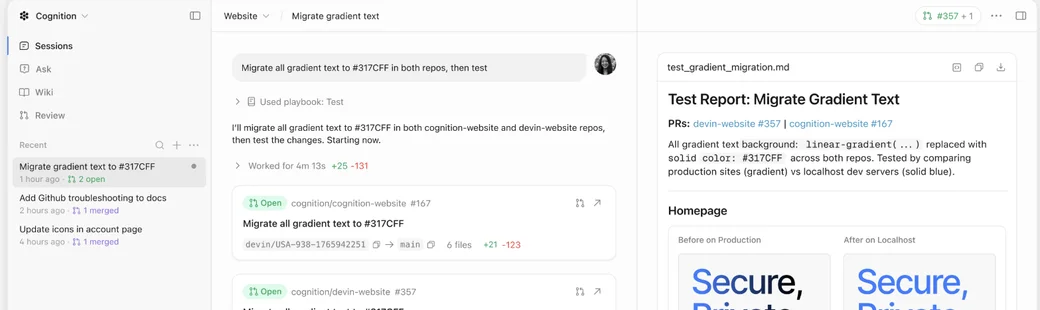
Source: Devin official site
Hand it a task, and it works autonomously
Rather than being instructed line by line, Devin is a coding agent that decides its own steps and runs to completion once you give it a goal. Work happens in a dedicated cloud environment, and when done, a Pull Request and a report come back.
Hand over a task in natural language
"Add a feature," "fix a bug," in plain language. You can standardise steps with a Playbook
Plan → implement → test
Plans in its own environment, branches, implements, and tests/debugs itself
Pull Request + report
Opens PRs across repos and reports with test results. You review and merge
Since you can run multiple sessions in parallel, you can use Devin like an asynchronous team member. It can also be triggered from Slack or GitHub.
How to use
-
Create an account
Create an account on the official site (devin.ai) and connect repositories such as GitHub.
-
Give it a task
In the Sessions input, write the feature to build or bug to fix in natural language (e.g., "fix the X bug and open a PR").
-
Wait for autonomous execution
Devin autonomously plans, implements, and tests. You can watch progress in real time and give feedback along the way.
-
Review the PR
When done, a Pull Request and test report are submitted. Review, request changes if needed, and merge.
-
Scale it out
Fold it into your daily flow via Slack integration, Playbooks (standardised steps), and triggering through the API/MCP.
Features
01Autonomous dev (Sessions)
- Plan → implement → test → PR — Runs the whole dev sequence from an instruction
- Multiple repos & parallel sessions — Handle several tasks at once
- Playbook — Standardise and reuse common procedures
02Work with the codebase
- Ask — Answers questions about the codebase
- Wiki — Auto-generates documentation for a repository
- Review — Automatic Pull Request review
03Connect
- GitHub / Slack / IDE integration — Trigger from and notify to your existing flow
- API / MCP — Call Devin from other tools and agents
Pricing
Pricing is calculated in ACUs (Agent Compute Units). An ACU is a measure of the compute Devin actually used, and 1 ACU ≈ 15 minutes of autonomous work.
| Plan | Price | Details |
|---|---|---|
| Core | from $20/mo (metered) | Pay-as-you-go (~$2.25/ACU). For individuals/small teams. Up to 10 concurrent sessions |
| Team | $500/mo | 250 ACUs included (~$2.00/ACU). Unlimited concurrent sessions |
| Enterprise | Custom | Dedicated environment, advanced security, internal-tool integration |
It used to centre on the Team plan ($500/mo), but since Devin 2.0 the Core plan (pay-as-you-go from $20/mo) has made it far easier for individuals to try. Cost scales with the amount of work (ACUs). Since 1 ACU ≈ 15 minutes of work, longer and more complex tasks consume more. Confirm the latest pricing on the official site.
Prices are a guide as of August 2026 (USD). They may change, so check the official pricing page for the latest.
Reputation
- Being able to work asynchronously is praised: "I can hand off whole refactors and test additions," and "results come back as PRs, which are easy to review."
- Some note it "excels at automating simple, repetitive tasks," while shared know-how says "for overly complex tasks, splitting the instructions is more stable."
- A common point: "estimating ACU consumption takes some getting used to."
How it differs from other AI coding tools
AI coding tools split into IDE-type (help you write) and agent-type (hand off a task). Devin represents the latter — an autonomous agent that works in an independent environment to completion, rather than assisting alongside you.
| Aspect | Devin | IDE assistants (Cursor / Copilot, etc.) |
|---|---|---|
| Positioning | Autonomous agent (hand off a task) | Assists your writing (suggests alongside) |
| Where it works | A dedicated cloud environment | Your local editor |
| Deliverable | Pull Request + test report | Code completion/edits in the editor |
| Parallelism | Multiple sessions, asynchronous | Mainly one task, interactive |
For editor completion and interactive development, Cursor, GitHub Copilot, and Windsurf; for terminal-based agents, Claude Code and Codex are comparison points. If you want to hand off whole tasks and receive them as PRs, Devin is a strong choice.
FAQ
Q. How much does Devin cost?
The Core plan starts at pay-as-you-go from $20/mo (~$2.25/ACU). For heavier use, the Team plan ($500/mo, 250 ACUs included), and for large organisations, Enterprise.
Q. What is an ACU?
Agent Compute Unit — a unit of the compute Devin actually used. One ACU ≈ 15 minutes of autonomous work, so longer and more complex tasks consume more.
Q. What can it do?
From a natural-language instruction, it autonomously plans, implements, tests, and opens a Pull Request. It also answers codebase questions (Ask), generates docs (Wiki), and reviews PRs (Review).
Q. Can I fold it into my existing dev flow?
Yes. It integrates with GitHub, Slack, and IDEs, and can be triggered via API/MCP — for example, assigning Devin a task from Slack.
Q. How is it different from Cursor or Copilot?
Cursor and Copilot assist your writing in your local editor. Devin is an autonomous agent that takes on a whole task in an independent environment and returns results as PRs.
Information on this page is based on the official site and various public figures as of August 2026. Features and pricing may change, so check the official site for the latest.
Frequently compared services






Articles featuring Devin
What Grok Bot Is [September 2026]: The AI Teammate That Came Down to $20 a Month — Pricing, What It Does, How to Start
Grok Bot launched on 11 August 2026, and the reason it suddenly got loud in September is not that the product changed — it is that the door came down from $200–300 upper tiers to Cursor Pro at $20 a month. This article walks through what Grok Bot actually does, following the official screens: it signs in to Salesforce, pulls 52 accounts, queues 36 drafts and holds them at "0 sent" waiting for approval, then saves the approved exchange as a routine. It covers the three routes in and eight plans, how Grok Bot differs from Manus, Devin and Genspark AI at the same $20 mark (what each one operates, and whether you hand over your accounts), and the three things to settle before handing anything over — which account it signs in with, how far it may act unattended, and the one shared cloud computer per user — all as published in September 2026.
![What Grok Bot Is [September 2026]: The AI Teammate That Came Down to $20 a Month — Pricing, What It Does, How to Start](/_next/image?url=%2Fimages%2Farticles%2Fgrok-bot-guide.png&w=3840&q=75 "What Grok Bot Is [September 2026]: The AI Teammate That Came Down to $20 a Month — Pricing, What It Does, How to Start")
Autonomous AI Agents Compared: 7 Picks for August 2026 — Grok Bot, Manus, Devin and How to Choose
You tried an AI agent and it ended at "wow, impressive" — because what it returned was an answer, not finished work. That changed in August 2026, when products that leave the work inside your actual tools arrived all at once. This article compares seven of them — Grok Bot, Hey Noah, Manus, Genspark AI, Devin, Kilo Code, and Cloudflare OS — along a single axis: where the output lands. It covers the unit of isolation, how much access you hand over, the three layers of cost, and where to start, all from primary sources.

[2026 Edition] The Complete Guide to Claude Code: From Installation to Advanced Techniques
A comprehensive guide covering Claude Code installation, basic operations, practical tips, and pricing plans. Packed with best practices you can apply immediately to real projects — suitable for beginners through intermediate users.
[2026 Edition] 20 AI Tools Transforming Developer Workflows | Coding Assistance, Automated Code Review, No-Code Web Development, and Workflow Automation
A curated look at the best AI tools for developers in 2026. Covers 18 tools across coding assistance, automated code review, no-code development, and workflow automation — all aimed at improving productivity.
![[2026 Edition] 20 AI Tools Transforming Developer Workflows | Coding Assistance, Automated Code Review, No-Code Web Development, and Workflow Automation](/_next/image?url=%2Fimages%2Farticles%2Fdeveloper-ai-programming-tools.png&w=3840&q=75 "[2026 Edition] 20 AI Tools Transforming Developer Workflows | Coding Assistance, Automated Code Review, No-Code Web Development, and Workflow Automation")